This thread has been locked.

If you have a related question, please click the "Ask a related question" button in the top right corner. The newly created question will be automatically linked to this question.

TMS320F280049C: Information about control card Launch pad

Part Number: TMS320F280049C
Other Parts Discussed in Thread: C2000WARE

Hi sir/madam

I have some confusion in what is the differnce between TMS320F280049C  control card launch pad

can you please explain me

thank you

  • Hi,

    The silicon residing on both the boards are one and the same.

    For launch pad there are a set of booster packs that it can interface to or it can be used to experiment stand alone with few GPIO's available handy.

    Here is a quick link for finding the available pre-existing booster packs for a given launch pad

    https://dev.ti.com/bpchecker/

    Control cards on the other hand needs a dock to use the existing I/O's if used stand alone. Its used in a lot of TI reference designs (for ex TIDM 1000) or if you intend to use this in one of your designs like a TI reference design that's possible too.

    Hope this helps.

  • Hi thanks for the reply

    we using TMS320F280049C control card,we need to toggle a LED,using code composer studio software,can you please provide steps to blink led on control card.

    thank you

  • You find the examples for the same from C2000ware

    ...\c2000\C2000Ware_3_02_00_00\driverlib\f28004x\examples\led

  • Hi,we want to initialize ADC,what are the files we need to add in ccs,can you please provide information for ADC initialization(TMS320F280049C) in this baord,

     thank you

  • Please go through the training and C2000ware as I suggested, so you can find all the information and examples

    C:\ti\c2000\C2000Ware_3_02_00_00\driverlib\f28004x\examples\adc

    If this/above replies answer your question, please close this thread by clicking verified answer and open a new thread for any other queries you might have.

  • thanks for the reply,

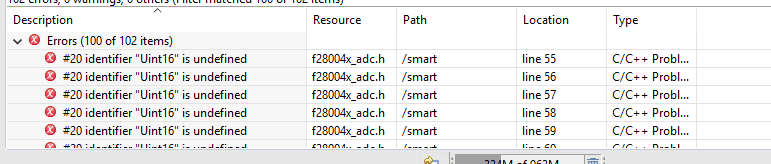
    while building my ADC project i get below errors can you please help me to reduce tha tproblems

    this is my ADC code

    //###########################################################################
    //
    // FILE: adc.c
    //
    // TITLE: C28x ADC driver.
    //
    //###########################################################################
    // $TI Release: F28004x Support Library v1.10.00.00 $
    // $Release Date: Tue May 26 17:06:03 IST 2020 $
    // $Copyright:
    // Copyright (C) 2020 Texas Instruments Incorporated - http://www.ti.com/
    //
    // Redistribution and use in source and binary forms, with or without
    // modification, are permitted provided that the following conditions
    // are met:
    //
    // Redistributions of source code must retain the above copyright
    // notice, this list of conditions and the following disclaimer.
    //
    // Redistributions in binary form must reproduce the above copyright
    // notice, this list of conditions and the following disclaimer in the
    // documentation and/or other materials provided with the
    // distribution.
    //
    // Neither the name of Texas Instruments Incorporated nor the names of
    // its contributors may be used to endorse or promote products derived
    // from this software without specific prior written permission.
    //
    // THIS SOFTWARE IS PROVIDED BY THE COPYRIGHT HOLDERS AND CONTRIBUTORS
    // "AS IS" AND ANY EXPRESS OR IMPLIED WARRANTIES, INCLUDING, BUT NOT
    // LIMITED TO, THE IMPLIED WARRANTIES OF MERCHANTABILITY AND FITNESS FOR
    // A PARTICULAR PURPOSE ARE DISCLAIMED. IN NO EVENT SHALL THE COPYRIGHT
    // OWNER OR CONTRIBUTORS BE LIABLE FOR ANY DIRECT, INDIRECT, INCIDENTAL,
    // SPECIAL, EXEMPLARY, OR CONSEQUENTIAL DAMAGES (INCLUDING, BUT NOT
    // LIMITED TO, PROCUREMENT OF SUBSTITUTE GOODS OR SERVICES; LOSS OF USE,
    // DATA, OR PROFITS; OR BUSINESS INTERRUPTION) HOWEVER CAUSED AND ON ANY
    // THEORY OF LIABILITY, WHETHER IN CONTRACT, STRICT LIABILITY, OR TORT
    // (INCLUDING NEGLIGENCE OR OTHERWISE) ARISING IN ANY WAY OUT OF THE USE
    // OF THIS SOFTWARE, EVEN IF ADVISED OF THE POSSIBILITY OF SUCH DAMAGE.
    // $
    //###########################################################################

    #include "f28004x_adc.h"

    //*****************************************************************************
    //
    // Defines for locations of ADC calibration functions in OTP for use in
    // ADC_setVREF(). Not intended for use by application code.
    //
    //*****************************************************************************
    #define ADC_OFFSET_TRIM_OTP 0x70594U

    //*****************************************************************************
    //
    // ADC_setVREF
    //
    //*****************************************************************************
    void
    ADC_setVREF(uint32_t base, ADC_ReferenceMode refMode,
    ADC_ReferenceVoltage refVoltage)
    {
    uint16_t *offset;
    uint16_t moduleShiftVal;
    uint16_t offsetShiftVal;

    //
    // Check the arguments.
    //
    ASSERT(ADC_isBaseValid(base));

    //
    // Assign a shift amount corresponding to which ADC module is being
    // configured.
    //
    switch(base)
    {
    case ADCA_BASE:
    moduleShiftVal = 0U;
    break;
    case ADCB_BASE:
    moduleShiftVal = 1U;
    break;
    case ADCC_BASE:
    moduleShiftVal = 2U;
    break;
    default:
    //
    // Invalid base address!!
    //
    moduleShiftVal = 0U;
    break;
    }

    //
    // Offset trim for internal VREF 3.3V is unique and stored in upper byte.
    //
    if((refMode == ADC_REFERENCE_INTERNAL) &&
    (refVoltage == ADC_REFERENCE_3_3V))
    {
    offsetShiftVal = 8U;
    }
    else
    {
    offsetShiftVal = 0U;
    }

    //
    // Set up pointer to offset trim in OTP.
    //
    offset = (uint16_t *)(ADC_OFFSET_TRIM_OTP + ((uint32_t)6U *
    (uint32_t)moduleShiftVal));

    //
    // Get offset trim from OTP and write it to the register.
    //
    EALLOW;
    HWREGH(base + ADC_O_OFFTRIM) = (*offset >> offsetShiftVal) & 0xFFU;

    //
    // Configure the reference mode (internal or external).
    //
    if(refMode == ADC_REFERENCE_INTERNAL)
    {
    HWREGH(ANALOGSUBSYS_BASE + ASYSCTL_O_ANAREFCTL) &=
    ~(ASYSCTL_ANAREFCTL_ANAREFASEL << moduleShiftVal);
    }
    else
    {
    HWREGH(ANALOGSUBSYS_BASE + ASYSCTL_O_ANAREFCTL) |=
    ASYSCTL_ANAREFCTL_ANAREFASEL << moduleShiftVal;
    }

    //
    // Configure the reference voltage (3.3V or 2.5V).
    //
    if(refVoltage == ADC_REFERENCE_3_3V)
    {
    HWREGH(ANALOGSUBSYS_BASE + ASYSCTL_O_ANAREFCTL) &=
    ~(ASYSCTL_ANAREFCTL_ANAREFA2P5SEL << moduleShiftVal);
    }
    else
    {
    HWREGH(ANALOGSUBSYS_BASE + ASYSCTL_O_ANAREFCTL) |=
    ASYSCTL_ANAREFCTL_ANAREFA2P5SEL << moduleShiftVal;
    }

    EDIS;
    }

    //*****************************************************************************
    //
    // ADC_setPPBTripLimits
    //
    //*****************************************************************************
    void
    ADC_setPPBTripLimits(uint32_t base, ADC_PPBNumber ppbNumber,
    int32_t tripHiLimit, int32_t tripLoLimit)
    {
    uint32_t ppbHiOffset;
    uint32_t ppbLoOffset;

    //
    // Check the arguments.
    //
    ASSERT(ADC_isBaseValid(base));
    ASSERT((tripHiLimit <= 65535) && (tripHiLimit >= -65536));
    ASSERT((tripLoLimit <= 65535) && (tripLoLimit >= -65536));

    //
    // Get the offset to the appropriate trip limit registers.
    //
    ppbHiOffset = (ADC_PPBxTRIPHI_STEP * (uint32_t)ppbNumber) +
    ADC_O_PPB1TRIPHI;
    ppbLoOffset = (ADC_PPBxTRIPLO_STEP * (uint32_t)ppbNumber) +
    ADC_O_PPB1TRIPLO;

    EALLOW;

    //
    // Set the trip high limit.
    //
    HWREG(base + ppbHiOffset) =
    (HWREG(base + ppbHiOffset) & ~ADC_PPBTRIP_MASK) |
    ((uint32_t)tripHiLimit & ADC_PPBTRIP_MASK);

    //
    // Set the trip low limit.
    //
    HWREG(base + ppbLoOffset) =
    (HWREG(base + ppbLoOffset) & ~ADC_PPBTRIP_MASK) |
    ((uint32_t)tripLoLimit & ADC_PPBTRIP_MASK);

    EDIS;
    }

  • Please check your include paths using any standard example that you can pull from C2000ware.

  • Since you have created a new thread for this issue and got addressed. Can you pls close this thread ?