This thread has been locked.

If you have a related question, please click the "Ask a related question" button in the top right corner. The newly created question will be automatically linked to this question.

TMS320F28379D: AD Conversion Time

Part Number: TMS320F28379D
Other Parts Discussed in Thread: LAUNCHXL-F28379D, TMDSCNCD28379D, C2000WARE

Hello, 

I use the 16 bit differential AD converter and calculated the needed acquisition time at 80ns. To be safe I used 20 cycles with a sysclock at 200MHZ which relates to 100ns. 

The ADC SOC is triggered by a PWM module. 

To verify my program the EOC toggles a GPIO. The measured conversion time is at 740ns which seems way too long. I know that the interrupts take some time but it still seems a bit too much. Could anybody explain what is happening here. 

Thank you very much!!

Martin

  • Martin,

    What are you using for the ADC trigger? If it's triggered by a time-based module like EPWM or TIMER, you can read back the module counter from the ISR to record how much time elapsed between the trigger and ISR. This is typically a little more reliable than GPIO monitoring.

    A lot of the conversion time is determined by the ADC clock and its prescale setting so it would be good to verify these. It is also a good idea to confirm the SYSCLK frequency using the XCLKOUT pin, or a time-based module output. The LAUNCHXL-F28379D and TMDSCNCD28379D boards have different crystal frequencies for their input clocks so the LAUNCHXL-F28379D will run at half-speed when using the C2000Ware examples unless "_LAUNCHXL_F28379D" is defined.

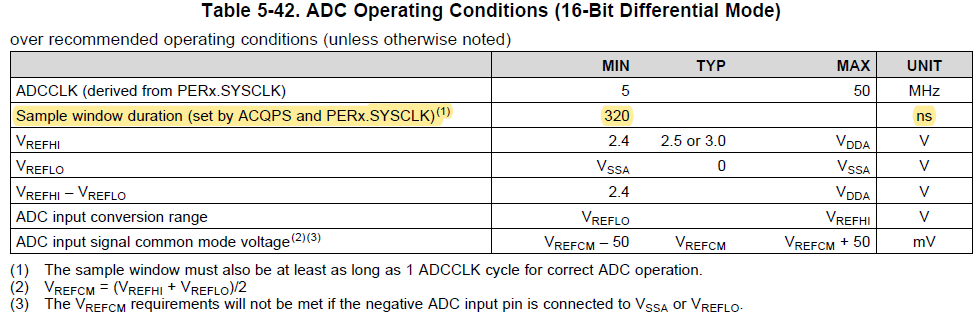
    Also take care to configure the ADC within the supported operating conditions. For example, the shortest supported ACQPS window for 16-bit conversions is 320-ns:

    -Tommy