This thread has been locked.

If you have a related question, please click the "Ask a related question" button in the top right corner. The newly created question will be automatically linked to this question.

TMS320F28075: HRPWM not behaving as expected

Part Number: TMS320F28075


Hi,

my customer is using HRPWM to output a duty cycle PWM to drive the high side of a buck controller.

In theory the output current should be proportional to the duty cycle of the buck converter. So by looking at the current we could see the duty cycle of the PWM generated. 

We can't use an scope to measure the duty cycle because the resolution is not enough to see such small change in duty cycle.

We get the result below:

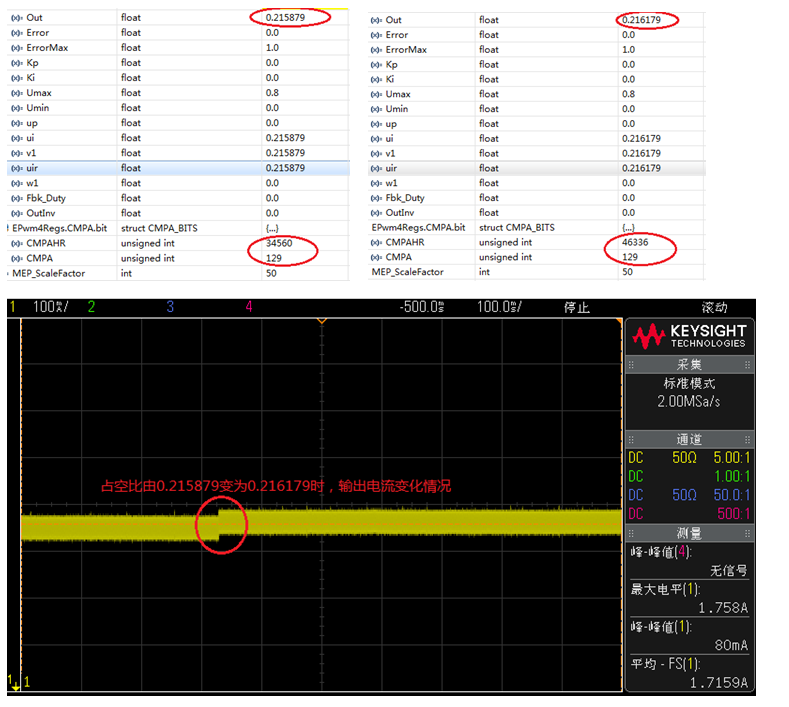
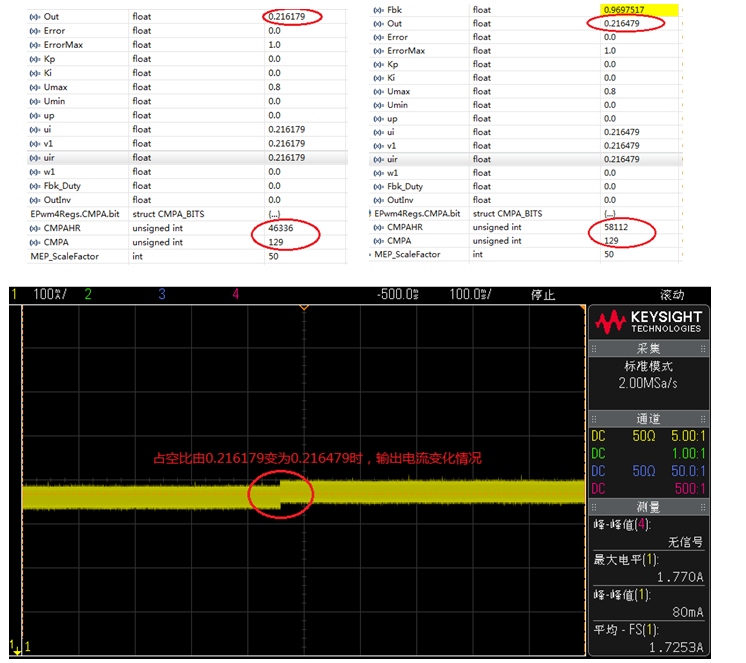
duty cycle expected duty cycle increment CMPA CMPAHR current measured current expected TBPRD
0.215279 129 10752 1 1 600
0.215579 0.003 129 22528 1.1 1.2 600
0.215879 0.003 129 34560 1.2 1.4 600
0.216179 0.003 129 46336 1.3 1.6 600
0.216479 0.003 129 58112 1.4 1.8 600
0.216779 0.003 130 4352 2 2 600

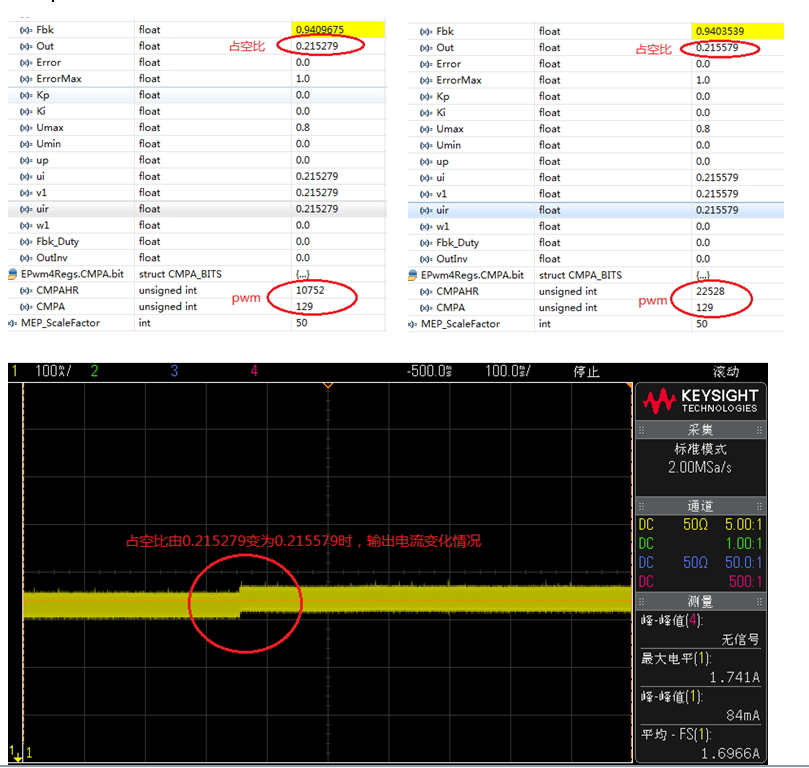
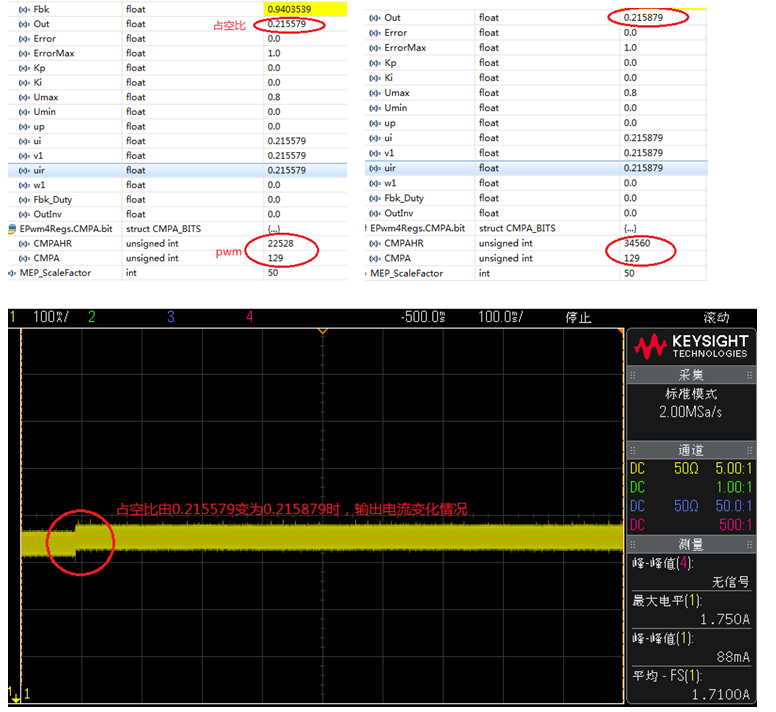
There will always be a big jump of current at the increment by 1 of CMPA.

The setting is as below, auto conversion is enabled.
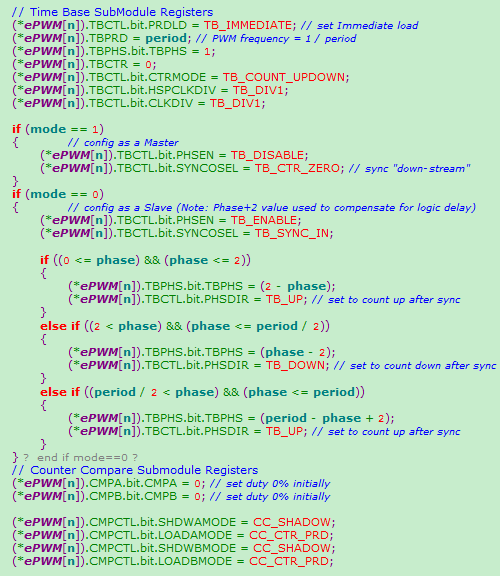
EPWM1Regs.CMPA.all=(Uint32)((float)DutyToCmpCst*(dutycycle));

DutyToCmpCst=TBPRD<<16=600*65536.

1.Duty cycle jump from 0.215279 to 0.215579: waveform is average current
2.Duty cycle jump from 0.215579 to 0.215879:
3.Duty cycle jump from 0.215879 to 0.216179:
4.Duty cycle jump from 0.216179 to 0.216479:
5.Duty cycle jump from 0.216479 to 0.216779:
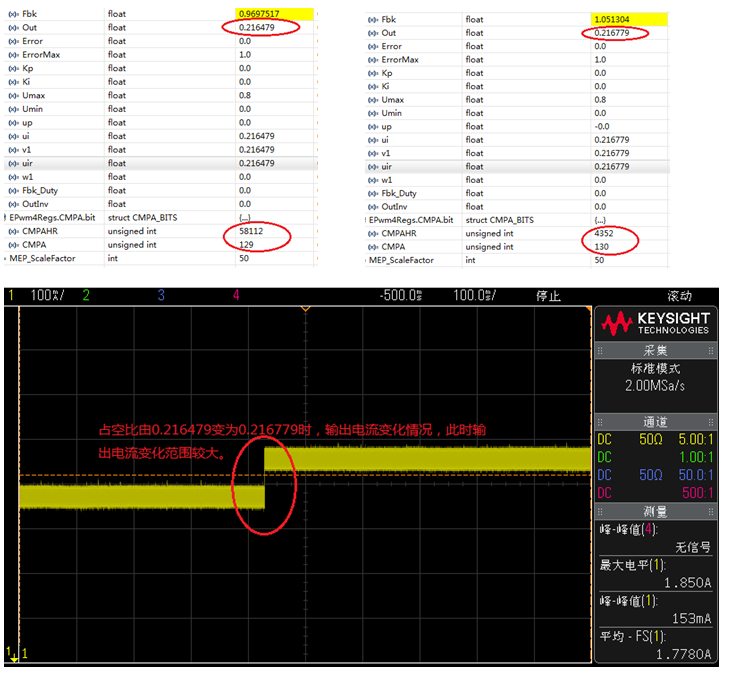
So we suspect the duty cycle is not incrementing as we expected, but we don't know where are things wrong.

  • This is in the PRD UP-DOWN mode?

    Nima

  • Nima, yes, it's up and down count mode.

  • i see in your code that you are using deadband module as well. I will take a look to see if I can spot the issue in the code.

    Can you send me a .c file with the configuration? or posts a code block on here?

    Nima

  • Nima,

    thanks. I've send the .c file to you.

  • First point from your c code, in HRPWM CTR UP-DOWN mode, you MUST use shadow load mode at CTR=ZRO and PRD.

    Nima

  • Nima,

    do you mean that we should use shadow load mode at both CTR=ZRO and PRD, not only PRD?

    Why?

    Have you tested with the same configuration with ours, and can you repeat the same result?

    Thanks.

  • Okay after reviewing the whole code, the only thing I see that is not correct in the setup is:

    1. Your shadow load modes in Up-Down count:

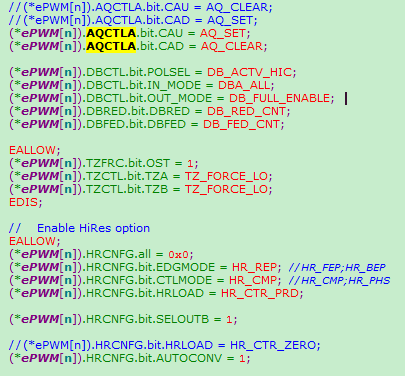
    	(*ePWM[n]).CMPCTL.bit.LOADAMODE = CC_CTR_PRD;
    	(*ePWM[n]).CMPCTL.bit.LOADBMODE = CC_CTR_PRD;

    These MUST to be CC_CTR_ZERO_PRD.

    2. For your HRPWM, you need to:

    	(*ePWM[n]).HRCNFG.bit.EDGMODE = HR_FEP;
    	(*ePWM[n]).HRCNFG.bit.CTLMODE = HR_CMP;
    	(*ePWM[n]).HRCNFG.bit.HRLOAD = HR_CTR_PRD;

    The edge mode needs to be BOTH edges in Up-Down mode: HR_BEP

    The HRCNFG CTLMODE is correct.

    The HRLOAD again MUST be : HR_CTR_ZERO_PRD

    Can you test this on your setup?

    If not, I can run this code on my setup and compare it to the HRPWM code below to see what setting is different causing the jumping.

            EPWM_setEmulationMode(ePWM[j], EPWM_EMULATION_FREE_RUN);
    
            //
            // Set-up TBCLK
            //
            EPWM_setTimeBasePeriod(ePWM[j], period-1);
            EPWM_setPhaseShift(ePWM[j], 0U);
            EPWM_setTimeBaseCounter(ePWM[j], 0U);
    
            //
            // set duty 50% initially
            //
            HRPWM_setCounterCompareValue(ePWM[j], HRPWM_COUNTER_COMPARE_A, (period/2 << 8) + 1);
            HRPWM_setCounterCompareValue(ePWM[j], HRPWM_COUNTER_COMPARE_B, (period/2 << 8) + 1);
    
    
            //
            // Set up counter mode
            //
            EPWM_setTimeBaseCounterMode(ePWM[j], EPWM_COUNTER_MODE_UP_DOWN);
            EPWM_disablePhaseShiftLoad(ePWM[j]);
            EPWM_setClockPrescaler(ePWM[j],
                                   EPWM_CLOCK_DIVIDER_1,
                                   EPWM_HSCLOCK_DIVIDER_1);
            EPWM_setSyncOutPulseMode(ePWM[j], EPWM_SYNC_OUT_PULSE_DISABLED);
    
    
            //
            // Set up shadowing
            // MUST BE CTR=(ZER & PRD)
            //
            EPWM_setCounterCompareShadowLoadMode(ePWM[j],
                                                 EPWM_COUNTER_COMPARE_A,
                                                 EPWM_COMP_LOAD_ON_CNTR_ZERO_PERIOD);
            EPWM_setCounterCompareShadowLoadMode(ePWM[j],
                                                 EPWM_COUNTER_COMPARE_B,
                                                 EPWM_COMP_LOAD_ON_CNTR_ZERO_PERIOD);
    
            //
            // Set actions
            //
    
            EPWM_setActionQualifierAction(ePWM[j],
                                          EPWM_AQ_OUTPUT_A,
                                          EPWM_AQ_OUTPUT_HIGH,
                                          EPWM_AQ_OUTPUT_ON_TIMEBASE_UP_CMPA);
            EPWM_setActionQualifierAction(ePWM[j],
                                          EPWM_AQ_OUTPUT_A,
                                          EPWM_AQ_OUTPUT_LOW,
                                          EPWM_AQ_OUTPUT_ON_TIMEBASE_DOWN_CMPA);
    
            EPWM_setActionQualifierAction(ePWM[j],
                                          EPWM_AQ_OUTPUT_B,
                                          EPWM_AQ_OUTPUT_HIGH,
                                          EPWM_AQ_OUTPUT_ON_TIMEBASE_UP_CMPB);
            EPWM_setActionQualifierAction(ePWM[j],
                                          EPWM_AQ_OUTPUT_B,
                                          EPWM_AQ_OUTPUT_LOW,
                                          EPWM_AQ_OUTPUT_ON_TIMEBASE_DOWN_CMPB);
    
    
            HRPWM_setMEPEdgeSelect(ePWM[j], HRPWM_CHANNEL_A, HRPWM_MEP_CTRL_RISING_AND_FALLING_EDGE);
            HRPWM_setMEPControlMode(ePWM[j], HRPWM_CHANNEL_A, HRPWM_MEP_DUTY_PERIOD_CTRL);
    
            //
            // Set up shadowing
            // MUST BE CTR=(ZER & PRD)
            //
            HRPWM_setCounterCompareShadowLoadEvent(ePWM[j], HRPWM_CHANNEL_A, HRPWM_LOAD_ON_CNTR_ZERO_PERIOD);
    
            HRPWM_setMEPEdgeSelect(ePWM[j], HRPWM_CHANNEL_B, HRPWM_MEP_CTRL_RISING_AND_FALLING_EDGE);
            HRPWM_setMEPControlMode(ePWM[j], HRPWM_CHANNEL_B, HRPWM_MEP_DUTY_PERIOD_CTRL);
    
            //
            // Set up shadowing
            // MUST BE CTR=(ZER & PRD)
            //
            HRPWM_setCounterCompareShadowLoadEvent(ePWM[j], HRPWM_CHANNEL_B, HRPWM_LOAD_ON_CNTR_ZERO_PERIOD);
    
            HRPWM_enableAutoConversion(ePWM[j]);
    
            //
            // Turn on high-resolution period control for DUTY to take HR on BOTH EDGEs.
            //
    
            HRPWM_enablePeriodControl(ePWM[j]);
            HRPWM_disablePhaseShiftLoad(ePWM[j]);

  • Nima,

    we tried the setup as you said: but the problem is still there.

    1. Your shadow load modes in Up-Down count:

    1
    2
    (*ePWM[n]).CMPCTL.bit.LOADAMODE = CC_CTR_PRD;
    (*ePWM[n]).CMPCTL.bit.LOADBMODE = CC_CTR_PRD;

    These MUST to be CC_CTR_ZERO_PRD.

    The edge mode needs to be BOTH edges in Up-Down mode: HR_BEP

    The HRCNFG CTLMODE is correct.

    The HRLOAD again MUST be : HR_CTR_ZERO_PRD

    1. We need your help to find the cause of the problem.

    2. Besides, could you please explain why we should use CC_CTR_ZERO_PRD, not PRD only or ZERO only?

  • I am setting up my hardware to run your code, on F2837xD since that has the same EPWM module.

    When using TBCTR in UP-DOWN count with the HIGH-RESOLUTION module, the use MUST use shadow load modes of ZERO_PRD. The values inside the CMPx register have another layer of internal shadows, which MUST BE UPDATED internally (not done by the user) at ZERO_PRD. 

    Nima

  • Howard,


    1. yes the hrpwm_config is not used.
    2. yes the PWM_1chHiResUpDwnCnt_CNF is used.

    When using TBCTR mode UP-DOWN, and you want to use Duty control, YOU MUST have the following configuration:


    EDGE mode BOTH

    CONTROL mode DUTY (in fact the TRM only says “this is duty or period control mode”) THIS IS CORRECT. It says DUTY but it actually is DUTY AND PERIOD.

    SHADOW mode ALWAYS (PRD AND ZERO) this is MUST. The internal logic of EPWM will not operate correctly if that is not the case.


    The duty/period control, will give you HR-MODE access to period and for the duty control , the CMPAHR increase part moves one edge (the rising edge before the PRD), closer to the PRD while it moves the falling edge AWAY from the PRD. so it either increases your duty or decreases your duty but shifting both edges closer to each other or away from each other.


    Howard, possibly the three examples I have created for you could help understand the setting for the code you need.


    Can you check out, or have the customer look at the following three examples?


    ex1 is counter up mode.

    ex3 is counter up/down mode showing Period control.

    ex4 is duty control in counter up/down mode.


    Nima

    //#############################################################################
    //
    // FILE:   hrpwm_ex1_duty_sfo.c
    //
    // TITLE:  HRPWM Duty Control with SFO.
    //
    //! \addtogroup driver_example_list
    //! <h1>HRPWM Duty Control with SFO</h1>
    //!
    //
    //
    //#############################################################################
    // $TI Release: $
    // $Release Date: $
    // $Copyright: $
    //#############################################################################


    //
    // Included Files
    //
    #include "driverlib.h"
    #include "device.h"
    #include "SFO_V8.h"
    
    #define EPWM_TIMER_TBPRD            100UL
    #define MIN_HRPWM_DUTY_PERCENT      4.0/((float32_t)EPWM_TIMER_TBPRD)*100.0
    //
    // Defines
    //
    #define LAST_EPWM_INDEX_FOR_EXAMPLE    5
    
    //
    // Globals
    //
    
    float32_t dutyFine = MIN_HRPWM_DUTY_PERCENT;
    uint16_t status;
    
    int MEP_ScaleFactor; // Global variable used by the SFO library
                         // Result can be used for all HRPWM channels
                         // This variable is also copied to HRMSTEP
                         // register by SFO() function.
    
    volatile uint32_t ePWM[] =
        {0, EPWM1_BASE, EPWM2_BASE, EPWM3_BASE, EPWM4_BASE};
    //
    // Function Prototypes
    //
    void initHRPWM(uint32_t period);
    void initEPWMGpio(void);
    void error(void);
    //__interrupt void epwm1ISR(void);
    //__interrupt void epwm2ISR(void);
    //__interrupt void epwm3ISR(void);
    //__interrupt void epwm4ISR(void);
    
    //
    // Main
    //
    void main(void)
    {
        uint16_t i = 0;
    
        //
        // Initialize device clock and peripherals
        //
        Device_init();
    
        //
        // Disable pin locks and enable internal pull ups.
        //
        Device_initGPIO();
    
        //
        // Initialize PIE and clear PIE registers. Disables CPU interrupts.
        //
        Interrupt_initModule();
    
        //
        // Initialize the PIE vector table with pointers to the shell Interrupt
        // Service Routines (ISR).
        //
        Interrupt_initVectorTable();
    
        //
        // Assign the interrupt service routines to ePWM interrupts
        //
        //Interrupt_register(INT_EPWM1, &epwm1ISR);
        //Interrupt_register(INT_EPWM2, &epwm2ISR);
        //Interrupt_register(INT_EPWM3, &epwm3ISR);
        //Interrupt_register(INT_EPWM4, &epwm4ISR);
    
        initEPWMGpio();
    
    
        //
        // CHANGE XBAR inputs from using GPIO0
        // if EPWM SYNCIN is enabled, EXTSYNCIN1 and EXTSYNCIN2 will use
        // GPIO0 (which is the output of EPWM1).
        // Pick and unused GPIO
        //
        XBAR_setInputPin(XBAR_INPUT5, 50);
        XBAR_setInputPin(XBAR_INPUT6, 50);
    
    
        //
        // Calling SFO() updates the HRMSTEP register with calibrated MEP_ScaleFactor.
        // HRMSTEP must be populated with a scale factor value prior to enabling
        // high resolution period control.
        //
        while(status == SFO_INCOMPLETE)
        {
            status = SFO();
            if(status == SFO_ERROR)
            {
                error();   // SFO function returns 2 if an error occurs & # of MEP
            }              // steps/coarse step exceeds maximum of 255.
        }


        //
        // Disable sync(Freeze clock to PWM as well)
        //
        SysCtl_disablePeripheral(SYSCTL_PERIPH_CLK_GTBCLKSYNC);
        SysCtl_disablePeripheral(SYSCTL_PERIPH_CLK_TBCLKSYNC);
    
        initHRPWM(EPWM_TIMER_TBPRD);
    
        //
        // Enable sync and clock to PWM
        //
        SysCtl_enablePeripheral(SYSCTL_PERIPH_CLK_TBCLKSYNC);
    
    
        // Enable ePWM interrupts
        //
        //Interrupt_enable(INT_EPWM1);
        //Interrupt_enable(INT_EPWM2);
        //Interrupt_enable(INT_EPWM3);
        //Interrupt_enable(INT_EPWM4);
    
        //
        // Enable Global Interrupt (INTM) and realtime interrupt (DBGM)
        //
        EINT;
        ERTM;
    
    
        for(;;)
        {
             //
             // Sweep DutyFine
             //
             for(dutyFine = MIN_HRPWM_DUTY_PERCENT; dutyFine < 99.9; dutyFine += 0.01)
             {
                 DEVICE_DELAY_US(1000);
                 for(i=1; i<LAST_EPWM_INDEX_FOR_EXAMPLE; i++)
                 {
                     float32_t count = (dutyFine * (float32_t)(EPWM_TIMER_TBPRD << 8))/100;
                     uint32_t compCount = (count);
                     HRPWM_setCounterCompareValue(ePWM[i], HRPWM_COUNTER_COMPARE_A, compCount);
                     HRPWM_setCounterCompareValue(ePWM[i], HRPWM_COUNTER_COMPARE_B, compCount);
                 }
    
                 //
                 // Call the scale factor optimizer lib function SFO()
                 // periodically to track for any change due to temp/voltage.
                 // This function generates MEP_ScaleFactor by running the
                 // MEP calibration module in the HRPWM logic. This scale
                 // factor can be used for all HRPWM channels. The SFO()
                 // function also updates the HRMSTEP register with the
                 // scale factor value.
                 //
                 status = SFO(); // in background, MEP calibration module
                                 // continuously updates MEP_ScaleFactor
    
                 if (status == SFO_ERROR)
                 {
                     error();   // SFO function returns 2 if an error occurs & #
                                // of MEP steps/coarse step
                 }              // exceeds maximum of 255.
             }
         }
    }
    
    //
    // epwm1ISR - ePWM 1 ISR
    //
    //__interrupt void epwm1ISR(void)
    //{
    //    EPWM_clearEventTriggerInterruptFlag(EPWM1_BASE);
    //    Interrupt_clearACKGroup(INTERRUPT_ACK_GROUP3);
    //}
    
    //
    // epwm2ISR - ePWM 2 ISR
    //
    //__interrupt void epwm2ISR(void)
    //{
    //    EPWM_clearEventTriggerInterruptFlag(EPWM2_BASE);
    //    Interrupt_clearACKGroup(INTERRUPT_ACK_GROUP3);
    //}
    
    //
    // epwm3ISR - ePWM 3 ISR
    //
    //__interrupt void epwm3ISR(void)
    //{
    //    EPWM_clearEventTriggerInterruptFlag(EPWM3_BASE);
    //    Interrupt_clearACKGroup(INTERRUPT_ACK_GROUP3);
    //}
    
    //
    // epwm4ISR - ePWM 4 ISR
    //
    //__interrupt void epwm4ISR(void)
    //{
    //    EPWM_clearEventTriggerInterruptFlag(EPWM4_BASE);
    //    Interrupt_clearACKGroup(INTERRUPT_ACK_GROUP3);
    //}


    void initEPWMGpio(void)
    {
        //
        // Configure GPIO0/1 as ePWM1A/1B pins respectively
        //
        GPIO_setPadConfig(0, GPIO_PIN_TYPE_STD);
        GPIO_setPinConfig(GPIO_0_EPWM1A);
        GPIO_setPadConfig(1, GPIO_PIN_TYPE_STD);
        GPIO_setPinConfig(GPIO_1_EPWM1B);
    
        //
        // Configure GPIO2/3 as ePWM2A/2B pins respectively
        //
        GPIO_setPadConfig(2, GPIO_PIN_TYPE_STD);
        GPIO_setPinConfig(GPIO_2_EPWM2A);
        GPIO_setPadConfig(3, GPIO_PIN_TYPE_STD);
        GPIO_setPinConfig(GPIO_3_EPWM2B);
    
        //
        // Configure GPIO4/5 as ePWM3A/3B pins respectively
        //
        GPIO_setPadConfig(4, GPIO_PIN_TYPE_STD);
        GPIO_setPinConfig(GPIO_4_EPWM3A);
        GPIO_setPadConfig(5, GPIO_PIN_TYPE_STD);
        GPIO_setPinConfig(GPIO_5_EPWM3B);
    
        //
        // Configure GPIO6/7 as ePWM4A/4B pins respectively
        //
        GPIO_setPadConfig(6, GPIO_PIN_TYPE_STD);
        GPIO_setPinConfig(GPIO_6_EPWM4A);
        GPIO_setPadConfig(7, GPIO_PIN_TYPE_STD);
        GPIO_setPinConfig(GPIO_7_EPWM4B);
    }
    
    void initHRPWM(uint32_t period)
    {
    
        uint16_t j;
    
        //
        // ePWM channel register configuration with HRPWM
        // ePWMxA / ePWMxB toggle low/high with MEP control on Rising edge
        //
        for (j=1;j<LAST_EPWM_INDEX_FOR_EXAMPLE;j++)
        {
            EPWM_setEmulationMode(ePWM[j], EPWM_EMULATION_FREE_RUN);
    
            //
            // Set-up TBCLK
            //
            EPWM_setTimeBasePeriod(ePWM[j], period-1);
            EPWM_setPhaseShift(ePWM[j], 0U);
            EPWM_setTimeBaseCounter(ePWM[j], 0U);
    
            //
            // set duty 50% initially
            //
            HRPWM_setCounterCompareValue(ePWM[j], HRPWM_COUNTER_COMPARE_A, (period/2 << 8));
            HRPWM_setCounterCompareValue(ePWM[j], HRPWM_COUNTER_COMPARE_B, (period/2 << 8));
    
    
            //
            // Set up counter mode
            //
            EPWM_setTimeBaseCounterMode(ePWM[j], EPWM_COUNTER_MODE_UP);
            EPWM_disablePhaseShiftLoad(ePWM[j]);
            EPWM_setClockPrescaler(ePWM[j],
                                   EPWM_CLOCK_DIVIDER_1,
                                   EPWM_HSCLOCK_DIVIDER_1);
            EPWM_setSyncOutPulseMode(ePWM[j], EPWM_SYNC_OUT_PULSE_DISABLED);
    
    
            //
            // Set up shadowing
            //
            EPWM_setCounterCompareShadowLoadMode(ePWM[j],
                                                 EPWM_COUNTER_COMPARE_A,
                                                 EPWM_COMP_LOAD_ON_CNTR_ZERO);
            EPWM_setCounterCompareShadowLoadMode(ePWM[j],
                                                 EPWM_COUNTER_COMPARE_B,
                                                 EPWM_COMP_LOAD_ON_CNTR_ZERO);
    
            //
            // Set actions
            //
    
            EPWM_setActionQualifierAction(ePWM[j],
                                          EPWM_AQ_OUTPUT_A,
                                          EPWM_AQ_OUTPUT_HIGH,
                                          EPWM_AQ_OUTPUT_ON_TIMEBASE_ZERO);
    
    
            EPWM_setActionQualifierAction(ePWM[j],
                                          EPWM_AQ_OUTPUT_B,
                                          EPWM_AQ_OUTPUT_HIGH,
                                          EPWM_AQ_OUTPUT_ON_TIMEBASE_ZERO);
    
            EPWM_setActionQualifierAction(ePWM[j],
                                          EPWM_AQ_OUTPUT_A,
                                          EPWM_AQ_OUTPUT_LOW,
                                          EPWM_AQ_OUTPUT_ON_TIMEBASE_UP_CMPA);
            EPWM_setActionQualifierAction(ePWM[j],
                                          EPWM_AQ_OUTPUT_B,
                                          EPWM_AQ_OUTPUT_LOW,
                                          EPWM_AQ_OUTPUT_ON_TIMEBASE_UP_CMPB);
    
    
            HRPWM_setMEPEdgeSelect(ePWM[j], HRPWM_CHANNEL_A, HRPWM_MEP_CTRL_FALLING_EDGE);
            HRPWM_setMEPControlMode(ePWM[j], HRPWM_CHANNEL_A, HRPWM_MEP_DUTY_PERIOD_CTRL);
            HRPWM_setCounterCompareShadowLoadEvent(ePWM[j], HRPWM_CHANNEL_A, HRPWM_LOAD_ON_CNTR_ZERO);
    
            HRPWM_setMEPEdgeSelect(ePWM[j], HRPWM_CHANNEL_B, HRPWM_MEP_CTRL_FALLING_EDGE);
            HRPWM_setMEPControlMode(ePWM[j], HRPWM_CHANNEL_B, HRPWM_MEP_DUTY_PERIOD_CTRL);
            HRPWM_setCounterCompareShadowLoadEvent(ePWM[j], HRPWM_CHANNEL_B, HRPWM_LOAD_ON_CNTR_ZERO);
    
            HRPWM_enableAutoConversion(ePWM[j]);
    
            //
            // Turn off high-resolution period control.
            //
    
            HRPWM_disablePeriodControl(ePWM[j]);
            HRPWM_disablePhaseShiftLoad(ePWM[j]);
    
    
            //
            // Interrupt where we will change the Compare Values
            // Select INT on Time base counter zero event,
            // Enable INT, generate INT on 1st event
            //
            //EPWM_setInterruptSource(ePWM[j], EPWM_INT_TBCTR_ZERO);
            //EPWM_enableInterrupt(ePWM[j]);
            //EPWM_setInterruptEventCount(ePWM[j], 1U);
        }
    
    }
    
    //
    // error - Halt debugger when called
    //
    void error (void)
    {
        ESTOP0;         // Stop here and handle error
    }
    
    
    //#############################################################################
    //
    // FILE:   hrpwm_ex3_prdupdown_sfo.c
    //
    // TITLE:  HRPWM Period Control.
    //
    //! \addtogroup driver_example_list
    //! <h1>HRPWM Period Control</h1>
    //!
    //
    //
    //#############################################################################
    // $TI Release: $
    // $Release Date: $
    // $Copyright: $
    //#############################################################################


    //
    // Included Files
    //
    #include "driverlib.h"
    #include "device.h"
    #include "SFO_V8.h"
    
    //
    // Defines
    //
    #define EPWM_TIMER_TBPRD    20UL
    #define LAST_EPWM_INDEX_FOR_EXAMPLE    5
    #define MIN_HRPWM_PRD_PERCENT   0.2
    
    //
    // Globals
    //
    
    float32_t periodFine = MIN_HRPWM_PRD_PERCENT;
    uint16_t status;
    
    int MEP_ScaleFactor; // Global variable used by the SFO library
                         // Result can be used for all HRPWM channels
                         // This variable is also copied to HRMSTEP
                         // register by SFO() function.
    
    volatile uint32_t ePWM[] =
        {0, EPWM1_BASE, EPWM2_BASE, EPWM3_BASE, EPWM4_BASE};
    //
    // Function Prototypes
    //
    void initHRPWM(uint32_t period);
    void initEPWMGpio(void);
    void error(void);
    
    //
    // Main
    //
    void main(void)
    {
        uint16_t i = 0;
    
        //
        // Initialize device clock and peripherals
        //
        Device_init();
    
        //
        // Disable pin locks and enable internal pull ups.
        //
        Device_initGPIO();
    
        //
        // Initialize PIE and clear PIE registers. Disables CPU interrupts.
        //
        Interrupt_initModule();
    
        //
        // Initialize the PIE vector table with pointers to the shell Interrupt
        // Service Routines (ISR).
        //
        Interrupt_initVectorTable();
    
        //
        // Initialize GPIO
        //
        initEPWMGpio();
    
    
        //
        // CHANGE XBAR inputs from using GPIO0
        // if EPWM SYNCIN is enabled, EXTSYNCIN1 and EXTSYNCIN2 will use
        // GPIO0 (which is the output of EPWM1).
        // Pick and unused GPIO
        //
        XBAR_setInputPin(XBAR_INPUT5, 50);
        XBAR_setInputPin(XBAR_INPUT6, 50);
    
    
        //
        // Calling SFO() updates the HRMSTEP register with calibrated MEP_ScaleFactor.
        // HRMSTEP must be populated with a scale factor value prior to enabling
        // high resolution period control.
        //
        while(status == SFO_INCOMPLETE)
        {
            status = SFO();
            if(status == SFO_ERROR)
            {
                error();   // SFO function returns 2 if an error occurs & # of MEP
            }              // steps/coarse step exceeds maximum of 255.
        }


        //
        // Disable sync(Freeze clock to PWM as well)
        //
        SysCtl_disablePeripheral(SYSCTL_PERIPH_CLK_GTBCLKSYNC);
        SysCtl_disablePeripheral(SYSCTL_PERIPH_CLK_TBCLKSYNC);
    
        initHRPWM(EPWM_TIMER_TBPRD);
    
        //
        // Enable sync and clock to PWM
        //
        SysCtl_enablePeripheral(SYSCTL_PERIPH_CLK_TBCLKSYNC);
    
        //
        // Enable Global Interrupt (INTM) and realtime interrupt (DBGM)
        //
        EINT;
        ERTM;
    
    
        for(;;)
        {
             //
             // Sweep DutyFine
             //
             for(periodFine = MIN_HRPWM_PRD_PERCENT; periodFine < 0.9; periodFine += 0.01)
             {
                 DEVICE_DELAY_US(1000);
                 for(i=1; i<LAST_EPWM_INDEX_FOR_EXAMPLE; i++)
                 {
                     float32_t count = ((EPWM_TIMER_TBPRD-1) << 8UL) + (float32_t)(periodFine * 256);
                     uint32_t compCount = count;
                     HRPWM_setTimeBasePeriod(ePWM[i], compCount);
                 }
    
                 //
                 // Call the scale factor optimizer lib function SFO()
                 // periodically to track for any change due to temp/voltage.
                 // This function generates MEP_ScaleFactor by running the
                 // MEP calibration module in the HRPWM logic. This scale
                 // factor can be used for all HRPWM channels. The SFO()
                 // function also updates the HRMSTEP register with the
                 // scale factor value.
                 //
                 status = SFO(); // in background, MEP calibration module
                                 // continuously updates MEP_ScaleFactor
    
                 if (status == SFO_ERROR)
                 {
                     error();   // SFO function returns 2 if an error occurs & #
                                // of MEP steps/coarse step
                 }              // exceeds maximum of 255.
             }
         }
    }
    
    void initEPWMGpio(void)
    {
        //
        // Configure GPIO0/1 as ePWM1A/1B pins respectively
        //
        GPIO_setPadConfig(0, GPIO_PIN_TYPE_STD);
        GPIO_setPinConfig(GPIO_0_EPWM1A);
        GPIO_setPadConfig(1, GPIO_PIN_TYPE_STD);
        GPIO_setPinConfig(GPIO_1_EPWM1B);
    
        //
        // Configure GPIO2/3 as ePWM2A/2B pins respectively
        //
        GPIO_setPadConfig(2, GPIO_PIN_TYPE_STD);
        GPIO_setPinConfig(GPIO_2_EPWM2A);
        GPIO_setPadConfig(3, GPIO_PIN_TYPE_STD);
        GPIO_setPinConfig(GPIO_3_EPWM2B);
    
        //
        // Configure GPIO4/5 as ePWM3A/3B pins respectively
        //
        GPIO_setPadConfig(4, GPIO_PIN_TYPE_STD);
        GPIO_setPinConfig(GPIO_4_EPWM3A);
        GPIO_setPadConfig(5, GPIO_PIN_TYPE_STD);
        GPIO_setPinConfig(GPIO_5_EPWM3B);
    
        //
        // Configure GPIO6/7 as ePWM4A/4B pins respectively
        //
        GPIO_setPadConfig(6, GPIO_PIN_TYPE_STD);
        GPIO_setPinConfig(GPIO_6_EPWM4A);
        GPIO_setPadConfig(7, GPIO_PIN_TYPE_STD);
        GPIO_setPinConfig(GPIO_7_EPWM4B);
    }
    
    void initHRPWM(uint32_t period)
    {
    
        uint16_t j;
    
        //
        // ePWM channel register configuration with HRPWM
        //
        for (j=1;j<LAST_EPWM_INDEX_FOR_EXAMPLE;j++)
        {
            EPWM_setEmulationMode(ePWM[j], EPWM_EMULATION_FREE_RUN);
    
            //
            // Set-up TBCLK
            //
            EPWM_setPeriodLoadMode(ePWM[j], EPWM_PERIOD_SHADOW_LOAD);
            EPWM_setTimeBasePeriod(ePWM[j], period-1);
            EPWM_setPhaseShift(ePWM[j], 0U);
            EPWM_setTimeBaseCounter(ePWM[j], 0U);
    
            //
            // set duty 50% initially
            //
            HRPWM_setCounterCompareValue(ePWM[j], HRPWM_COUNTER_COMPARE_A, (period/2 << 8));
            HRPWM_setCounterCompareValue(ePWM[j], HRPWM_COUNTER_COMPARE_B, (period/2 << 8));
    
    
            //
            // Set up counter mode
            //
            EPWM_setTimeBaseCounterMode(ePWM[j], EPWM_COUNTER_MODE_UP_DOWN);
            EPWM_disablePhaseShiftLoad(ePWM[j]);
            EPWM_setClockPrescaler(ePWM[j],
                                   EPWM_CLOCK_DIVIDER_1,
                                   EPWM_HSCLOCK_DIVIDER_1);
            EPWM_setSyncOutPulseMode(ePWM[j], EPWM_SYNC_OUT_PULSE_DISABLED);
    
    
            //
            // Set up shadowing
            //
            EPWM_setCounterCompareShadowLoadMode(ePWM[j],
                                                 EPWM_COUNTER_COMPARE_A,
                                                 EPWM_COMP_LOAD_ON_CNTR_ZERO);
            EPWM_setCounterCompareShadowLoadMode(ePWM[j],
                                                 EPWM_COUNTER_COMPARE_B,
                                                 EPWM_COMP_LOAD_ON_CNTR_ZERO);
    
            //
            // Set actions
            //
    
            EPWM_setActionQualifierAction(ePWM[j],
                                          EPWM_AQ_OUTPUT_A,
                                          EPWM_AQ_OUTPUT_HIGH,
                                          EPWM_AQ_OUTPUT_ON_TIMEBASE_UP_CMPA);
    
    
            EPWM_setActionQualifierAction(ePWM[j],
                                          EPWM_AQ_OUTPUT_B,
                                          EPWM_AQ_OUTPUT_HIGH,
                                          EPWM_AQ_OUTPUT_ON_TIMEBASE_UP_CMPB);
    
            EPWM_setActionQualifierAction(ePWM[j],
                                          EPWM_AQ_OUTPUT_A,
                                          EPWM_AQ_OUTPUT_LOW,
                                          EPWM_AQ_OUTPUT_ON_TIMEBASE_DOWN_CMPA);
            EPWM_setActionQualifierAction(ePWM[j],
                                          EPWM_AQ_OUTPUT_B,
                                          EPWM_AQ_OUTPUT_LOW,
                                          EPWM_AQ_OUTPUT_ON_TIMEBASE_DOWN_CMPB);
    
    
            HRPWM_setMEPEdgeSelect(ePWM[j], HRPWM_CHANNEL_A, HRPWM_MEP_CTRL_RISING_AND_FALLING_EDGE);
            HRPWM_setMEPControlMode(ePWM[j], HRPWM_CHANNEL_A, HRPWM_MEP_DUTY_PERIOD_CTRL);
            HRPWM_setCounterCompareShadowLoadEvent(ePWM[j], HRPWM_CHANNEL_A, HRPWM_LOAD_ON_CNTR_ZERO_PERIOD);
    
            HRPWM_setMEPEdgeSelect(ePWM[j], HRPWM_CHANNEL_B, HRPWM_MEP_CTRL_RISING_AND_FALLING_EDGE);
            HRPWM_setMEPControlMode(ePWM[j], HRPWM_CHANNEL_B, HRPWM_MEP_DUTY_PERIOD_CTRL);
            HRPWM_setCounterCompareShadowLoadEvent(ePWM[j], HRPWM_CHANNEL_B, HRPWM_LOAD_ON_CNTR_ZERO_PERIOD);
    
            HRPWM_enableAutoConversion(ePWM[j]);
    
            //
            // Turn on high-resolution period control.
            //
    
            HRPWM_enablePeriodControl(ePWM[j]);
            HRPWM_enablePhaseShiftLoad(ePWM[j]);
    
            EPWM_forceSyncPulse(ePWM[j]);
        }
    
    }
    
    //
    // error - Halt debugger when called
    //
    void error (void)
    {
        ESTOP0;         // Stop here and handle error
    }
    
    
    //#############################################################################
    //
    // FILE:   hrpwm_ex4_duty_updown_sfo.c
    //
    // TITLE:  HRPWM Duty Control with UPDOWN Mode.
    //
    //! \addtogroup driver_example_list
    //! <h1>HRPWM Duty Control with UPDOWN Mode</h1>
    //!
    //
    //
    //#############################################################################
    // $TI Release: $
    // $Release Date: $
    // $Copyright: $
    //#############################################################################
    
    
    //
    // Included Files
    //
    #include "driverlib.h"
    #include "device.h"
    #include "SFO_V8.h"
    
    #define CHANNEL_B_AS_ZRO_PRD_REF    0
    #define EPWM_TIMER_TBPRD            100UL
    #define MIN_HRPWM_DUTY_PERCENT      4.0/((float32_t)EPWM_TIMER_TBPRD)*100.0
    //
    // Defines
    //
    #define LAST_EPWM_INDEX_FOR_EXAMPLE    5
    
    //
    // Globals
    //
    
    float32_t dutyFine = 50.0;
    uint16_t status;
    
    int MEP_ScaleFactor; // Global variable used by the SFO library
                         // Result can be used for all HRPWM channels
                         // This variable is also copied to HRMSTEP
                         // register by SFO() function.
    
    volatile uint32_t ePWM[] =
        {0, EPWM1_BASE, EPWM2_BASE, EPWM3_BASE, EPWM4_BASE};
    //
    // Function Prototypes
    //
    void initHRPWM(uint32_t period);
    void initEPWMGpio(void);
    void error(void);
    //__interrupt void epwm1ISR(void);
    //__interrupt void epwm2ISR(void);
    //__interrupt void epwm3ISR(void);
    //__interrupt void epwm4ISR(void);
    
    //
    // Main
    //
    void main(void)
    {
        uint16_t i = 0;
    
        //
        // Initialize device clock and peripherals
        //
        Device_init();
    
        //
        // Disable pin locks and enable internal pull ups.
        //
        Device_initGPIO();
    
        //
        // Initialize PIE and clear PIE registers. Disables CPU interrupts.
        //
        Interrupt_initModule();
    
        //
        // Initialize the PIE vector table with pointers to the shell Interrupt
        // Service Routines (ISR).
        //
        Interrupt_initVectorTable();
    
        //
        // Assign the interrupt service routines to ePWM interrupts
        //
        //Interrupt_register(INT_EPWM1, &epwm1ISR);
        //Interrupt_register(INT_EPWM2, &epwm2ISR);
        //Interrupt_register(INT_EPWM3, &epwm3ISR);
        //Interrupt_register(INT_EPWM4, &epwm4ISR);
    
        initEPWMGpio();
    
    
        //
        // CHANGE XBAR inputs from using GPIO0
        // if EPWM SYNCIN is enabled, EXTSYNCIN1 and EXTSYNCIN2 will use
        // GPIO0 (which is the output of EPWM1).
        // Pick and unused GPIO
        //
        XBAR_setInputPin(XBAR_INPUT5, 50);
        XBAR_setInputPin(XBAR_INPUT6, 50);
    
    
        //
        // Calling SFO() updates the HRMSTEP register with calibrated MEP_ScaleFactor.
        // HRMSTEP must be populated with a scale factor value prior to enabling
        // high resolution period control.
        //
        while(status == SFO_INCOMPLETE)
        {
            status = SFO();
            if(status == SFO_ERROR)
            {
                error();   // SFO function returns 2 if an error occurs & # of MEP
            }              // steps/coarse step exceeds maximum of 255.
        }


        //
        // Disable sync(Freeze clock to PWM as well)
        //
        SysCtl_disablePeripheral(SYSCTL_PERIPH_CLK_GTBCLKSYNC);
        SysCtl_disablePeripheral(SYSCTL_PERIPH_CLK_TBCLKSYNC);
    
        initHRPWM(EPWM_TIMER_TBPRD);
    
        //
        // Enable sync and clock to PWM
        //
        SysCtl_enablePeripheral(SYSCTL_PERIPH_CLK_TBCLKSYNC);
    
    
        // Enable ePWM interrupts
        //
        //Interrupt_enable(INT_EPWM1);
        //Interrupt_enable(INT_EPWM2);
        //Interrupt_enable(INT_EPWM3);
        //Interrupt_enable(INT_EPWM4);
    
        //
        // Enable Global Interrupt (INTM) and realtime interrupt (DBGM)
        //
        EINT;
        ERTM;
    
    
        for(;;)
        {
             //
             // Sweep DutyFine
             //
             for(dutyFine = MIN_HRPWM_DUTY_PERCENT; dutyFine < (100.0-MIN_HRPWM_DUTY_PERCENT); dutyFine += 0.01)
             {
                 DEVICE_DELAY_US(1000);
                 for(i=1; i<LAST_EPWM_INDEX_FOR_EXAMPLE; i++)
                 {
                     float32_t count = ((100.0 - dutyFine) * (float32_t)(EPWM_TIMER_TBPRD << 8))/100.0;
                     uint32_t compCount = (count);
                     uint32_t hrCompCount = (compCount & (0x000000FF));
                     if (hrCompCount == 0)
                     {
                         //
                         // Add 1 to not have CMPxHR = 0
                         //
                         compCount |= 0x00000001;
                     }
                     HRPWM_setCounterCompareValue(ePWM[i], HRPWM_COUNTER_COMPARE_A, compCount);
    #if CHANNEL_B_AS_ZRO_PRD_REF == 0
                     HRPWM_setCounterCompareValue(ePWM[i], HRPWM_COUNTER_COMPARE_B, compCount);
    #endif
                 }
    
                 //
                 // Call the scale factor optimizer lib function SFO()
                 // periodically to track for any change due to temp/voltage.
                 // This function generates MEP_ScaleFactor by running the
                 // MEP calibration module in the HRPWM logic. This scale
                 // factor can be used for all HRPWM channels. The SFO()
                 // function also updates the HRMSTEP register with the
                 // scale factor value.
                 //
                 status = SFO(); // in background, MEP calibration module
                                 // continuously updates MEP_ScaleFactor
    
                 if (status == SFO_ERROR)
                 {
                     error();   // SFO function returns 2 if an error occurs & #
                                // of MEP steps/coarse step
                 }              // exceeds maximum of 255.
             }
         }
    }
    
    //
    // epwm1ISR - ePWM 1 ISR
    //
    //__interrupt void epwm1ISR(void)
    //{
    //    EPWM_clearEventTriggerInterruptFlag(EPWM1_BASE);
    //    Interrupt_clearACKGroup(INTERRUPT_ACK_GROUP3);
    //}
    
    //
    // epwm2ISR - ePWM 2 ISR
    //
    //__interrupt void epwm2ISR(void)
    //{
    //    EPWM_clearEventTriggerInterruptFlag(EPWM2_BASE);
    //    Interrupt_clearACKGroup(INTERRUPT_ACK_GROUP3);
    //}
    
    //
    // epwm3ISR - ePWM 3 ISR
    //
    //__interrupt void epwm3ISR(void)
    //{
    //    EPWM_clearEventTriggerInterruptFlag(EPWM3_BASE);
    //    Interrupt_clearACKGroup(INTERRUPT_ACK_GROUP3);
    //}
    
    //
    // epwm4ISR - ePWM 4 ISR
    //
    //__interrupt void epwm4ISR(void)
    //{
    //    EPWM_clearEventTriggerInterruptFlag(EPWM4_BASE);
    //    Interrupt_clearACKGroup(INTERRUPT_ACK_GROUP3);
    //}


    void initEPWMGpio(void)
    {
        //
        // Configure GPIO0/1 as ePWM1A/1B pins respectively
        //
        GPIO_setPadConfig(0, GPIO_PIN_TYPE_STD);
        GPIO_setPinConfig(GPIO_0_EPWM1A);
        GPIO_setPadConfig(1, GPIO_PIN_TYPE_STD);
        GPIO_setPinConfig(GPIO_1_EPWM1B);
    
        //
        // Configure GPIO2/3 as ePWM2A/2B pins respectively
        //
        GPIO_setPadConfig(2, GPIO_PIN_TYPE_STD);
        GPIO_setPinConfig(GPIO_2_EPWM2A);
        GPIO_setPadConfig(3, GPIO_PIN_TYPE_STD);
        GPIO_setPinConfig(GPIO_3_EPWM2B);
    
        //
        // Configure GPIO4/5 as ePWM3A/3B pins respectively
        //
        GPIO_setPadConfig(4, GPIO_PIN_TYPE_STD);
        GPIO_setPinConfig(GPIO_4_EPWM3A);
        GPIO_setPadConfig(5, GPIO_PIN_TYPE_STD);
        GPIO_setPinConfig(GPIO_5_EPWM3B);
    
        //
        // Configure GPIO6/7 as ePWM4A/4B pins respectively
        //
        GPIO_setPadConfig(6, GPIO_PIN_TYPE_STD);
        GPIO_setPinConfig(GPIO_6_EPWM4A);
        GPIO_setPadConfig(7, GPIO_PIN_TYPE_STD);
        GPIO_setPinConfig(GPIO_7_EPWM4B);
    }
    
    void initHRPWM(uint32_t period)
    {
    
        uint16_t j;
    
        //
        // ePWM channel register configuration with HRPWM
        // ePWMxA / ePWMxB toggle low/high with MEP control on Rising and Falling edges
        //
        for (j=1;j<LAST_EPWM_INDEX_FOR_EXAMPLE;j++)
        {
            EPWM_setEmulationMode(ePWM[j], EPWM_EMULATION_FREE_RUN);
    
            //
            // Set-up TBCLK
            //
            EPWM_setTimeBasePeriod(ePWM[j], period-1);
            EPWM_setPhaseShift(ePWM[j], 0U);
            EPWM_setTimeBaseCounter(ePWM[j], 0U);
    
            //
            // set duty 50% initially
            //
            HRPWM_setCounterCompareValue(ePWM[j], HRPWM_COUNTER_COMPARE_A, (period/2 << 8) + 1);
            HRPWM_setCounterCompareValue(ePWM[j], HRPWM_COUNTER_COMPARE_B, (period/2 << 8) + 1);
    
    
            //
            // Set up counter mode
            //
            EPWM_setTimeBaseCounterMode(ePWM[j], EPWM_COUNTER_MODE_UP_DOWN);
            EPWM_disablePhaseShiftLoad(ePWM[j]);
            EPWM_setClockPrescaler(ePWM[j],
                                   EPWM_CLOCK_DIVIDER_1,
                                   EPWM_HSCLOCK_DIVIDER_1);
            EPWM_setSyncOutPulseMode(ePWM[j], EPWM_SYNC_OUT_PULSE_DISABLED);
    
    
            //
            // Set up shadowing
            // MUST BE CTR=(ZER & PRD)
            //
            EPWM_setCounterCompareShadowLoadMode(ePWM[j],
                                                 EPWM_COUNTER_COMPARE_A,
                                                 EPWM_COMP_LOAD_ON_CNTR_ZERO_PERIOD);
            EPWM_setCounterCompareShadowLoadMode(ePWM[j],
                                                 EPWM_COUNTER_COMPARE_B,
                                                 EPWM_COMP_LOAD_ON_CNTR_ZERO_PERIOD);
    
            //
            // Set actions
            //
    
            EPWM_setActionQualifierAction(ePWM[j],
                                          EPWM_AQ_OUTPUT_A,
                                          EPWM_AQ_OUTPUT_HIGH,
                                          EPWM_AQ_OUTPUT_ON_TIMEBASE_UP_CMPA);
            EPWM_setActionQualifierAction(ePWM[j],
                                          EPWM_AQ_OUTPUT_A,
                                          EPWM_AQ_OUTPUT_LOW,
                                          EPWM_AQ_OUTPUT_ON_TIMEBASE_DOWN_CMPA);
    
    #if CHANNEL_B_AS_ZRO_PRD_REF == 1
            //
            // Use B channel as the ZERO and PRD reference
            //
            EPWM_setActionQualifierAction(ePWM[j],
                                          EPWM_AQ_OUTPUT_B,
                                          EPWM_AQ_OUTPUT_HIGH,
                                          EPWM_AQ_OUTPUT_ON_TIMEBASE_ZERO);
            EPWM_setActionQualifierAction(ePWM[j],
                                          EPWM_AQ_OUTPUT_B,
                                          EPWM_AQ_OUTPUT_LOW,
                                          EPWM_AQ_OUTPUT_ON_TIMEBASE_PERIOD);
    #else
            EPWM_setActionQualifierAction(ePWM[j],
                                          EPWM_AQ_OUTPUT_B,
                                          EPWM_AQ_OUTPUT_HIGH,
                                          EPWM_AQ_OUTPUT_ON_TIMEBASE_UP_CMPB);
            EPWM_setActionQualifierAction(ePWM[j],
                                          EPWM_AQ_OUTPUT_B,
                                          EPWM_AQ_OUTPUT_LOW,
                                          EPWM_AQ_OUTPUT_ON_TIMEBASE_DOWN_CMPB);
    #endif
    
    
            HRPWM_setMEPEdgeSelect(ePWM[j], HRPWM_CHANNEL_A, HRPWM_MEP_CTRL_RISING_AND_FALLING_EDGE);
            HRPWM_setMEPControlMode(ePWM[j], HRPWM_CHANNEL_A, HRPWM_MEP_DUTY_PERIOD_CTRL);
    
            //
            // Set up shadowing
            // MUST BE CTR=(ZER & PRD)
            //
            HRPWM_setCounterCompareShadowLoadEvent(ePWM[j], HRPWM_CHANNEL_A, HRPWM_LOAD_ON_CNTR_ZERO_PERIOD);
    
    #if CHANNEL_B_AS_ZRO_PRD_REF == 0
            HRPWM_setMEPEdgeSelect(ePWM[j], HRPWM_CHANNEL_B, HRPWM_MEP_CTRL_RISING_AND_FALLING_EDGE);
            HRPWM_setMEPControlMode(ePWM[j], HRPWM_CHANNEL_B, HRPWM_MEP_DUTY_PERIOD_CTRL);
    
            //
            // Set up shadowing
            // MUST BE CTR=(ZER & PRD)
            //
            HRPWM_setCounterCompareShadowLoadEvent(ePWM[j], HRPWM_CHANNEL_B, HRPWM_LOAD_ON_CNTR_ZERO_PERIOD);
    #endif
    
            HRPWM_enableAutoConversion(ePWM[j]);
    
            //
            // Turn on high-resolution period control for DUTY to take HR on BOTH EDGEs.
            //
    
            HRPWM_enablePeriodControl(ePWM[j]);
            HRPWM_disablePhaseShiftLoad(ePWM[j]);
    
    
            //
            // Interrupt where we will change the Compare Values
            // Select INT on Time base counter zero event,
            // Enable INT, generate INT on 1st event
            //
            //EPWM_setInterruptSource(ePWM[j], EPWM_INT_TBCTR_ZERO);
            //EPWM_enableInterrupt(ePWM[j]);
            //EPWM_setInterruptEventCount(ePWM[j], 1U);
        }
    
    }
    
    //
    // error - Halt debugger when called
    //
    void error (void)
    {
        ESTOP0;         // Stop here and handle error
    }


  • Howard,

    Were you able to take a look at above?

    Can you let me know if any of the examples/notes above helped you find the issue?

    Starting with one of the examples above, can you send me an example C file with updated content so I can check on my setup to see if the issue persists?

    Nima

  • Howard,

    How are we doing on this issue? What can I help with next? Did the customer try the examples I sent over?

    Nima

  • Howard,

    How are we doing on this issue?

    Nima

  • Nima,

    We have tried the example you provided but the problem is still there.

  • In my example the HR duty didn't change as expected? I have verified the change in the HR duty on my oscilloscope. 

  • Howard,

    I believe, if the customer has used my verified example, and the jump in the current measurement still exists, it must be from somewhere else in the signal chain. If you can please have the customer connect oscilloscope to the EPWM output GPIOs and view how the values change and the HRPWM signals change. I have verified that all the values sweeped, jump by the expected HR amount.

    Nima

  • Nima,

    how can you measure the HRPWM signal change, since the high resolution part change is really small, the duty cycle change is really hard to observe.

    Is it that you test with short period duty cycle, thus make the duty cycle change relatively easier to be observed?

  • So to see the change, have your scope trigger on rising edge, then zoon in on the Falling edge, as close as you can to see the change when you switch the CMPx value. I can see the MEP scale factor jump everytime I change the CMPx value.

    BUT you have to trigger the scope on one edge, then zoom in on the other edge.

    Nima