This thread has been locked.

If you have a related question, please click the "Ask a related question" button in the top right corner. The newly created question will be automatically linked to this question.

TMS320F280049: EPWM pulled high when external cyrstal shorted to ground

Part Number: TMS320F280049

Hi expert,

My customer is investigating in what will happen when external crystal is fhorted to ground. In below graph, green and red lines are two EPWM output from same EPWM module and yellow is wave on crystal itself.
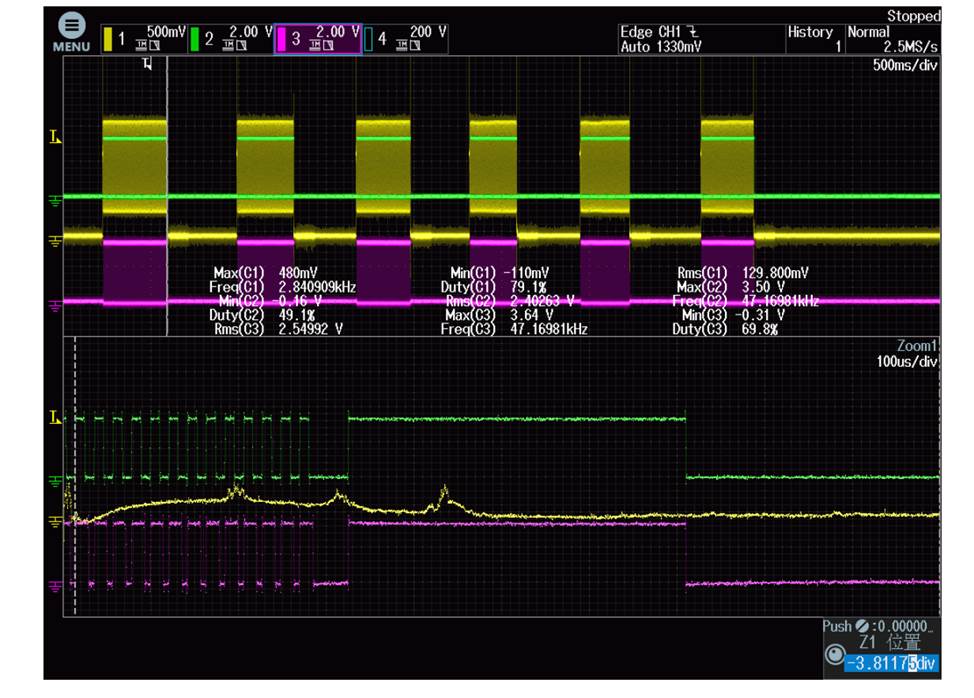
When they short the crystal to ground, two EPWM output channels go to high voltage for some time below tieded to ground.

Could you help us explain why it goes high?

Thanks

Sheldon

  • BTW, if these two EPWM channels are complementary, will there be a risk of output high voltage level at the same time to damage a half bridge?

    Thanks

  • The purple and the green are complementary PWM? because the screenshot doesn't show them to be complementary when they are both operating in the beginning.

    Nima

  • Hi Nima,

    Wave shown here is not complementary. Actually, here are two separate questions.

    Q1: Why crystal shorted to ground will make two EPWM (module or channels whatever) goes to high voltage. 

    Q2: Assume we have two complementary EPWM output, will crystal shorted to ground cause short through of a half bridge? (Due to both of channels go to high at the same tiem)

    Thanks

    Sheldon

  • Is the EPWMCLK is running from SYSCLK, when the crystal which is the source for the PLL/SYSCLK fails, the EPWM clock stops, the TBCLK stops and EPWM will get stuck in the output it was. I bet if you try it at different times, they could both get stuck at LOW level. If they are in complementary mode, this shouldnt happen. One high one low.

    Yes this is something you have to account for. Use the deadband module and set the EPWM in complementary mode. Then I would say even go a bit further and use the CLB for an extra layer of protection to make sure the two EPWM are never high right before sending them out to GPIO.

    Also since youre using F280049 you have access to a peripheral named DCC. Use DCC to check the validity of the crystal. IF the crystal is failing, DCC can catch it, and SWITCH to INTOSC. 

    Built all of these internal to your MCU if you are worried about the crystal getting shorted or failing.

    Nima