This thread has been locked.

If you have a related question, please click the "Ask a related question" button in the top right corner. The newly created question will be automatically linked to this question.

TMS320F280049C: C2000ware FSI example err

Part Number: TMS320F280049C
Other Parts Discussed in Thread: C2000WARE

I attempted to debug the FSI example in c2000ware, but when i have loaded the  software project and i compiled it , but the errors of below i cann't solved them, please help me, tks!

  • i had attempted to remove it or delete it , but it did work; 

  • Can you create a new workspace and import this example and build?

    Regards,

    Veena

  • yes, i have created a new workspace, but  it didn't work also

  • Is this happening for all examples, or specifically for this particular example?

    Regards,

    Veena

  • seem all driverlib examples have this problem; but device support examples have no problem;

  • Can you share the device.c file which you are using?

  • //#############################################################################
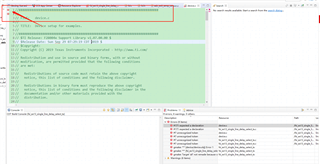
    //
    // FILE: device.c
    //
    // TITLE: Device setup for examples.
    //
    //#############################################################################
    // $TI Release: F28004x Support Library v1.07.00.00 $
    // $Release Date: Sun Sep 29 07:29:19 CDT 2019 $
    // $Copyright:
    // Copyright (C) 2019 Texas Instruments Incorporated - http://www.ti.com/
    //
    // Redistribution and use in source and binary forms, with or without
    // modification, are permitted provided that the following conditions
    // are met:
    //
    // Redistributions of source code must retain the above copyright
    // notice, this list of conditions and the following disclaimer.
    //
    // Redistributions in binary form must reproduce the above copyright
    // notice, this list of conditions and the following disclaimer in the
    // documentation and/or other materials provided with the
    // distribution.
    //
    // Neither the name of Texas Instruments Incorporated nor the names of
    // its contributors may be used to endorse or promote products derived
    // from this software without specific prior written permission.
    //
    // THIS SOFTWARE IS PROVIDED BY THE COPYRIGHT HOLDERS AND CONTRIBUTORS
    // "AS IS" AND ANY EXPRESS OR IMPLIED WARRANTIES, INCLUDING, BUT NOT
    // LIMITED TO, THE IMPLIED WARRANTIES OF MERCHANTABILITY AND FITNESS FOR
    // A PARTICULAR PURPOSE ARE DISCLAIMED. IN NO EVENT SHALL THE COPYRIGHT
    // OWNER OR CONTRIBUTORS BE LIABLE FOR ANY DIRECT, INDIRECT, INCIDENTAL,
    // SPECIAL, EXEMPLARY, OR CONSEQUENTIAL DAMAGES (INCLUDING, BUT NOT
    // LIMITED TO, PROCUREMENT OF SUBSTITUTE GOODS OR SERVICES; LOSS OF USE,
    // DATA, OR PROFITS; OR BUSINESS INTERRUPTION) HOWEVER CAUSED AND ON ANY
    // THEORY OF LIABILITY, WHETHER IN CONTRACT, STRICT LIABILITY, OR TORT
    // (INCLUDING NEGLIGENCE OR OTHERWISE) ARISING IN ANY WAY OUT OF THE USE
    // OF THIS SOFTWARE, EVEN IF ADVISED OF THE POSSIBILITY OF SUCH DAMAGE.
    // $
    //#############################################################################

    //
    // Included Files
    //
    #include "device.h"
    #include "driverlib.h"
    #ifdef __cplusplus
    using std::memcpy;
    #endif

    #define PASS 0
    #define FAIL 1

    uint32_t Example_PassCount = 0;
    uint32_t Example_Fail = 0;

    //*****************************************************************************
    //
    // Function to initialize the device. Primarily initializes system control to a
    // known state by disabling the watchdog, setting up the SYSCLKOUT frequency,
    // and enabling the clocks to the peripherals.
    //
    //*****************************************************************************
    void Device_init(void)
    {
    //
    // Disable the watchdog
    //
    SysCtl_disableWatchdog();

    #ifdef _FLASH
    //
    // Copy time critical code and flash setup code to RAM. This includes the
    // following functions: InitFlash();
    //
    // The RamfuncsLoadStart, RamfuncsLoadSize, and RamfuncsRunStart symbols
    // are created by the linker. Refer to the device .cmd file.
    //
    memcpy(&RamfuncsRunStart, &RamfuncsLoadStart, (size_t)&RamfuncsLoadSize);
    #endif

    //
    // Set up PLL control and clock dividers
    //
    SysCtl_setClock(DEVICE_SETCLOCK_CFG);

    //
    // Make sure the LSPCLK divider is set to the default (divide by 4)
    //
    SysCtl_setLowSpeedClock(SYSCTL_LSPCLK_PRESCALE_4);

    //
    // These asserts will check that the #defines for the clock rates in
    // device.h match the actual rates that have been configured. If they do
    // not match, check that the calculations of DEVICE_SYSCLK_FREQ and
    // DEVICE_LSPCLK_FREQ are accurate. Some examples will not perform as
    // expected if these are not correct.
    //
    ASSERT(SysCtl_getClock(DEVICE_OSCSRC_FREQ) == DEVICE_SYSCLK_FREQ);
    ASSERT(SysCtl_getLowSpeedClock(DEVICE_OSCSRC_FREQ) == DEVICE_LSPCLK_FREQ);

    //
    // Call Flash Initialization to setup flash waitstates. This function must
    // reside in RAM.
    //
    Flash_initModule(FLASH0CTRL_BASE, FLASH0ECC_BASE, DEVICE_FLASH_WAITSTATES);

    //
    // Turn on all peripherals
    //
    Device_enableAllPeripherals();
    }

    //*****************************************************************************
    //
    // Function to turn on all peripherals, enabling reads and writes to the
    // peripherals' registers.
    //
    // Note that to reduce power, unused peripherals should be disabled.
    //
    //*****************************************************************************
    void Device_enableAllPeripherals(void)
    {
    SysCtl_enablePeripheral(SYSCTL_PERIPH_CLK_CLA1);
    SysCtl_enablePeripheral(SYSCTL_PERIPH_CLK_DMA);
    SysCtl_enablePeripheral(SYSCTL_PERIPH_CLK_TIMER0);
    SysCtl_enablePeripheral(SYSCTL_PERIPH_CLK_TIMER1);
    SysCtl_enablePeripheral(SYSCTL_PERIPH_CLK_TIMER2);
    SysCtl_enablePeripheral(SYSCTL_PERIPH_CLK_HRPWM);
    SysCtl_enablePeripheral(SYSCTL_PERIPH_CLK_TBCLKSYNC);

    SysCtl_enablePeripheral(SYSCTL_PERIPH_CLK_EPWM1);
    SysCtl_enablePeripheral(SYSCTL_PERIPH_CLK_EPWM2);
    SysCtl_enablePeripheral(SYSCTL_PERIPH_CLK_EPWM3);
    SysCtl_enablePeripheral(SYSCTL_PERIPH_CLK_EPWM4);
    SysCtl_enablePeripheral(SYSCTL_PERIPH_CLK_EPWM5);
    SysCtl_enablePeripheral(SYSCTL_PERIPH_CLK_EPWM6);
    SysCtl_enablePeripheral(SYSCTL_PERIPH_CLK_EPWM7);
    SysCtl_enablePeripheral(SYSCTL_PERIPH_CLK_EPWM8);

    SysCtl_enablePeripheral(SYSCTL_PERIPH_CLK_ECAP1);
    SysCtl_enablePeripheral(SYSCTL_PERIPH_CLK_ECAP2);
    SysCtl_enablePeripheral(SYSCTL_PERIPH_CLK_ECAP3);
    SysCtl_enablePeripheral(SYSCTL_PERIPH_CLK_ECAP4);
    SysCtl_enablePeripheral(SYSCTL_PERIPH_CLK_ECAP5);
    SysCtl_enablePeripheral(SYSCTL_PERIPH_CLK_ECAP6);
    SysCtl_enablePeripheral(SYSCTL_PERIPH_CLK_ECAP7);

    SysCtl_enablePeripheral(SYSCTL_PERIPH_CLK_EQEP1);
    SysCtl_enablePeripheral(SYSCTL_PERIPH_CLK_EQEP2);

    SysCtl_enablePeripheral(SYSCTL_PERIPH_CLK_SD1);

    SysCtl_enablePeripheral(SYSCTL_PERIPH_CLK_SCIA);
    SysCtl_enablePeripheral(SYSCTL_PERIPH_CLK_SCIB);

    SysCtl_enablePeripheral(SYSCTL_PERIPH_CLK_SPIA);
    SysCtl_enablePeripheral(SYSCTL_PERIPH_CLK_SPIB);

    SysCtl_enablePeripheral(SYSCTL_PERIPH_CLK_I2CA);

    SysCtl_enablePeripheral(SYSCTL_PERIPH_CLK_CANA);
    SysCtl_enablePeripheral(SYSCTL_PERIPH_CLK_CANB);

    SysCtl_enablePeripheral(SYSCTL_PERIPH_CLK_ADCA);
    SysCtl_enablePeripheral(SYSCTL_PERIPH_CLK_ADCB);
    SysCtl_enablePeripheral(SYSCTL_PERIPH_CLK_ADCC);

    SysCtl_enablePeripheral(SYSCTL_PERIPH_CLK_CMPSS1);
    SysCtl_enablePeripheral(SYSCTL_PERIPH_CLK_CMPSS2);
    SysCtl_enablePeripheral(SYSCTL_PERIPH_CLK_CMPSS3);
    SysCtl_enablePeripheral(SYSCTL_PERIPH_CLK_CMPSS4);
    SysCtl_enablePeripheral(SYSCTL_PERIPH_CLK_CMPSS5);
    SysCtl_enablePeripheral(SYSCTL_PERIPH_CLK_CMPSS6);
    SysCtl_enablePeripheral(SYSCTL_PERIPH_CLK_CMPSS7);

    SysCtl_enablePeripheral(SYSCTL_PERIPH_CLK_PGA1);
    SysCtl_enablePeripheral(SYSCTL_PERIPH_CLK_PGA2);
    SysCtl_enablePeripheral(SYSCTL_PERIPH_CLK_PGA3);
    SysCtl_enablePeripheral(SYSCTL_PERIPH_CLK_PGA4);
    SysCtl_enablePeripheral(SYSCTL_PERIPH_CLK_PGA5);
    SysCtl_enablePeripheral(SYSCTL_PERIPH_CLK_PGA6);
    SysCtl_enablePeripheral(SYSCTL_PERIPH_CLK_PGA7);

    SysCtl_enablePeripheral(SYSCTL_PERIPH_CLK_DACA);
    SysCtl_enablePeripheral(SYSCTL_PERIPH_CLK_DACB);

    SysCtl_enablePeripheral(SYSCTL_PERIPH_CLK_LINA);

    SysCtl_enablePeripheral(SYSCTL_PERIPH_CLK_PMBUSA);
    SysCtl_enablePeripheral(SYSCTL_PERIPH_CLK_FSITXA);
    SysCtl_enablePeripheral(SYSCTL_PERIPH_CLK_FSIRXA);

    SysCtl_enablePeripheral(SYSCTL_PERIPH_CLK_CLB1);
    SysCtl_enablePeripheral(SYSCTL_PERIPH_CLK_CLB2);
    SysCtl_enablePeripheral(SYSCTL_PERIPH_CLK_CLB3);
    SysCtl_enablePeripheral(SYSCTL_PERIPH_CLK_CLB4);
    }

    //*****************************************************************************
    //
    // Function to disable pin locks and enable pullups on GPIOs.
    //
    //*****************************************************************************
    void Device_initGPIO(void)
    {
    //
    // Disable pin locks.
    //
    GPIO_unlockPortConfig(GPIO_PORT_A, 0xFFFFFFFF);
    GPIO_unlockPortConfig(GPIO_PORT_B, 0xFFFFFFFF);
    GPIO_unlockPortConfig(GPIO_PORT_H, 0xFFFFFFFF);
    }

    //*****************************************************************************
    //
    // Error handling function to be called when an ASSERT is violated
    //
    //*****************************************************************************
    void __error__(char *filename, uint32_t line)
    {
    //
    // An ASSERT condition was evaluated as false. You can use the filename and
    // line parameters to determine what went wrong.
    //
    ESTOP0;
    }

  • I use 280049c

  • and the device.c also has error:

  • I am unable to reproduce the error. It could be because one header file got modified. If possible, can you rerun the C2000ware installer?

    I would recommend moving to the latest C2000ware.

    Regards,

    Veena

  • i install the newest C2000ware ,but the error still exist; Is it a configuration issue? why device support example work ok

  • Which CCS version are you using? Can you install the latest CCS version?

    Regards,

    Veena

  • this is no relationship with CCS version; since i use CCSV9 and CCSV10.1.1, problem still exist;

    maybe some config must to set

  • That's weird. What kind of bug does it feel like

  • hi Veena, i have found the solution, look below, but i don't know why the defualt OUTPUT of example you TI set is "ELF" not "COFF"

  • The examples present in f28004x can be compiled in both EABI and COFF format. COFF is the older format. For the newer devices, we only support EABI format. From the compiler perspective, the new features are implemented in EABI, which may not be present in the COFF format.

    Hence it is recommended to use EABI. Not sure why this has resolved your issue

    There were similar issues reported while using UTF-8 encoding.

    Regards,

    Veena

  • but why i select ELF and the error exist;  what's your select? did you repeat the question to use"UTF-8"?

    Why does my problem appear? Is it an individual case?

  • I used both formats, and it is compiling fine. I will notify the compiler experts about this issue.

  • ok,Looking forward to your expert's reply

  • I do not understand why changing from EABI to COFF fixed the problem.  

    Please put the project back in the state where the unexpected error diagnostics occur.  Then add the compiler option --verbose_diagnostics.  That causes the compiler to echo the problem source line with a marker to where the problem begins.  This appears in the Console view, and not the problems view.  Please tell us what you find.

    Thanks and regards,

    -George

  • According to your instructions, the error display below: now I suspect this is caused by our company's encryption system, may not your TI's bug; 

  • yes ,our IT engineer have solved the problem, thank you very much for all guys help!!