This thread has been locked.

If you have a related question, please click the "Ask a related question" button in the top right corner. The newly created question will be automatically linked to this question.

TMS320F280049: Anti-Aliasing on analog inputs

Part Number: TMS320F280049
Other Parts Discussed in Thread: BOOSTXL-3PHGANINV

What is the recommendation for anti-aliasing filters on the analog inputs for the measured motor current? I am not able to find information on the required amount of attenuation and the eval board examples don't seem to have much of any filtering on these lines.

For example, the BOOSTXL-DRV8320 eval board has the following inputs for current. Is the assumption that the current will be inherently filtered by the motor windings for most applications? And since there are over current protections that use these  inputs do you advise keeping the bandwidth on these channels very wide? Is there a recommended maximum bandwidth? 
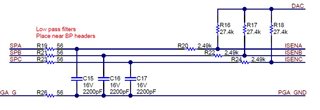
The BOOSTXL-3PHGANINV eval board has a similar RC filter on it's input.

Thanks.

  • Hi Gabe,

    Have a look at the following app. notes:

    https://www.ti.com/lit/an/spract6/spract6.pdf 

    https://www.ti.com/lit/an/spracv0/spracv0.pdf   

    Generally, the drive stage of the ADC needs to have high bandwidth to ensure the S+H can be settled in a reasonable time (SPRACT6).  If you want an anti-aliasing filter or some other heavy low-pass filtering, you'd need to build it in a previous signal conditioning stage. 

    The exception to this is if you are using a "charge sharing" input design (ADC input design with a very large capacitor) you can sometimes get away with getting heavy low-pass filtering, sometimes up to a true anti-aliasing filter (see SPACV0).  The caveat here is that charge-sharing imposes a limitation on the maximum sample-rate on that particular pin.

    I'm not sure on the specific bandwidth needs for the signal of interest for current sensing in motor control.  I can pull in a motor control expert if the app. notes above don't fully answer your question. 

  • Hi Devin, Thanks for the app note references, those will help me confirm my design choices, but I would like for someone familiar with the instaspin processor to weigh in on the need for anti-aliasing for a motor drive application with this processor. I understand that if incorporated, it would need to occur in a previous filter stage and that approach is preferred to the charge sharing suggested for my application. It would appear as though anti aliasing is not important based on the eval board designs referenced above, but that goes against general design practices as motor drives can inherently generate significant EMI. 

  • Hi Gabe,

    As Devin mentioned above, you might select the RC filter according to the ADC, and the cut-off frequency of the RC filter should be far higher than the phase voltage filter pole.