Hi,
I am encountering something that is a bit baffling and am hoping someone could clarify.
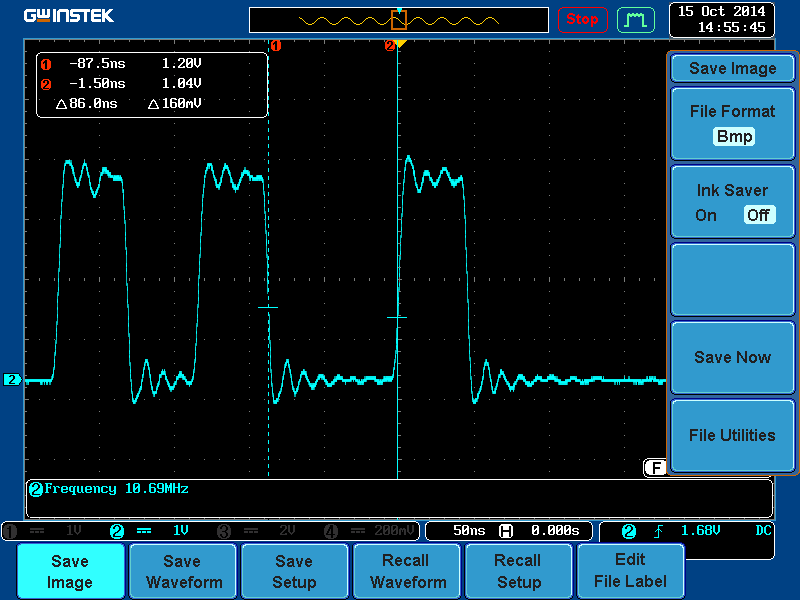
I am running a bit of code in an interruption and it is taking longer than I am expecting to execute when I check on my oscilloscope I also checked using the clock feature in debugger mode to see how many clock cycles it is taking to execute an instruction, which I have included in the comments. This is the code in question:
// Interrupt routines uses in this example:
#pragma CODE_SECTION(epwm_timer_isr, "ramfuncs");
interrupt void epwm_timer_isr(void)
{
   //EPwmTimerIntCount++;
	GpioDataRegs.GPBTOGGLE.bit.GPIO32 = 1; //1 cycle - 49ns
	GpioDataRegs.GPBTOGGLE.bit.GPIO32 = 1; //1 cycle - 49ns
	GpioDataRegs.GPBTOGGLE.bit.GPIO32 = 1; //1 cycle - 49ns
	GpioDataRegs.GPBTOGGLE.bit.GPIO32 = 1; //1 cycle - 49ns

	aux = GpioDataRegs.GPCDAT.all;         //3 cycles - 86ns

	GpioDataRegs.GPBTOGGLE.bit.GPIO32 = 1; //1 cycle - 49ns
	GpioDataRegs.GPBTOGGLE.bit.GPIO32 = 1; //1 cycle - 49ns

   // Clear INT flag for this timer
   EPwm1Regs.ETCLR.bit.INT = 1;

   // Acknowledge this interrupt to receive more interrupts from group 3
   PieCtrlRegs.PIEACK.all = PIEACK_GROUP3;
}
I am running this code off of RAM after transferring from FLASH. I also checked running only from RAM and the behavior is the same. I have also checked putting that bit of code directly into the main loop and disabling the interrupts and the behavior is the same. I would expect to see the time it takes to toggle on and off that pin should be about 7ns. Can anyone help me figure out what may be going on?
I am including more code so you can see how I have setup the main portion:
#include "DSP28x_Project.h"     // Device Headerfile and Examples Include File

// Prototype statements for functions found within this file.
interrupt void epwm_timer_isr(void);


#define FLASH 1

#define CPU_CLOCK_HZ     150000000UL
#define wait_usec(us) DSP28x_usDelay((us)*(CPU_CLOCK_HZ/1000000UL/5)-2)

// Global variables used in this example
Uint32  EPwmTimerIntCount;
int aux;
float x = 1;
float w = 0.35;
float z = 2.5;

int main(void) {
	// Step 1. Initialize System Control:
	// PLL, WatchDog, enable Peripheral Clocks
	// This example function is found in the DSP2833x_SysCtrl.c file.
	   InitSysCtrl();

	// Step 2. Initalize GPIO:
	// This example function is found in the PTEL2_Gpio.c file and
	// illustrates how to set the GPIO to it's default state.
	   InitGpio();

	// Step 3. Clear all interrupts and initialize PIE vector table:
	// Disable CPU interrupts
	   DINT;

	// Initialize the PIE control registers to their default state.
	// The default state is all PIE interrupts disabled and flags
	// are cleared.
	// This function is found in the DSP2833x_PieCtrl.c file.
	   InitPieCtrl();

	// Disable CPU interrupts and clear all CPU interrupt flags:
	   IER = 0x0000;
	   IFR = 0x0000;

	// Initialize the PIE vector table with pointers to the shell Interrupt
	// Service Routines (ISR).
	// This will populate the entire table, even if the interrupt
	// is not used in this example.  This is useful for debug purposes.
	// The shell ISR routines are found in DSP2833x_DefaultIsr.c.
	// This function is found in DSP2833x_PieVect.c.
	   InitPieVectTable();

#ifdef FLASH
	// Section ramfuncs contains user defined code that runs from RAM
	   memcpy(&ramfuncs_runstart, &ramfuncs_loadstart, (Uint32)&ramfuncs_loadsize);

	//--- Initialize the Flash and OTP
	   InitFlash();						// Initialize the Flash
#endif //(FLASH)

	// ISR functions found within this file.
	   EALLOW;  // This is needed to write to EALLOW protected registers
	   PieVectTable.EPWM1_INT = &epwm_timer_isr;
	   EDIS;    // This is needed to disable write to EALLOW protected registers

	// Initialize the PWM
	   InitEPwm();

	// Initalize counters:
	   EPwmTimerIntCount = 0;

	// Step 4. User specific code, enable interrupts:
	// Enable CPU INT3 which is connected to EPWM1-6 INT:
	   IER |= M_INT3;

	// Enable EPWM INTn in the PIE: Group 3 interrupt 1-6
	   PieCtrlRegs.PIEIER3.bit.INTx1 = 1;

	// Enable global Interrupts and higher priority real-time debug events:
	   EINT;   // Enable Global interrupt INTM
	   ERTM;   // Enable Global realtime interrupt DBGM

	// Step 5. Loop and execute functions forever.
	   for(;;)
	   {

	   }
}
If you need any further information please advise.
Thanks,
-Alex