Part Number: MSP430FR2355
Dear expert,
I would appreciate if you would give me comment how to think sink current for ADC input pin.
This thread has been locked.
If you have a related question, please click the "Ask a related question" button in the top right corner. The newly created question will be automatically linked to this question.
Part Number: MSP430FR2355
Dear expert,
I would appreciate if you would give me comment how to think sink current for ADC input pin.
Hi Ryo,
There is no direct specification for this.
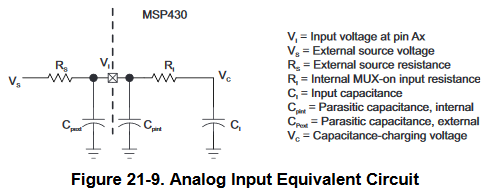
The input to the ADC through the mux looks like the diagram below (user guide, section 21.2.5.3) where the value for Ri is 2k (datasheet, section 5.12.9). The sink current is determined by Rs and Ri and the applied voltage on the analog pin.
Does this help answer your question?
Each sample will require a little bit of current to charge the sampling capacitor. Average current will depend on sample rate.
It sounds as though the voltage divider will have a high enough resistance so that the time to charge the sampling capacitor will exceed the sampling time. (You can control that via ADC configuration.) Which means that you need to add a buffer amp.
In some cases with low sampling rates, a small external capacitor can be used to the same effect. It charges between samples and provides a low resistance source during sampling. Size needs to be large enough compared to the sampling capacitor so you don't get errors but not so large that it can't recharge between samples.
Hello Dennis-san,
Hello David-san,
I have no idea if your source resistance will work because I don't know what it is. In any case, the analysis required is Circuits 101 stuff that any EE student can do.
Dennis didn't mention this explicitly, but that User Guide section (21.2.5.3) contains a formula which you can use to compute the required sample/hold time. From that and your ADC clock speed, you can compute the required ADCSHT setting.
Hello Bruce-san,
Thank you for your reply.
I understand we can estimate required sample/hold time with using equation (14).
Thanks and best regards,
Ryo Akashi
**Attention** This is a public forum