This thread has been locked.

If you have a related question, please click the "Ask a related question" button in the top right corner. The newly created question will be automatically linked to this question.

MSP-GANG: unexpected voltage at Testpoints

Other Parts Discussed in Thread: MSP-GANG

We are reading incorrect voltages at certain test points and we are investigating if they are caused by the MSP-Gang programmer.

TI Could you please answer a few questions concerning MSP-Gang Programmer:

We’d like to know more about the logic translator circuit used inside the MSP-GANG programmer. The schematic in the User Guide shows a power rail (VTIO) as the power supply to the target-side of the logic translator circuit. What we would like to know is:

1.       How is this voltage level set when an external power supply is used to power the target?

a.       It is not clear how VTIO is set to match the voltage on Vext

2.       What happens when some targets are using one voltage level and other targets are using a different voltage level?

a.       Will VTIO adjust depending on which target is being programmed?

b.      Is this handled within TI’s GUI?

3.       What logic level does VTIO go to when the programming process is complete?

a.       Is there a way to set VTIO_EN from the GUI to turn off VTIO?

                                                               i.      Does it do this automatically or is there a manual setting to turn off VTIO?

b.      What happens to VTIO when the GUI is closed?

Thanks

Richard

  • Hi Richard,

    I'm checking on these items for you and should have some information shortly.

    Thanks,
    Walter

  • Hi Richard,
    We’d like to know more about the logic translator circuit used inside the MSP-GANG programmer. The schematic in the User Guide shows a power rail (VTIO) as the power supply to the target-side of the logic translator circuit. What we would like to know is:

    1.       How is this voltage level set when an external power supply is used to power the target?

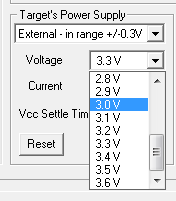
            When using an external supply, it is necessary to specify in the MSP-GANG programmer that an external supply is being used.  The VTIO voltage is set by the MSP-GANG.  You specify this value to the MSP-GANG.  Below is an image of what this would look like in the GUI.  You must specify this value to be within 300mV of the externally supplied target voltage, or an error will be thrown by the MSP-GANG.

    You can also select "External - Whole Range" as a power supply option- here, the MSP-GANG will not require the +/- 300mV range- but errors in JTAG communication may occur.  Below is a snapshpot from the MSP-GANG User's Guide discussing the procedure for using an external supply.

    a.       It is not clear how VTIO is set to match the voltage on Vext

            It is set manually to be within the range of the external supply voltage.  Please see the above information.

    2.       What happens when some targets are using one voltage level and other targets are using a different voltage level?

            Based on reviewing the schematic, I do not believe that programming multiple targets supplied by external supplies at different voltages would be supported.  This is because the logic translator adjusts the logic levels for all 8 devices at the same time.  I'm going to check with the designer to verify this, and I will get back to you.

    a.       Will VTIO adjust depending on which target is being programmed?

    b.      Is this handled within TI’s GUI?

    As all targets are programmed in parallel, VTIO does not adjust between targets.

    3.       What logic level does VTIO go to when the programming process is complete?

    a.       Is there a way to set VTIO_EN from the GUI to turn off VTIO?

                                                                   i.      Does it do this automatically or is there a manual setting to turn off VTIO?

    b.      What happens to VTIO when the GUI is closed?

    I will check on thesefurther.  I would assume that VTIO remains at the level specified in the GUI.

  • Richard,

    Here is the follow-up information:

    To answer your questions about the state of the IO lines, when programming is finished all of the IO lines enter a tri-state mode (High-Z).

    With regard to external power modes, here are two modes for handling externally powered targets:

    1. If “external – in range +/-0.3V” is selected in the GUI, then VTIO is set as the expected VCC that is specified in the GUI- this is for all targets.

    2. If “external – whole range” is selected in the GUI, then each V-Ext sensing input is sampled by the MSP-GANG.  VTIO is then set to the average of all the V-Ext measurements.  For example, if you had one device running at 3.0V and one running at 2.0V, VTIO would be set to 2.5V.  This could be problematic if your connected devices vary greatly in voltage.


    Walter

  • Thanks Walter that information is very useful to us.

    I have a followup question

    If external - whole range is used, will the VTIO adjust automatically in the case where the target MCU's VCC voltage changes during programming operation or is the VTIO's voltage only set once at the beginning and will not re-adjust during the programming operation.

    Richard.

  • Richard,

    The VTIO is set at the beginning.
    During programming, the device Vcc-Ext input is monitored for being "Too High," "Too Low," or "OK."  The status is then reported back.

    Do you have targets with varying voltage rails during programming?

    Walter

  • Yes in a circumstance it will start at 1.9V and after reset it will move to 3.1.

  • Hi Richard,

    It is not recommended that the voltage change during your programming sequence, especially so drastically - this will cause problems (as I think you have seen). I believe this is probably the root cause of your problems with the MSP-GANG. You will need to make sure that your boards are at a known voltage for programming and won't change partway through - maybe you will need to do something that puts your system into a programming state where it won't be doing this kind of switching with the voltage. But this is something you will have to handle in your application design to get it to work with the tool. I think you would see a similar problem if your voltage does a large change, no matter what programming tool you use. Alternately if you don't want to change your system at all you may need to pre-program your parts instead before putting them on this board.

    Regards,

    Katie

  • Thanks Katie, your responses have been very useful.


    We have placed a voltage translator on the SBW interface signals to prevent the programmer from seeing the voltage change.

    Due to the bi-directional of the voltage translator it is not able to drive the timing capacitor on the SBW reset/data cleanly. We want to know if we can remove the timing capacitor completely, and whether the MSP430 will power up and come out of reset properly?

    If a timing capacitor is required what is the minimum value?

    Richard

  • Hi Richard,

    Are you referring to the capacitor on RST/SBWTCK? This capacitor has no minimum value for programming, and can actually be left off - the important thing for the programming is that the max 2.2nF is not exceeded, and there is no minimum value.

    However for normal device operation, this is more of a system-level application consideration. Your part should be able to startup and run without the cap, but typically we recommend having some capacitance there simply to help make the RST line more robust against any glitches or noise potentially resetting the part during operation that could cause RST to drop low momentarily - the cap is there just to help smooth these out if possible. This risk in your particular application is something you will have to assess - it will depend on how you have RST connected, if you have anything hanging off of it (any long traces for example that could pick up noise) and what kind of environment you would be running in, and considering how big of an impact or not an unexpected reset from the RST line would have in your application. I hope that helps give enough insight into the purpose of the RST cap to help you make an informed decision based on your particular application situation and constraints.

    Regards,

    Katie

**Attention** This is a public forum