This thread has been locked.

If you have a related question, please click the "Ask a related question" button in the top right corner. The newly created question will be automatically linked to this question.

EVM430-F6736: EVM430F6736

Part Number: EVM430-F6736
Other Parts Discussed in Thread: TPS5401, , MSP-FET

Hi. I just received my EVM430F6736 test module and I do have some questions about it. If I am to supply it 220 VAC, where do I plug on the terminal lugs? because the wires from the LINE/NEUTRAL source is not connected to the terminal lugs. Please help. Also, I noticed that the AGND is shorted with the DGND is it ok? Thank you.

  • Hello Nereo,

    Nereo Pe said:
    Hi. I just received my EVM430F6736 test module and I do have some questions about it. If I am to supply it 220 VAC, where do I plug on the terminal lugs? because the wires from the LINE/NEUTRAL source is not connected to the terminal lugs. Please help.

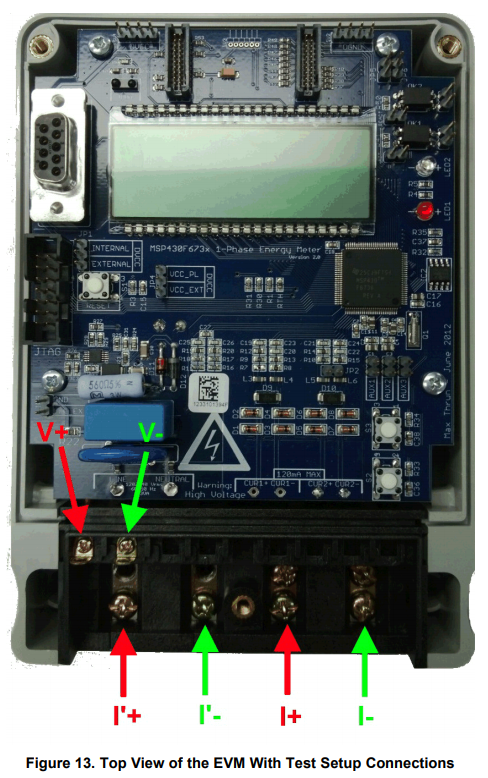
    Are you using a test setup that can provide independent RMS voltages and currents? If so, you'll want to connect Line (220VAC) to V+ and then Neutral to (V-) on top of the terminal block. For the current, you'll want to connect across I+ and I-. These connections can be seen in Figure 13 in the User's Guide.

    If you're not using a test setup and want to connect an actual load (versus the simulated load by the test setup), you'll have to connect to the EVM differently. If so, please refer to Figure 2 in the User's Guide. Basically, you'll want to connect Line (220VAC) to I+. Then, connect I- to V+ and one side of your load. Connect the other side of your load and V- to Neutral. Obviously, the wires connected from Line through I+, I-, your load, and back to Neutral will need to handle the current consumed by your load. The connections to V+ and V- are for sensing Line and referencing Neutral, so they aren't going to be carrying the current of the load.

    In Figure 2, it appears that the "I1+/-" notations should be reversed with "I2+/-" connections as shown in the schematic. At the top of page 17 in the User's Guide, it mentions that although the EVM hardware and software supports measurement for a second current channel, the EVM obtained from Texas Instruments does not have the second sensor and any current inputs must be connected to I+ and I- only. If additional sensor needs to be placed, please use the two bottom left slots close to terminals I’+ and I’-. Additional connections need to be made to connect the output of these sensors to points CUR1+ and CUR1- on the PCB.

    Nereo Pe said:
    Also, I noticed that the AGND is shorted with the DGND is it ok? Thank you.

    Yes, this is fine. AGND and DGND have separate pours on the same plane, but they are connected through R22 and L2, whose values can be adjusted based on any encountered noise.

    As always, please be careful and follow all our cautions and warnings when working with High Voltage.

    Regards,

    James

    MSP Customer Applications

  • Hi!
    Thank you for your prompt reply to my inquiry yesterday. I have another concern right now, I noticed on the schematic diagram that I've downloaded, the DVCC appears to be from an external source and it doesn't seem to be connected to the power block. Please confirm.
  • Hello Nereo,

    DVCC can be derived either via JTAG, external power or the ac mains through the capacitive power supply. Various jumper headers and jumper settings are present to add to the flexibility to the board. Please refer to Section 5.1.2 and Table 1 in the User's Guide.

    Regards,

    James

    MSP Customer Applications

  • Hi James,

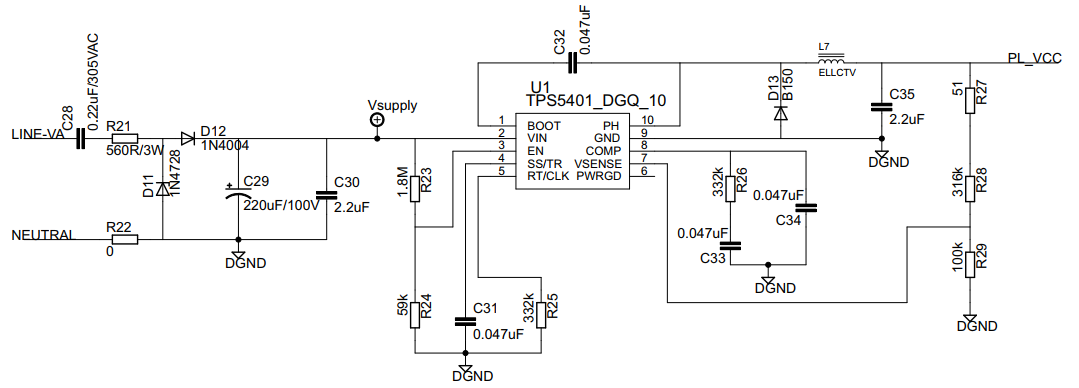
    I've tried your suggestion on powering the EVM and i'm still getting the same result. Furthermore, I've supplied 22VAC to the V+ and V- terminals then measured the DC voltage going to the TPS5401. The input voltage going to the requlator is 39VDC but i'm not getting any power on the R27 node. I also supplied 3.6VDC from an external to check the LCD and it worked. Are there any problem on my DC Regulator?

    Thank you.

    Nereo Pe Jr., ECE
    R&D Engineer
  • Hello Nereo,

    Did you mean to type 220VAC instead of 22VAC? If you're measuring 39VDC at the TPS5401, then I would assume it's 220VAC. If you have JP4 set to PL_VCC and 220VAC applied, you should be measuring 3.3VDC to 3.6VDC at R27. Could any of the components surrounding the TPS5401 be damaged or are missing? Is there a possibility that the output was shorted to GND?

    It may be helpful to refer to the datasheet of the TPS5401 during your debug efforts.

    Regards,

    James

    MSP Customer Applications

  • Hi James,

    Sorry I supplied 220VAC not 22VAC on the EVM. We don't see any issues on the input side of TPS5401 wherein we're getting 39V but the output side doesn't still provide any voltage. I've also checked the components surrounding the TPS5401 and I don't see any problem. It seems that the TPS5401 is defective and we look forward to get my EVM replaced thru Mouser Electronics.

    Thank you.

    Nereo Pe Jr., ECE
    R&D Engineer
  • Hi Nereo,

    Thanks for the update. Please let me know if you have any more issues.

    Regards,

    James

    MSP Customer Applications
  • Hi James,

    How do i go about the repair/replacement of our evaluation kit? we need to make this work ASAP.

    Thank you.


    Nereo Pe Jr., ECE
    R&D Engineer
    (+63)9153115602
  • Hello Nereo,

    I would recommend checking the resistors related to the TPS5401. Refer to the schematic for the correct values. Unfortunately, I suspect that resistors with wrong values were placed incorrectly when the EVM was manufactured.

    These resistors include:

    • R23 (1.8M)
    • R24 (59k)
    • R25 (332k)
    • R26 (332k)
    • R27 (51)
    • R28 (316k)
    • R29 (100k)

    Try replacing these and see if the TPS5401 works. If that still doesn't work, please let me know.

    Regards,

    James

    MSP Customer Applications

  • Hi James,

    If ever the resistors or the IC were found to be defective, am I allowed to get these components replaced? This procedure will void the warranty of the EVM. I just want to be sure since I cannot just remove this components on the board.

    Thank you.


    Nereo Pe Jr., ECE
    R&D Engineer
    (+63)9153115602
  • Hello Nereo,

    I'm working through this issue and will keep you updated.

    Regards,

    James

    MSP Customer Applications
  • Hello Nereo,

    I recently received a new EVM430-F6736 myself, and I've encountered a similar issue. I'm debugging it now.

    Unfortunately, I'll be out of office over the next few days, so as a temporary workaround to help keep your development moving, you could connect a battery (e.g. Li-Ion which can output around 3.6V) to the VCC_EXT and GND pins of JP3 and change JP4 from VCC_PL to VCC_EXT. This would allow you to connect the EVM to high voltage more safely than using an external bench power supply applied to VCC_EXT and GND pins of JP3. If a battery is used, you'll want to make sure that the output voltage doesn't exceed the max input voltage for the MSP430. Also, I'd monitor the battery voltage while powering the EVM. If the supply voltage changes too much, you'll need to re-calibrate the meter, but for general testing this should work.

    When you're not connected to high voltage, you can always re-configure the EVM to get powered by the MSP-FET for general code development/debugging work.

    I'll keep you posted.

    Regards,

    James

    MSP Customer Applications

  • Hi James,

    My department head would want to go about our warranty claims for our product. How do we go about it.

    Thank you.

    Nereo Pe Jr., ECE
    R&D Engineer
    (+63)9153115602
  • Hello Nereo,

    Please reach out to Mouser first, since that’s where the EVM was purchased. If they are unable to help you, please let me know as soon as possible.

    Regards,

    James

    MSP Customer Applications
  • Hi James,

    I was referred by mouser to your side since it has to do with the hardware of the device.

    Thank you.

    Nereo Pe Jr., ECE
    R&D Engineer
    (+63)9153115602
  • Hello Nereo,

    I'll reach out to you directly.

    Regards,

    James

    MSP Customer Applications

**Attention** This is a public forum