This thread has been locked.

If you have a related question, please click the "Ask a related question" button in the top right corner. The newly created question will be automatically linked to this question.

DRV8462EVM: Complete EVM with CPU that can support custom application for attached motor

Part Number: DRV8462EVM
Other Parts Discussed in Thread: DRV8462, DRV8711EVM,

Hello.

Can someone from TI please tell me if the above part number would support the following stepper motor?  I would like to find the correct platform EVM to develop my application on.

Thank you

https://www.omc-stepperonline.com/p-series-nema-23-stepper-motor-2nm-283-28oz-in-with-electromagnetic-brake-23bk20-20

  • Hi Steve, 

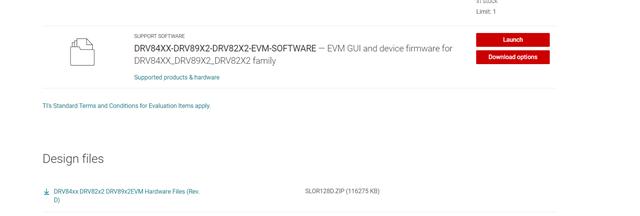
    The DRV8462 is compatible with the motor as it can support up to 5 A full scale current. The hardware and firmware files for the EVM can be found in the EVM page:

    DRV8462EVM Evaluation board | TI.com

    What is the application? The DRV8462 has a lot of features that could help with the application. Here is a good app note on autotorque and its benefits:

    System Efficiency Improvement With the DRV8452 and DRV8462 (ti.com)

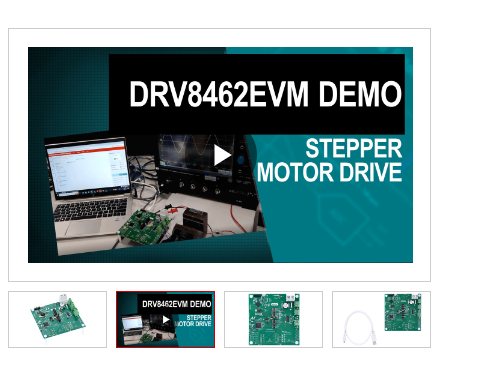
    There is also a good demo video of EVM and the GUI on the EVM page:

    Best,

    Keerthi

  • Hello Keerthi....

    My concern is the spec sheet calls out 5.6A / phase.  When a stepper is driven there is a sequence where both phases will be supplied power.  Wouldn't this require 2 * 5.6A for a driver capability?

  • Hey Steve,

    Check out the DRV8462 datasheet - https://www.ti.com/lit/ds/symlink/drv8462.pdf  You'll see the DDW package (DDV hasn't released yet) supports 5A Full-Scale or 3.5A RMS.  

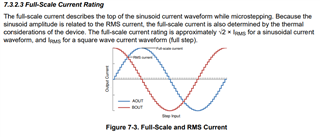
    See the below chart about how our Full-Scale vs RMS current is specified for microstepping:

    So you are correct, this driver cannot run your given motor at its 100% full potential.  However, there won't be a time needing 2 * 5.6A, the max should be 5/6A / √2 = 3.96A.  

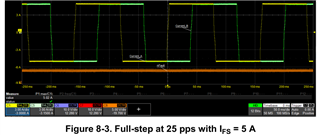
    That said, you're correct if you were to use Full-Step mode with that motor, there is a time where both outputs are at 100% on (see where yellow and green overlap)

    This driver would still be able to run your motor near peak performance.  Unless your motor is under heavy load near stall condition it probably won't need to draw its full stall current. 

    Beyond the DRV8462, you'll probably need a Gate Driver stepper motor driver such as DRV8711.  

    Best,

    Jacob

  • Hello Jacob...

    So can you tell me if the DRV8711EVM would support testing and Proof Of Concept for the mentioned motor?  (It appears the CSD18531 mosfets can handle the 5.6A)....This will be, most likely, a Half Step Drive system.  

    I would also want to ensure that application code could be put onto the development processor on that EVM?

    thanks

    Steve

  • Hey Steve,

    Yes, either DRV8711EVM or DRV8462EVM would support that testing.  Personally I recommend DRV8462, as it is a much more modern motor driver and will soon have the DDV package released that supports 10A full-scale with external heatsink.  

    I would also want to ensure that application code could be put onto the development processor on that EVM?

    You can find the source code for either EVM on their product page.  You would download that source code, download Code Composer Studio and open that project, make your changes, and flash it to the board.  Note that you would be limited to using the MSP430 model on the EVM board if you go that route. 

    Alternately, many people use the EVM as hardware-only and jump all the signals from the EVM to their microcontroller.  Simply remove all the jumper shunts on the main header on the board to disconnect the signals from the MSP430 to the motor driver, and place a jumper wire on the motor driver side of the header using your MCU signal.  That way you can write code for your own platform.  If you go this route, it is easiest to first get the motor up and spinning with the nice interactive web GUI (ex. https://dev.ti.com/gallery/view/MotorDriversBSM/DRV84xx_DRV82x2_DRV89x2-EVM-GUI/ ) to quickly adjust any register settings you want.   Note down all the register values.  Then in your code just write all those values to the device - ex. SPI_Write(0x00, 0x50); SPI_WRITE(0x01, 0xFF); etc. 

    These EVM's are not for production use per their terms, but are designed for prototype testing proof of concept like you say.  

    Best,

    Jacob