This thread has been locked.

If you have a related question, please click the "Ask a related question" button in the top right corner. The newly created question will be automatically linked to this question.

DRV8262: DRV8262

Part Number: DRV8262


Tool/software:

Hello, 

I know that there is DDV package for DRV8262 and its EVM with a big heatsink. 

Dose this EVM (DRV8262 DDV package) use of heatsink as main source of dissipating the heat? I was initially thinking of using DDW package and I know that its EVM does not require heatsink as it uses copper layer of PCB to dissipate the thermal dissipation (please correct me if I am misunderstanding). If I want to dissipate the heat properly and be able to drive about 5A at DC by using single H-bridge to drive brushed DC motor, how smaller can PCB possibly be sized? I know DDW package has been simulated with a certain size of copper (around 110mm x 80mm) without heatsink. Is it possible to design with 50mm x 50mm (either with DDV or DDW) of PCB with an external heatsink assuming that I have enough room for adding heatsink? Or would it be possible to design for my application (5A DC) with higher PCB layer count, for example, 6 layer or 8 layers if necessary. I currently don't have thermal simulation tool with me so It's hard to anticipate the result, but I wanted to see feasibility before proceeding with the design.  

Thanks

  • Hi Jake,

    Thanks for your post.

    The DDW package thermal performance and hence continuous DC current at a specific VM voltage level depends on the PCB thermal dissipation capabilities which would include 2-oz copper for the top and bottom layers for maximum dissipation as in our EVM and also the inner layers and the area of copper that dissipates the heat as well as the ambient temperature TA. See below thermal transient information from the datasheet. This is data simulated using the conditions and PCB mentioned in the footer of the table. Based on this table you can see by using Single H-Bridge i.e. both H-Bridges connected in parallel, you can 4.9 A DC at VM = 48 V, the device will be running pretty hot (over 100 °C) under this condition. Any smaller dimension of the PCB area and if not using 2-oz Cu for top and bottom the thermal performance will be significantly lower and the device cannot support this level of DC current. 

    You can also perform calculation using the power loss calculations formula in section 7 Application and Implementation, in the datasheet

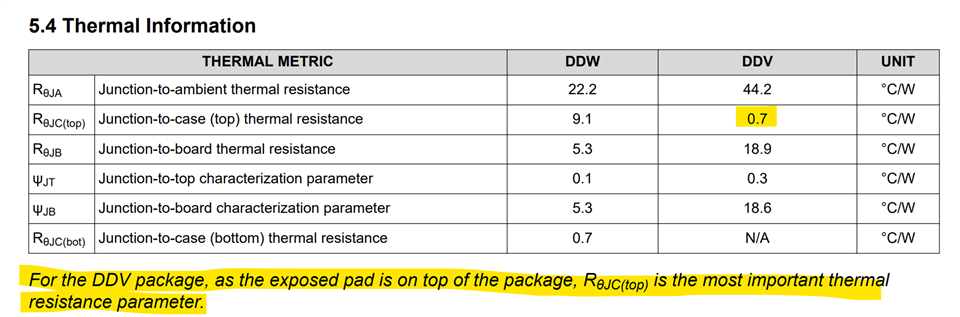
    The DDV package requires externally mounted heatsink. It cannot be used without an heatsink. In the DDV package the heatsink is the primary source of heat dissipation. See below thermal information from the datasheet. Except for RθJC(top) thermal resistance all other thermal resistances of the DDV package is much higher than the DDW package, and must not be used without an heatsink in an application. It is also important there is good air movement around the heatsink. If the TA is much higher than 25 °C, a fan may be necessary to maintain air movement that can effectively remove hot air from around the heatsink fins. 

    Likewise, DDW package cannot support a top mounted heatsink because its RθJC(top) is higher resistance and does not conduct heat effectively. The main dissipation interface is the thermal pad at the bottom of the package. Thank you.

    Regards, Murugavel 

  • Hi again Murugavel, 

    so, If I decided to go with PCB size of 70mm x 70mm with DDV package and as long as I use proper heatsink size (probably not as big as one used in EVM for DDV) and proper copper thickness & dimension, I shouldn't really see an issue with damaging the part. Is this correct understanding? I am planning on using 5C/W heatsink on top of DDV package but I wasn't sure how effective it is when PCB board size itself is only 70mm x 70mm whereas your EVM has much larger dimension. 5C/W heatsink seems to be feasible with the PCB size. I mean everything needs to be simulated and tested in the lab later, but I wanted to make sure that my approach is appropriate.