This thread has been locked.

If you have a related question, please click the "Ask a related question" button in the top right corner. The newly created question will be automatically linked to this question.

DRV8220: DRV8220

Part Number: DRV8220


Tool/software:

using the DRV8220 in PH/EN Mode with low duty cycle will go to auto sleep in "normal operation"

I drive a small DC Motor with direction contol connected to PH and a 8bit PWM to the EN Pin of the driver. Mode and Sleep is µC controlled by constant set to high during initialisation.

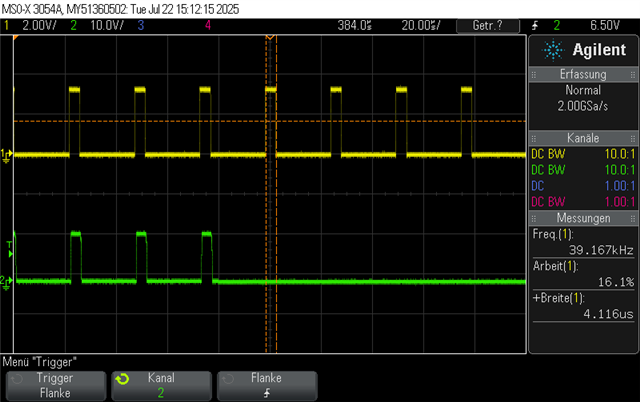
typical PWM frequence is 10kHz. If the the high periode is less than 4.5µs the driver go to sleep, if duty is increased to >16µs the driver will restart. frequency on the PWM = EN Pin is constantly running.

If i change to 20 or 40Khz the problem increases as i can only use the dutycycle >80%.

This was not expacted after reading the datsheet. What is the minimum PWM Pulse-width the device can handle? 

  • DRV8220 start hbridge out at 16.35us input pulse.pngDRV8220 stop hbridge out at 4.11us input pulse.png EN-Signal PWM input (yellow) and OUT1(green) while changeing the duty cycle

  • Hi Christian,

    I verified this same behavior in the lab. I'm looking into the reason for this and will reply later today. 

    Best,

    David

  • Hi Christian,

    A delay of around 5 microseconds is being introduced on the INx pins, resulting in any pulse width less than 5 microseconds being ignored. As a consequence, even though the 1pin is actively toggling with PWM, the auto-sleep timer incorrectly interprets both INx pins as being in a low state (0). This ultimately leads to the device shutting down after the auto-sleep timer expires (approximately 13 cycles or 1.3 milliseconds).

    If you are looking for a device that doesn't see this behavior, I would suggest looking at the DRV8231 for full range of duty cycle without autosleep. 

    Best,

    David

  • Hello David,

    thanks for the information. However, I still miss this important information in the datasheet so I could have avoided this in advance. The suggested alternative component would actually work well for us.

    My Solution for the DRV8220:

    Yesterday, I set the mode (MODE=0) to PWM mode and updated the firmware. Since IN1 or IN2 is now always high, I can fully utilize the inverted PWM on the respective other line at 78 kHz.

    Perhaps others will discover this hint in time.