This thread has been locked.

If you have a related question, please click the "Ask a related question" button in the top right corner. The newly created question will be automatically linked to this question.

TPS61202: Too High output ripple when Vin > (Vout - 200 mV) - Look for solution or alternative IC

Part Number: TPS61202
Other Parts Discussed in Thread: TPS61022, TPS63802, TPS61023

Hello,


We are looking for a boost converter with following specifications:


Vin = 5.20V to 1.50V

Vout = 5V , 200 mA


The input voltage of the boost converter (Vin) is the 5V external power input of a video processing module.

The output of the boost converter is used to supply power to electronics that must work properly during the ramp down of the input voltage (non-planned power input loss)

Our target is to still have 5V (with 200 mA source capability) until Vin reach 1.5 Volt.
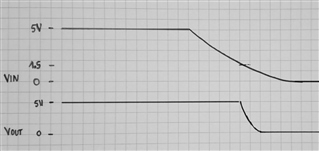
 

In regular operating condition (outside power down phase), the input and output voltage will be approximately the same.

But, due to the tolerance on the Vin voltage and accuracy of the boost converter output, we could be in different situations:

Vin > Vout (for example Vin = 5.2V and Vout = 4.9V )

Vin < Vout (for example Vin = 4.8V and Vout = 5.1V )


We could be satisfied with a pass-through mode in case of Vin > Vout, but we need a clean output in all conditions without big ripple due to change of operating mode of the converter.


Test of TPS61202:

We have evaluated the TPS61202 component (Eval board).

With this component, as long as Vin is lower than 4.8V (for Vout = 5V), everything work perfectly and the output voltage ripple is quite good.

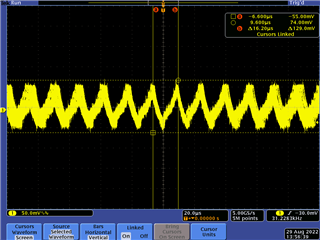
But, for Vin = 4.9V or 5V or 5.1V, we get very high ripple at the output ( -> more than 120 mVpp at quite low frequency 60 KHz)

TPS61202_VIN-5V_VOUT-5V_200mALoad_MultiTrace  (cursors: delta T = 16uS, delta V = 120 mVpp)
TPS61202_VIN-5V_VOUT-5V_200mALoad_SingleTrace  (cursors: delta T = 16uS, delta V = 120 mVpp)
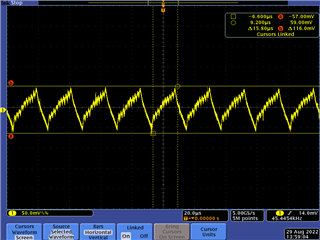
 

The state of the mode pin does not change anything, the component seems to work in a kind of PFM mode with high amplitude low frequency ripple.

Do you believe that the behavior observed were normal for this component or is it a defective EVAL board?

With this component, do you believe that it will be possible to get a low ripple at the output when Vin is close to Vout?


We have tried to put a bigger capacitor at the output (680uF OSCON) to reduce the ripple, but by doing that we have finally destroyed the component (after failure: almost short circuit at the Vin pin of the TPS61202)!

During the last test made (before failure), I have (most probably) connected during operation, a discharged capacitor (680uF 22mR) to the output of the converter!

But, I am surprised it will be sufficient to destroy the component, the component does not seems very robust to this kind of stress.

Any comment about that ?


TPS610022:

We have also identified the TPS61022 as a possible candidates for this converter.

We have not yet evaluated this component.

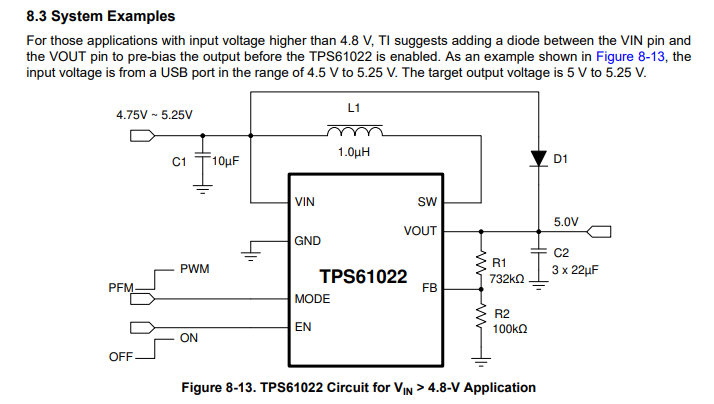
But, for this component we can read this remark: Vin = 0.5 to 5.5V -> Output voltage pre biased > 0.7V before start-up

On the TPS61022EVM schematics we can read Vin = 0.5 to 5.5V but, no diode present for output pre-bias, what is the consequences to not have a pre-bias (no start up, stress in IC...)?


TPS63802:

We have also identified the TPS63802 as a possible candidates for this converter.

We have not yet evaluated this component.

For this component, what about the risk to have ripple due to change of operating mode boot/buck-boost/buck (even if we can read in datasheet: The device provides a seamless transition between all modes).

What are the Vin transition values between the 3 modes for a 5V output?


What is the best candidate for our use case?

Any comments and suggestions will be welcome


Thank you for your support

  • Hi Michel,

    Thanks for reaching out.

    In passthrough mode(or down mode) of Boost converter, VOUT = VIN-Vdrop, VOUT will be larger than the regular voltage you set. So if you want VOUT always equal to 5V when VIN changes from 1.5V to 5.2V, you have to choose Buck-Boost converter, or if you can accept that VOUT is a little larger than 5V when VIN>5V, Boost converter could be more suitable because its lower price.

    About the failure problem of TPS61202, what the detailed condition? Like VIN, IOUT?

    For TPS61022, it can't support VIN>4.8V unless adding pre-biased VOUT>0.7V, you can take this section in datasheet as reference:

    Maybe you can choose TPS61023, it can support VIN > 4.8V without any pre-biased VOUT. 

    What's more, what is VIN when startup? Dose it drop to 1.5V before startup? Because TPS61023 can't support VIN<1.8V when startup, but after startup, the minimum VIN it can support will be 0.5V.

    Best Regards,

    Nathan

  • Thank you for your reply.

    First some clarification about our use case:

    As explained in our service request, when Vin is greater than Vout we can accept pass-through mode.

    So, in these situations, Vout will follow the input voltage(could reach 5V2 in case of our Vin max) and output will also follow the ripple and noise level of input voltage. But we cannot accept big ripple due to change of operating mode of the converter (boost <-> pass-through). We need seamless transition between boost/pass-through. Situations were Vin is wandering some mV above and under Vout target voltage must be also managed correctly (probably will need some hysteresis on the threshold between boost/pass-through).

    Our need for operation at Vin = 1V5 is only on Vin falling, so we can accept solution starting operation a 1V8 or even 2V5 on Vin rising.

    Remarks about TPS61202:

    We have not found something in the datasheet explaining the operation in case of  Vin >Vout. But specification of the TSP61202EVM (5V output) is Vin = 0.3 to 5.5V so we could expect good behavior of the component when Vin>5V.

    Our main question is to know if what we have observed were normal for this component or if could be a defective EVAL board?

    Second question is:  do you believe it is possible to get a low ripple at the output when Vin is close to Vout with this component?

    We can forget the problem of failure of the EVAL board, I am not 100% sure of conditions leading to that (I believe that Vin was 5V1, Iout = 200 mA and discharged 470uF 22mR ESR was connected “live” to the output).  


    Remarks about TPS61023:

    We have also identified this component, but this component work in auto PFM at light load (no mode pin to force PWM). According to figure 8-9 we believe we will be always in light load mode and the ripple will be too high for our need (we target typically 10 to 20 mVpp). That’s why we have not considered this component


    Remarks about TPS61022:

    With the diode added for pre-bias, do you believe that this component will meet our target spec?

    - Ok if Vout follow Vin (including noise and ripple of Vin) when Vin>Vout target

    - Low output ripple in all conditions (10 to 20 mV with appropriated Cout and output filtering)

    - Seamless transition between boost/pass-through (including situations were Vin is wandering some mV above and under Vout target voltage)


    What about our last suggestion TPS63802:

    For this component, what about the risk to have ripple due to change of operating mode boot/buck-boost/buck (even if we can read in datasheet: The device provides a seamless transition between all modes)?

    What are the Vin transition values between the 3 operating modes for a 5V output?

    Hysteresis on these values?

    Do you believe component will meet our target spec?


    Thank you for your help and all suggestions and comments wil be welcome

    Regards

    Michel Counson

  • Hi Michel,

    Thanks for your detailed explanation.

    About TPS61202,  the failure should not be an normal situation, but I am not sure the specific reasons due to the lack of more detailed information. I guess it may be caused by overheating of the chip, because high side FET will work in saturation region during startup, it will have larger power loss, if your output capacitor is too larger, the startup time will be very long, so maybe the FET will be damaged due to overheating.

    And more, I don't think there is a method to get a ideal ripple as low as you require.

    About TP61022, I will tell you the results after further checking. 

    About TPS63802, there will be a little transient behavior when transition between different modes, so I think it may not satisfy the requirement of very low ripple (10~20mV) in all conditions.

    Best Regards,

    Nathan.

  • Hello,

    Our concern about ripple (10-20 mV) target is mainly during normal operation that means when Vin is close (+/- 5%) to Vout.

    So, for TPS63802 if range for buck-boost operation is wide enough, we could be always in this mode for regular operation (outside of our power ramp-down), 

    It is the reason of my questions:

    - What are the Vin transition values between the 3 operating modes ( boot, buck-boost, buck) for a 5V output?

    - Is it value with some hyteresis?

    Thank you for your support.

    Best regards

  • Hi Michel,

    So, from my understanding, as long as the output voltage can be  steady and the ripple is about 20~30mV in steady state, then you can accept there will be a little overshoot or undershoot when buck-boost converter transition between difference modes, right?

    Best regards,

    Nathan

  • Yes, but if Vin is wandering some mV above and under Vout target voltage (let's say +/-5%) during steady operation, we want to stay in the same operating mode (buck-boost) to not have continously the overshoot/undershoot due to transition to boost only or buck only.

    So, it will be nice to have an answer to my two questions:

    - What are the Vin transition values between the 3 operating modes ( boost, buck-boost, buck) for a 5V output?

    - Is it value with some hyteresis (and order of magnitude of the hysteresis)?

    Thank's a lot for your help

    Best regards

    Michel Counson

  • Hi Michel,

    Thanks for your explanation, I will check the information you need with my colleague who supports buck-boost converter and give you feedback later.

    Best Regards,

    Nathan

  • Hi  Michel,

    with 5V output, TPS63802 will enter buck-boost mode when Vin is around 4.4V and will enter boost mode again when Vin is around 4.05V.

    yes, the hysteresis is around 300mV.

    Regards

    Tao

  • Hello,

    Thanks for the value for boost-only <-> buck-boost transition

    Have you the value for buck-boost <-> buck transition?

    We could suppose we have some kind of symmetry compare to the other transition: enter buck-only when Vin rise above 5.95V and return to buck-boost when Vin decrease to 5.6V ??

    We have ordered the EVAL board to check operation in real operating conditions.

    Thank you for your support

  • Hi  Michel,

    the point for buck<->buck-boost transition is around 5.4V and without hysteresis.

    BTW, TPS63802's maximum input voltage should be 5.5V.

    Regards

    Tao