This thread has been locked.

If you have a related question, please click the "Ask a related question" button in the top right corner. The newly created question will be automatically linked to this question.

TPS62180: Switching frequency and phase

Part Number: TPS62180

Hi team,

I tested TPS62180 and got two questions.

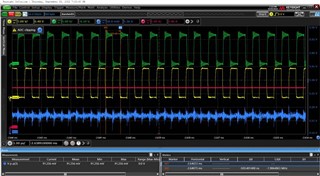
First question: When I use only one phase and run in light load, I can see the other phase switching in a certain frequency, which is about 110kHz. The picture is below, the green line is normal phase, the yellow line is 110kHz phase. Why does the second phase run in 110kHz?

Second question: When it runs in 2A, the switching frequency is 1.5MHz and phase differences is 90 degree. When it runs in 3A, the switching frequency is 2MHz and phase differences is 180 degree. The pictures are below. What does it cause the switching frequency and phase difference?

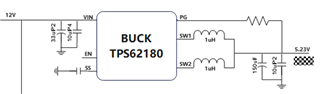
The circuit is below.
Best Regards,

Peter

  • Hi Peter,

    TPS62180 offers two features called Power Save Mode (PSM) and AEE (Automatic Efficiency Enhancement) that provide high efficiency over a wide range of load currents.
    Your first observed waveform/shot is related to Power Save Mode (PSM) operation, please look at page 10, section 8.4.2 of the datasheet.

    https://www.ti.com/lit/gpn/tps62180

    The other observed frequency and phase shift change is due to PSM as well.
    The switching frequency changes to get less of power losses.
    Please look at page 11, section 8.4.4 of the datasheet.

    Please note that the phase shift is always a fixed shift of 250 nS.

    When Fsw is about 1.5 MHz, then 250 nS is equivalent to 135 degrees of phase shift.
    When Fsw is about 2.0 MHz, then 250 nS is equivalent to 180 degrees of phase shift.

    Hope this helps.

    Regards,

    Yitzhak Bolurian

  • Hi Yitzhak,

    Thanks for your answer! But I still have questions: Why does the second phase run in such situation? If I need only one phase, the efficiency will be higher if the second phase does not run. What is the function of PSM?

    Now I know that the frequency will be higher when the load gets heavier. And I wonder the relationship between load and frequency in TPS62180. Moreover, usually we recognize that higher frequency causes lower efficiency. Do you have any information about higher frequency causes lower MOSFET switching loss? 

    Best Regards,

    Peter

  • Hi Peter,

    Even when the second phase is not switching, it is still active.
    Meaning it looks for a reason to kick in, if needed (Load current increases).
    Now in this specific case, I am not sure why it starts switching once a while, but this is the actual behavior of the device.
    Many things, like margins, noise, ... can make this act slightly differently. If you do not like the PSM behavior, you can configure the device in PWM mode.

    Regarding the SW frequency change.
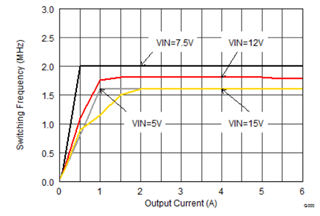
    The frequency decreases when output current is low, in order to keep the efficiency high at light loads. Not the other way around.
    Here is the frequency relationship with load current:

    Hope this addresses your questions.

    Regards,

    Yitzhak