This thread has been locked.

If you have a related question, please click the "Ask a related question" button in the top right corner. The newly created question will be automatically linked to this question.

TPS65987D: DRP Mode Konfiguration

Part Number: TPS65987D
Other Parts Discussed in Thread: TPS65987

Hello,

I am just testing with the TPS65987EVM and the Application Customization Tool for my new project.
The target design should be a USB-C design with a DFP USB3.1 (Host) for e.g. a powered USB Hub or a USB-C docking station and a 20V 3.5A sink function for charging the host.
For this design I think I have to work with a DRP Port Configuration – right.
My question is, where can I define, that this USB-C port in Dual Role Port mode  is only a DFP for USB (Host - USB20 and USB3.1) and cannot switch over to a UFP (Device)?
I doesn’t find any right option in the configuration tool.

Regards Markus

  • Hi Markus,

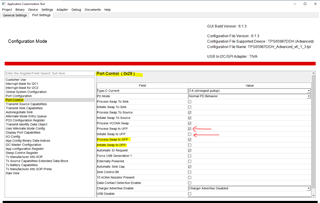
    Under Port Control (register 0x29), you can disable Process/Initiate Swap to UFP and vice versa enable Process/Initiate Swap to DFP. This would set the TPS65987 to be a DFP device only (as shown below):

    You can also set the Port Configuration (0x28) to be a DFP only as well:

    Thanks and Regards,

    Raymond Lin

  • Hi Raymond,

    thanks for your fast replay.

    Setting in 0x28 Port Configuration to DFP is not working. This I tried before. And now again. If I configure this to DFP than the power path is cycling on/off.
    But with only initiate and process swap to DFP settings, this will work.
    I have to test this now if the USB path is working well.

    Thank you very much.
    Regards Markus

  • Hi Markus,

    Glad to hear you were able to resolve your issue! The cycling on/off might be due to the process/initiate swap to UFP/DFP. Depending on how which settings are enable, if a connected device share same Data Role preference (i.e both are DRP and initiate swap to DFP/UFP) then it's likely you would see the case where both devices keep initiating data role swap, resulting in the on/off cycling. 

    I'll go ahead and close this thread, if you have any further questions please click "+ Ask a related question" for better tracking!

    Thanks and Regards,

    Raymond Lin