Other Parts Discussed in Thread: REF4132, REF35, ADS1287
Hi,
1. Can you please publish on web-site pdfs of the following presentations:
https://training.ti.com/node/1150046 (NPU: Enable low power precision data conversion with industry’s lowest-IQ voltage reference)
https://training.ti.com/ti-precision-labs-reference-drive-hands-on?context=1139747-1140267-1128375-1139107-1136044 (9.6 Hands-on
experiment: Reference drive).
2. Is there a relatively easy method to define the applicability of the reference for ADC ref. input drive (12 bit ADC, sampling cap 20 - 40pF, clock 10MHz) for relatively low sampling rate, say 10ksps - 100ksps, working in continuous (sampling 1 sample each 100us - 10us) or burst mode (sampling of several samples within several us, then wait 10 - 100us, then sampling several samples again)?
There are newer families of references - like REF60xx, REF61xx and REF62xx - that have a good characterization for ADC ref. input drive, but what about other families?
Looking through datasheet or REF20xx, for example, we can see at Fig.24 and Fig. 25 load response for +/-1mA transient - it is long (time scale 500us) and over- / under-shoot is about 10mV. Does this alone makes REF20xx inapplicable, or - with Cout=1uF...10uF - average current from reference is low enough to ignore this graph?
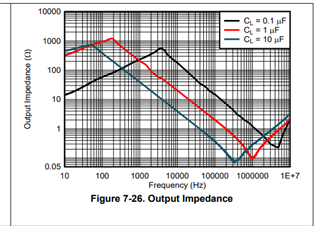
I realize that voltage at ADC ref. input filter capacitor should recover between samples within 1/2 LSB (and stay in this range between during bit conversion), but I am not sure how to correlate these requirements with reference characteristics like transient response and output impedance at sampling and clock frequencies.
Thanks.