This thread has been locked.

If you have a related question, please click the "Ask a related question" button in the top right corner. The newly created question will be automatically linked to this question.

TPS2595: TPS2595 Short-Circuit Current (Isc) Missing from Datasheet

Part Number: TPS2595
Other Parts Discussed in Thread: TPS2663, TPS2597

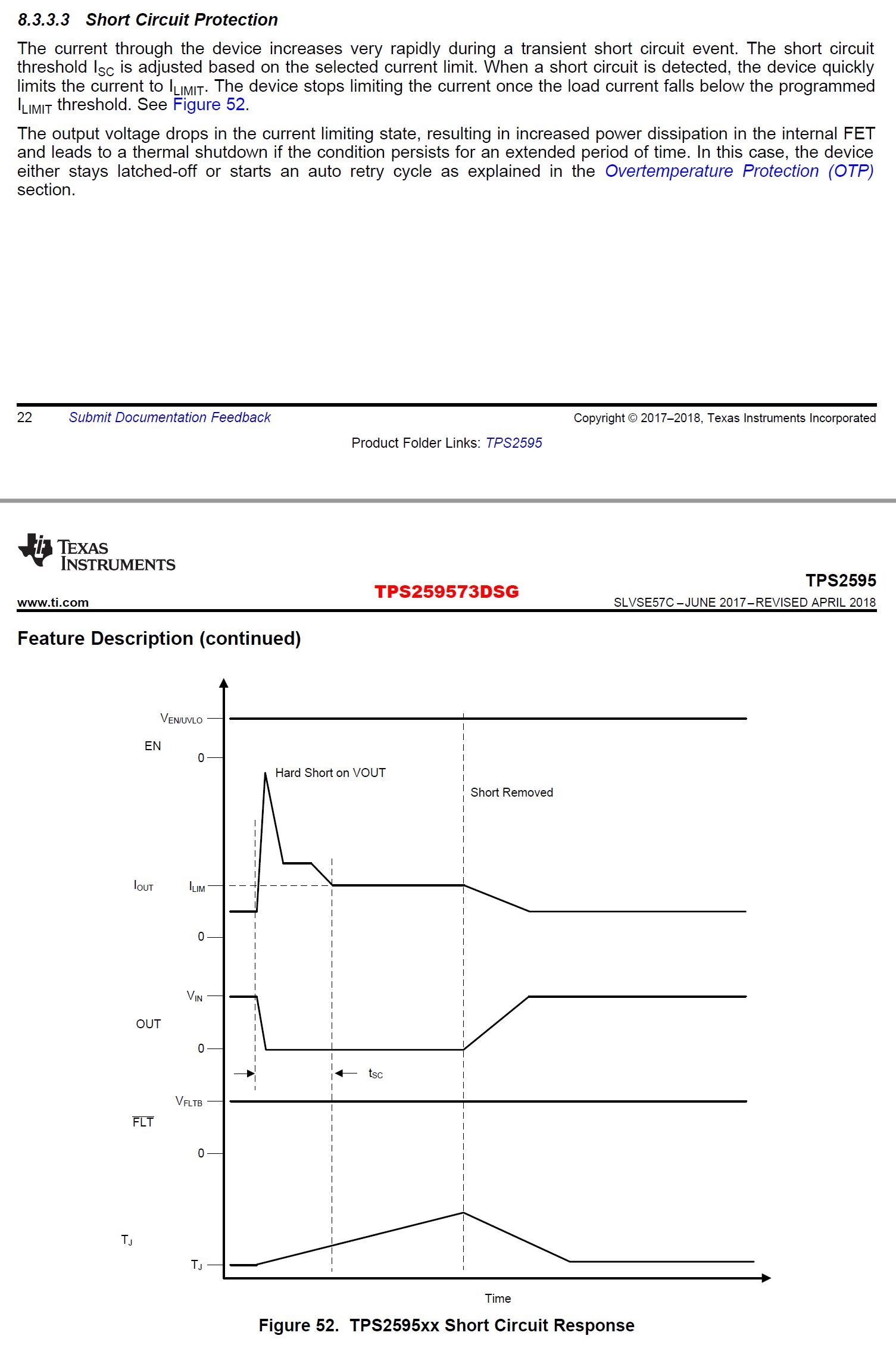
The TPS2595 datasheet references short-circuit current (Isc) without defining its value. See 2 pics below.
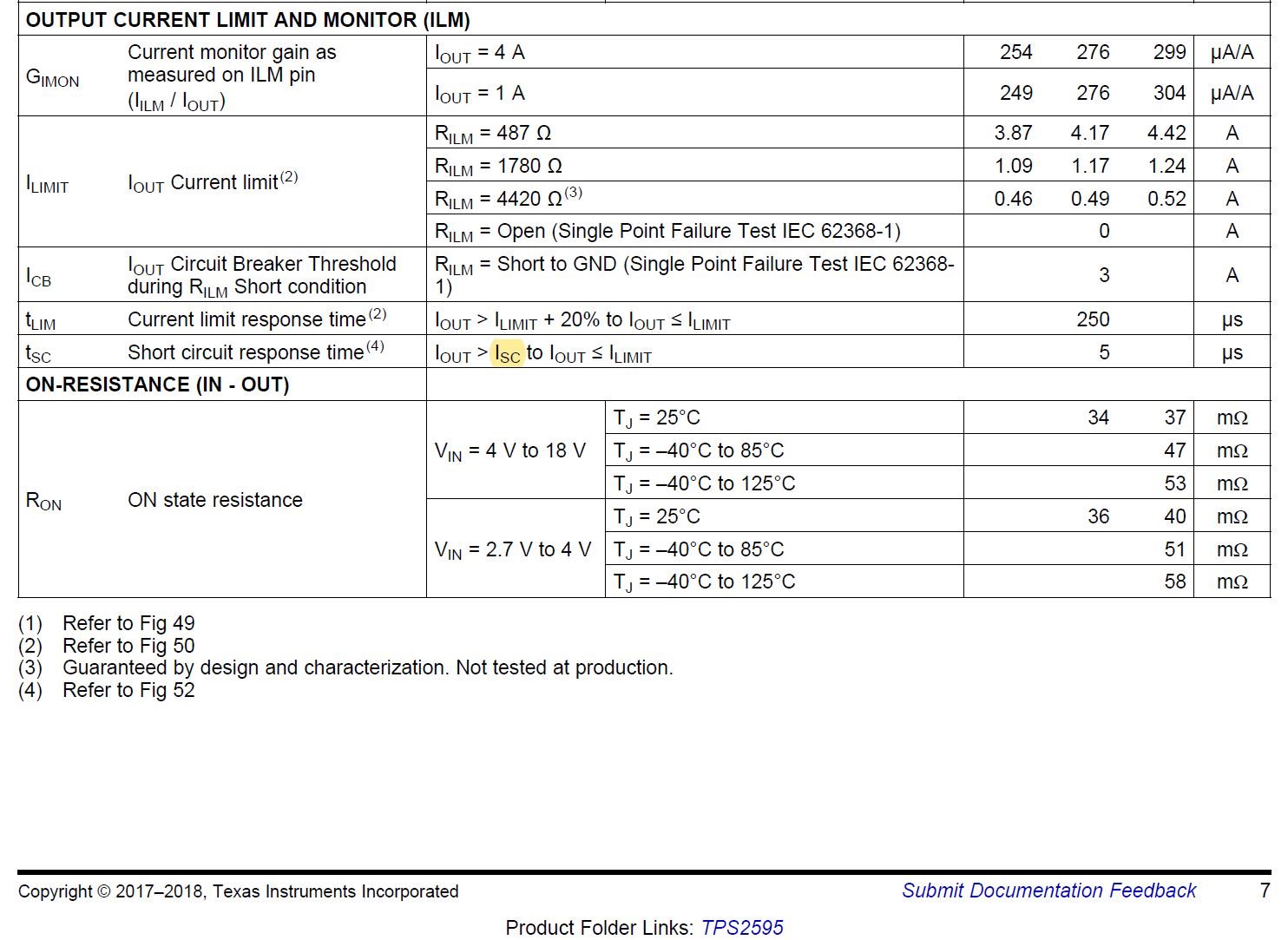

Figure 52:

Side note: for other TI eFuses, this is specifically called out, as well as the transient pulse current limit (see, for example, datasheet for TPS2663). 

  • Hi Canyon,

    I will get back by tomorrow on this.

    Regards

    Kunal Goel

  • Okay great, thanks Kunal

  • Hi Canyon,

    Please refer this thread.

    e2e.ti.com/.../3091622

    Regards

    Kunal Goel

  • Hi Kunal,

    Thanks for responding, very much appreciated. I did see that post, and I probably should have contributed to that thread instead.

    I am still confused as to why short circuit current is specified for a similar TI eFuse (TPS2663) and is not for this part (TPS2595). The block diagram for the TPS2663 is much more detailed, but comparing between the two, the architecture appears very similar. 

    The reason I am asking is that I recently did some testing with the TPS26632 on one of my boards and discovered firsthand the difference between the TPS26632 and the TPS26633 (for some of my loads I need the additional pulse ability of the "3" over the "2"), which I can measure and verify against expected, calculated from the information available in the datasheet. However, for the TPS2595, I am not certiain what to expect for various load transients. As an example, I have servo load that will be very low average current, but will spike for very short durations. Configurijng a TPS25953 for 12V@1A, what would we expect to happen for a 20A pulse at 50us duration? Would the short-circuit comparator kick in (tSC=5us) or would we expect the load to remain connected (tLIM=250us)?

    Apologize in advance for the long-winded answer, and maybe there is something I am fundamentally misunderstanding with respect to the difference between the TPS2663 and the TPS2595. In my mind, fundamentally speaking, the TPS2663 is simply the larger/higher-voltage version of the TPS2595, ignoring the minor feature differences (which we are not using). Maybe I have this wrong?  Anyways thanks again!

  • Hi Canyon,

    TPS2595 and TPS2663 are devices with different architecture though you can always find functionality similarity between our different eFuse devices. I understand your concern regarding short circuit threshold.  I need to check why we dont' mention threshold in datasheet. Can you consider using device TPS2597?

    Regards

    Kunal Goel