This thread has been locked.

If you have a related question, please click the "Ask a related question" button in the top right corner. The newly created question will be automatically linked to this question.

UCC28782: ADAPTOR+CHARGER USING UCC28782

Part Number: UCC28782
Other Parts Discussed in Thread: TPS65987D, TPS55288, TPS65987, BQ25730, TPS2546

Hello:

We have a cool UCC28782 ac-dc circuit finally fully operational up to 100W , 20V output.

Our intention is to productize it for USBC PD AND a versatile charger.

The base design with UCC28782 shows a WT6636 USB interface chip . We got a fixed ROM based chip from Weltrend.

But now we prefer a programmable approach with full support through a forum such as TI.s

We thus need to find an optimum 1-chip solution to cover the charger/adaptor approach from 5V 3A to 20V @5amp. We intend to make off-USB mark by offering 24V @5amp  adaptor/charger.

Our base converter is : exactly as in UC28782EVM specs. But our output will be fixed 24V max 5amp MAX FROM ucc28782 CONTROLLER.

- We can use TPS55288RPMR for all outputs at the receptacle. 

- we will have 2 receptacles. One for VBUS PD as a DFP. Another for the charger. If this becomes a necessity.

What we are confused about is the nature of the USB C receptacle: can VBUS output serve as a charger port as well? If so, can the same chip behave as a charger controller through the USB C PD by using configuration signals such as C1/C2 and D+/D- or some other functional pins?

If so, which chip do you suggest we use? I do not think we need any "path selector" or sourcing from an external battery or such capabilities. Our module will be a source only whether for PD or charger. Automatically configuring one or the other.

Is there a chip with such a capability?

Appreciate any clarification on the chip selection.

r

  • Hello Robin, 

    Thank you for reaching out. Agree that there is a lot of value in having a direct channel of support such as this one. 

    In short, for what you are trying to accomplish, the best combinations will likely be the TPS65987D + TPS55288. 

    In order to negotiate any voltage above 5V, you need a Type-C PD controller like the TPS65987D. Reason being is that applying 20V on VBUS directly without first negotiating a PD contract in non compliant and no compliant solution will charge this. They will see this as a failure and not draw any power. So a PD controller is needed to help first negotiate the contract before applying the higher power. 

    For the DCDC unfortunately we do not have a PD controller solution that integrates both the DCDC and PD controller, which is why the TPS55288 is needed. The TPS65987D does integrate the high voltage power path which helps save cost and boards space. 

    The following reference design is a good starting point for pairing the TPS65987D with the TPS55288

    https://www.ti.com/tool/PMP40801 

  • Hello Adam:

    Thanks a lot for the suggestions.

    Appreciated.

    Looked thru the d/s of TPS65987D, but could not reckon how this chip will interface with TPS55288  to put appropriate VBUS voltage after it settles contract from CC lines.

    For this to happen, should not  there be some signal- maybe a Feedback generated from inside  from VBUS? This will complete the loop. For example, CC tells the TPS65987 that the connected device needs 15v @ 3amp or may be 20V @ 5amp ?

    How will TPS55288 put out this voltage without 65987 handshaking thru feedback loop?

    Finally, can these combinations provide a "charger" behavior( with BMS) as well?

    Any comments on these will be highly appreciated.

  • Hi Robin,

    The TPS65987D can communicate with TPS55288 via I2C (PD is master and buck-boost converter is slave) or GPIO events from TPS65987D to TPS55288. The I2C/GPIO configuration is set up through the Application Customization Tool for the TPS65987D (you can request for access from ti.com). After the PD negotiates the power contract with the far-end device, it will communicate with the TPS55288 to configure it based on the power negotiated. You can find out more technical details on the I2C setup and functionality here: https://www.ti.com/lit/an/slvaeq7/slvaeq7.pdf?ts=1674252282496&ref_url=https%253A%252F%252Fwww.ti.com%252Fproduct%252FTPS55288 

    If you have any further questions, please don't hesitate to ask! 

    Thanks and Regards,

    Raymond Lin

  • Hello Raymond:

    Appreciate your clarification and we will vigorously follow up.

    A crucial question : we can obtain a PD  product for sure. BUT are there signals at the port to tell it to behave as a real  charger? For example , a 20v LiP battety with full I-V charging control?

    I do not see any such talk in any USB  C forums . All imply PD can also be a " charger".

    This is not true- and we will not advertize a PD as becoming a charger !

    Do we have to add a BQ25730 chip as well ?

    Finally, I cannot for the life io me figure out path selecting switches. Why?

    appreciate any discussions on these subjects.

    -r

  • Hi Robin,

    The PD itself is not a battery charger, in order to do any battery charging it will still require a battery charger device (BQ devices). The PD is the first level of interaction to the port and negotiates the power level (Voltage/Current). For example, if the PD is operating in sink mode and requests 20V,3A, this will be negotiated with the source PD connected and if the source PD is capable of supplying this power contract, this is what will be sent.

    The PD also is capable of supporting BC1.2 operation, which is the USB Battery Charging Specification and negotiates the power contract according to this spec. Even in supporting this operation, a battery charge device is still needed. For more information on BC1.2, check out the data sheet for TPS2546. However, this spec is more relevant for traditional type C and legacy devices, not PD. With PD, power can be negotiated up 100W for SPR and it is up to the battery charging device to support the charging scheme.

    Finally, I cannot for the life io me figure out path selecting switches. Why?

    Can you clarify what you mean by path selecting switches and where you are seeing this?

    Very Respectfully,

    Brandon Beader

  • Hello Brandon:

    Thanks for the clarification. We are going to add a BQ device if our system is called a "USB charger".

    I will check the BC 1..2 specs for sure. Will also check TPS2546 ds

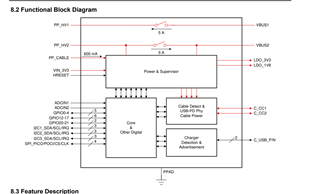
    Pl see the highlighted area from one page  of TPS65987

    In our implementation, we will have  UCC28782 generating a fixed 26V up to 5 amp- a TPS55288 in strictly buck mode output voltage is selected by WT6636 chip with current control by WT6636 current sensor. 

    So our module will be a DSP as PD source only. As an adaptor.

    If we add a charger, we will add a BQ device that can interface with WT6636 or preferably a TI programmable chip to act as BC 1.2 charging source.

    Inviting again your expert comments/reviews.

    BTW: what is TI equivalent to WT6626? Programmable.

    -r

    POWER_PATH.pptx

  • Hi Robin,

    BC 1.2 is a charging scheme and is more closely related to traditional type C ports compared to PD. Type-C using BC 1.2 you are limited to 7.5W, where as Type-C  PD you can ahieve up to 100W SPR. Using a BQ device + PD you can achieve higher power levels.

    In regards to the power path selector switches, on the D version of this device there are 2 integrated power paths. One is for sourcing up to 20V and one for sinking up to 20V. This is configurable through the GUI and you are able to set your default configuration as well as your prefered configuration, therefore after negotiation on the CC lines, the correct power path that is associated with your configuration following negotiation will be turned on. 

    For the replacement for WT6636, do you need PPS? 

    Very Respectfully,

    Brandon Beader