This thread has been locked.

If you have a related question, please click the "Ask a related question" button in the top right corner. The newly created question will be automatically linked to this question.

TPS61322: Inductor selection from WEBENCH query

Part Number: TPS61322

Hi!WBDesign14_Load Transient-1.pdfPower Supply SMATH PDF.pdfo05e.pdfLQM2HPN2R2MG0#.pdf

Our company has a prospective FDA medical device that contains the TPS613222ADBVR (5V Fixed Boost) as part of the power supply circuitry. To help customize the circuit better than just the standard callout in the datasheet, we used the WEBENCH tool provided via TI to help get an idea of the circuitry and BOM costs etc. When doing some more in-depth analysis on the inductor that was selected for this product, we found that the inductor being called out for has a lower Saturation Current than what we are calculating to use.

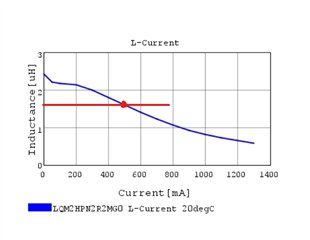
With that being said, I will attach the report generated by the WEBENCH for the particular parameters we selected, and then a snapshot of our Math CAD used for calculations. The datasheet for the Murata inductor selected does not provide a saturation current, but according to Murata in a chip inductor product sheet, the point in which the inductance decreases by 30% of the initial inductance value is the allowable saturation current. Taking this information to the chosen inductor's datasheet and looking at inductance vs. current curve, this does not seem to fit the bill.

Please take a look get back to us and let us know if something was missed in our calculations or perhaps the explanation why the WEBENCH chose this inductor. Thank You!-

-- Randy

  • Hi Randy,

    Thanks for using E2E.

    I think it may because you consider safety factor and the WENCH tool doesn't. 

    Regards,

    Nathan

  • Nathan

    2 things here:

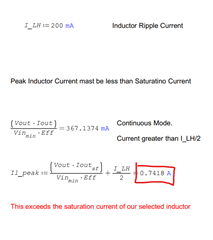
    A. I have added a few snips of the the areas from the documents attached that I believe are in question. The top level here is that this inductors saturation current is somewhere in the 500mA area and our calculations say the peak current Il_peak = 742mA and the WEBENCH peak current calculates Ic_Ipk = 713.993mA. Both of these values exceed the recommended inductor selection's saturation current.

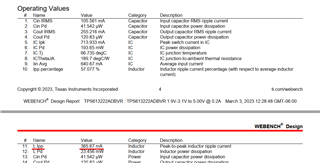
    B. Inside of the report, there are some parameters that WEBENCH calculated that we found different in our calculations. The biggest one that stood out was the inductor ripple current. We used I_LH = 200mA of inductor ripple current and the simulator calculated L_Ipp = 365.67mA of ripple current. The datasheet says the device tries to maintain a 200mA typical, yet WEBENCH is outputting almost double that value. The other value that we are unsure of is the switching peak current vs. the peak inductor current. The values look close, just unsure if they are the same or not. 

    1. From A: Can you explain how the inductor selected via the simulator meets the criteria as explained in the datasheet and the information given above?

    2. From B: Why is the simulator giving an almost double value for the inductor ripple current?

    3. From B: Is the switching peak current and the inductor peak current the same parameter in these calculations?

  • Hi Randy,

    I am not sure how the WEBENCH works, but I find in your calculation you multiple a safety factor and the you get a larger current.

    And switching peak current and the inductor peak current are actually the same parameter.

    Regards,

    Nathan 

  • Nathan

    Thank you for clarifying that the switching peak and peak inductor current are the same parameter. I assumed this was true, just wanted to make sure with TI that this was the case.

    The safety factor that we used in our calculations are the exact criteria that were input into the WEBENCH. I am unsure why the safety factor even matters in this particular situation. I am trying to understand why the WEBENCH is choosing an inductor that seems to not be rated for the particular design it is saying that can handle it. Can you point me to someone that understands WEBENCH and the calculations it uses? We really need to understand the design implementations for our prospective FDA product and any information on why these two items (inductor underrated saturation current and almost double inductor ripple current) do not align.


    Thanks!

    -Randy

  • Hi Randy,

    Thanks for noting. I have moved this thread to WEBENCH team and ask for their help.

    Regards,

    Nathab

  • HI Randy,

    We are looking into this, We will get back to you with update by next week.

    Thanks and Regards

    Shaheen S M

  • Hey Nathan

    I just want to be sure I am understanding you correctly. When you said we are multiplying a safety factor and getting a larger current, are you implying that the inductor value selected would be ok if we did not use the safety factor current (Iout_sf)? Or were you just merely stating that because we are using the safety factor current (Iout_sf) in the calculation that we are getting a larger current?

    The reason I am asking is because we did not supply the design with the nominal current of 114.4mA (Iout) into the WEBENCH design. We supplied the safety factor current (Iout_sf) to design the safety into the circuit and that is where I am seeing the inductor current rating issue. Clarity on the response " but I find in your calculation you multiple a safety factor and the you get a larger current." would be appreciated. Thank you!

    -Randy

  • Hi Randy,

    What I mean is the second note, "because we are using the safety factor current (Iout_sf) in the calculation that we are getting a larger current"

    Thanks.

    Regards,

    Nathan

  • Hi Randy,

    Please find my comments below for above queries,

    1. From A: Can you explain how the inductor selected via the simulator meets the criteria as explained in the datasheet and the information given above?

    Shaheen: Inductor selection on WEBENCH considers only Rated current( (Itemp) (Based on Temperature rise))  which is 1.3A for the selected inductor, which why this inductor is getting selected. Unfortunately, By Default we do not consider Isat rating while selecting an inductor.

    However we have now updated the WEBENCH model for TPS613222A device to check the Isat rating in inductor selection and for the input condition(1.9-3.1Vin, 5Vout, 0.2AIout) we are getting below mentioned inductor part after the update.

    DFE201612E-2R2M=P2  

    This change will be available on ti.com by next WEBENCH release(Tentetively by end of this month).

    2. From B: Why is the simulator giving an almost double value for the inductor ripple current?

    Shaheen: Typically, the ipp is 200mA, but this can be affected by below highlighted points as per the datasheet, WEBENCH model considers the comparator delay in Ipp calculation, However, we will check the variation with product experts and get back to you on this

    3. From B: Is the switching peak current and the inductor peak current the same parameter in these calculations?

    Shaheen: Switching peak current and the inductor peak current are the same parameter.


    Regards

    Shaheen S M

  • Shaheen

    Please do get back to us on the current ripple variation question as well. It is not ultimately affecting our design, but we would like to know if WEBENCH is appropriately giving values for calculations correctly or not. 

    -Randy

  • Hi Randy,

    Sure, We will get back to you once we get response from the team.

    Regards

    Shaheen

  • Hi Randy,

    We confirmed with the team and got a confirmation that Inductor ripple current can be affected by internal comparator delay as mentioned in above comment, This variation in Ipp is larger than 200mA.

    I hope this answers all your queries related to WEBENCH model for TPS61322A, Updates related to inductor selection will be released on ti.com, Tentatively by end of this month, We will inform you once this is released.

    Regards

    Shaheen

  • Hi Randy,

    Update related to inductor selection is now available on ti.com.

    Regards

    Shaheen