


Hello!
Introdution
I have a buck converter which have to charge battery so it works in current limit mode.
Instead of using internal current limiting feature I use external ciruit which consist of:
1) differential amplifier which is sensing output current (voltage drop on 1R resistor)
2) ouput of this diff-op is connected to a voltage divider with a NPN transistor
3) if the current reach certain limit the NPN transistor inject voltage to the feedback network of the converter which decrease output voltage.
I attach a .zip file with a LTSpice simulation of the circuit.
Problem
The customer wants to be 100% sure that this system is stable under all conditions,
and in particular that there will be no audible frequency oscillation (since there is a loudspeaker in the system).
Solution
Typically a FRA is performed to check gain and phase margin.
But in this case converter works under special conditions and it can be seen on the pictures below.
These photos refer to the AP64060 tests, but the LMR54406 has the same pinout and similar capabilities.
Bode Plot of the DUT which works under normal conditions e.i. Constant Voltage (CV) mode.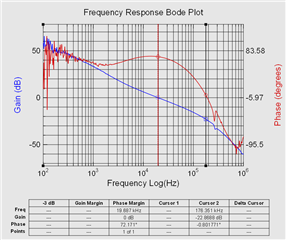
Bode Plot of the DUT which works under current limit conditions e.i. Constant Current (CC) mode.
I use 10 ohm resistors in series with the feedback and the 1:1 1Hz to 100kHz injection transformer is used.
Question
Is FRA an appropriate method to check the stability of such a system.
How to interpret the results.
What would the results be if there was a possibility of being unstable and generating audible noise.

