This thread has been locked.

If you have a related question, please click the "Ask a related question" button in the top right corner. The newly created question will be automatically linked to this question.

BQ2970: Battery protection for 200mA max current

Part Number: BQ2970
Other Parts Discussed in Thread: BQ24074, BQ2980, CSD16406Q3, , CSD17483F4

I need some help to ensure I have the right design for my battery protection circuit.

  • I have selected the BQ24074 charger.
  • The battery is a 300mAh lithium polymer, UL or UN38.3 certified (undecided).
  • It could have factory in-built protection circuit or not. (undecided). 
  • The max sustained discharge current is about 200mA and the charging current is 90mA (or less).
  • There are in-rush current spikes higher than this but they are not sustained (I can test duration if need be).
  • I want to add battery protection on the PCB along with PTCs and Fuses where possible.
  • I want a protection circuit which will protect against currents greater than 200mA.

I do not see how to fix a max current using the BQ29700, it's not clear to me from reading the datasheet how this is done. I believe a sense resistor and the right mosfet choice might provide a means but I'd like advice. 

Another option I believe is the BQ2980 series and perhaps there are other options. 

Can you give me some advice please? How can I set a reasonable current limit and what mosfet options and resistors are required?

Thanks in advance,

Kind regards,

-Jason

  • I've tried to make some progress.The BQ298217 might be a good option. I've tried to understand the datasheet for setting the current limit.

    Can I confirm that I have this correct?

    On page 5 of the datasheet for OCD of the BQ298217 I see 60mV. 

    So 60mV / 200mA = 0.06 / 0.2 = 0.3 ohms.

    So the SENS resistor for 200mA discharge current is 300mOhms? Is that correct?

    And for OCC I see -36mV so I should expect 120mA max charge current.

    SCD is 200mA so Short circuit discharge is 0.2/0.3 = 666mA

  • Hi Jason,

    I just finished typing this up when I saw your newest comment. I'll leave my initial reply as is if you would like to look it over.

    You're correct. For a 60mV OCD threshold, to choose 200mA of current a 300mohm sense resistor is used.

    Initial response:

    The BQ297xy and the BQ298xyz devices should both work for you. The BQ298xyz offers improved current sensing accuracy over the BQ297xy (+/-1mV vs +/-5mV typical), but I will explain how the current protections work on both devices.

    BQ297xy

    This device does not actually utilize a sense resistor, but instead measures the voltage drop across the FETs. The device measures the voltage difference between the V- pin and the VSS pin and should the voltage difference exceed either the OCD threshold for the OCD delay time, the SCD threshold for the SCD delay time, or the OCC threshold for the OCC delay time, it will turn off the appropriate FETs.

    Section 9.4.4: Discharge Overcurrent Status (Discharge Overcurrent, Load Short-Circuit) and Section 9.4.5: Charge Overcurrent Status of the datasheet cover this in more detail.

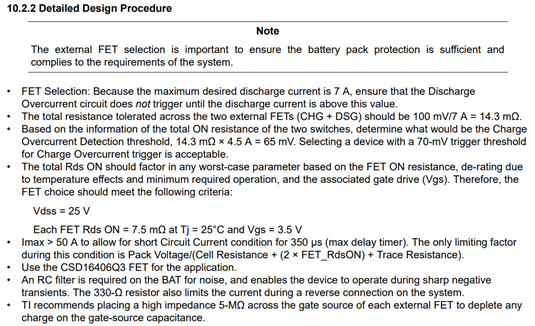
    Since the FETs are acting as a sense resistor for this part, there are some more criteria on how they are chosen. The image below is taken from the datasheet. In this example the criteria were a 7A discharge current and a 4.5A charge current, your numbers will be different. There are many different versions of the BQ297xy and you will need to consider the OVP and UVP thresholds as well. I recommend filtering out the versions that won't work for your cell voltage, then considering each version's current thresholds.

    (It's not explicitly stated, but the 100mV in the 2nd bullet point is the chosen OCD threshold)


    BQ298xyz

    This device's current protections are much like the BQ297xy but use a sense resistor instead of the FETs. The calculations you do to pick the value of the sense resistor will be the same as well. Again, I recommend looking through the device comparison table on the datasheet, and filtering out the devices that have settings that won't work for you before picking your current thresholds.

    You should be fine as long as the transients settle before the corresponding protection delay timers expire.


    I hope this helps!

    Regards,

    Max Verboncoeur

  • Thank you Max, I completely misunderstood the current sensing on the BQ29700, so this explanation really helped.

    I spent a long time this morning looking for appropriate mosfets and I did this believing the mosfet gate driver used 8V. But I've subsequently realised that it actually uses BAT, which can be anything from 2.8V upto 4.2V.

    So now I don't understand why the example in the datasheet specifies the CSD16406Q3. (https://www.ti.com/product/CSD16406Q3)

    In the BQ29700 datasheet it says 

    The Rds curve for the CSD16406Q3 looks like this.

    This seems very strange, The current thresholds will vary dramatically depending on the battery voltage. So I don't know why this mosfet is suitable. 

    If the current thresholds are so dependent on the mosfet resistance, then I might be better to use the BQ298217

    The mosfet I selected was this one https://www.ti.com/product/CSD17483F4.

    It has better RDS(on) stability at expected BAT voltages but there's still about 20mOhms (10%) variation between 3v and 4.2v. 

    Really, I wish the datasheet had examples for a broad range of potential use cases, along with the BOM required for each. Its easier to learn by example. And it's even easier to simply copy a known good implementation.

    Anyway, thanks again for your help!

    -Jason

  • Hi Jason,

    If you're concerned about using the Rdson of the FETs for current sensing, then the BQ298xyz would be a suitable alternative.

    If you're looking for more example schematics using these parts, you can also refer to the EVM, which is a TI designed and tested example circuit. I'll link the user guides below where you can find information and schematics + BOMs for the EVMs (these are also available on the product pages).

    BQ2970: https://www.ti.com/lit/ug/sluuaz3/sluuaz3.pdf

    BQ2980: https://www.ti.com/lit/ug/slvub38/slvub38.pdf

    I hope this helps!

    Regards,

    Max Verboncoeur

  • thanks Max, I saw the EVM pages already. I was just concerned that I'd simply misunderstood the datasheet, but I guess the example in the datasheet isn't trying to ensure a specific current limit. I dont think I can use the BQ298217 because I want to use certified batteries (UN38.3, UL etc) and I can't find those without protection circuits. (Or at least my preferred supplier doesn't have them pre-certified.) So I need zero volt charging. I think the CSD17483F4 with the BQ29700 should give some current protection above 250mA. 

    Thank you for your help, I wouldn't have this solution without your explanation.

    Kind regards,

    -Jason