This thread has been locked.

If you have a related question, please click the "Ask a related question" button in the top right corner. The newly created question will be automatically linked to this question.

BQ25798: No current flowing to the battery when in Fast Charge

Part Number: BQ25798
Other Parts Discussed in Thread: , TPS25221

Hi Support Team, 

I'm facing an issue I'm not understanding. We've a custom board with the BQ25798 connected on a 12V lab power supply via the VAC1/ACDRV1 and related FET. We have a single LiPo cell. The BQ25798 seems correctly qualifying the power source (I can't see any strange values in the statuses and/or control registers) and entering in Fast Charge, but there is no current flowing into the battery. We expect a maximum of 700mA (as programmed in the REG03) but it falls to 0mA as soon as the charger enters in the Fast Charge status.

I've replaced the LiPo battery with a "simulated" battery via a 12ohm resistor connected to a lab-power supply + reverse diode protection and I was able to simulate several battery conditions.

For what I can see, there is a current flowing to the battery when the BQ25798 is in Pre-Charge, but as soon as the simulated battery voltage exceed 2.9/3.0V (71.4% of VREG), the current stops flowing. The BQ25798 correcly identifies and enters in the over voltage when the battery voltage is too high. 

I'm not able to see any suspect values in the registers. Could you, please, give a hint on this to help me to identify why no current is flowing when in fast charge?

I've attached a .xls file with registers dump in different conditions.

Thank you and best regards,

Marco.

BQ25798_RegistersDump.xlsx

  • HI Marco,

    One of your measurements show V(SYS)<V(BAT)+0.6V.  That is impossible unless the internal BATFET is damaged because there is a diode that points from BAT to SYS.  Also, even in precharge, the current isn't being regulated to the register setting.  Can you send your schematic and layout?  Does this occur on multiple boards/ICs or only one?  If you move that IC to a BQ25798EVM, does it work correctly?

    Regards,

    Jeff

  • Hi Jeff, thank you for your feedback. The BATFET damaged can be a good explanation: seems like the IC is asking to connect the SYS to BAT but nothing happens. 

    Unfortunately I don't have (today and next week) other boards as they were sent for a small field test yesterday. I remember I tested a couple of batteries with a different board, before shipping, but with the same behaviour. I'm sure I was able, some days ago, to completely charge a battery. So there was at least one debug board who worked some days ago. 

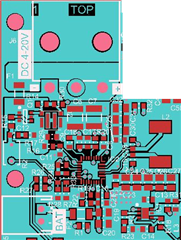
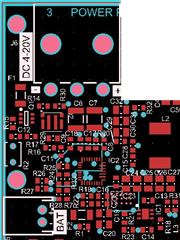
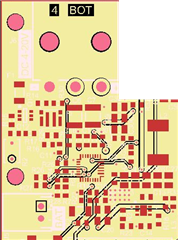
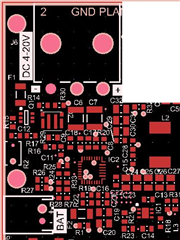
    I've attached the schematics and the layout. It's a 4 layers board. As you may note, there is an external IC1 (TPS25221DRVR) who may short the SYS rail with the BATT. We tried to replicate what is suggested in (I think you wrote?) the "How to quickly and safely charge super capacitors" AN on figure 2-7, page 6. In my knowledge, we used only LiPo and the current firmware never turned on the SC_CH_EN line... but we left the pull-up on the host so I can't warranty anything when the debugger/programmer is on the stage (!) and/or the CPU was reset. My question is: shorting SYS to BAT through the TPS25221, when a LiPO battery is on, can damage the BATFET?

    I've two new IC so I can replace the one I've with a new one. I can also remove the TPS25221, if required. Unfortunately I can't test the "broken" IC as I don't have the EV board.

    A side note is that all the prototypes worked for several days at -20C, with only battery and no power supply.

    Thank you and best regards,

    Marco.
    0537.PowerSupply.PDF

  • Hi Marco,

    On the schematic, I am puzzled by the multiple pins (STAT1, STAT2).  Also, we later learned that the SDRV capacitor must be connected to GND not BAT or switching noise from the SDRV charge pump couples in and confuses the current sense amplifier.

    On the layout, same issue with the current sense amplifier if you don't follow our recommend layout in the datasheet and EVM.  Specifically, the SWx pins must be via'd down under the IC so that the 100nF PMID and SYS decoupling caps can lay on top of the IC and filter the switching noise to GND pin without vias.

    I think the 2 items are above are your issues.

    Regards,

    Jeff

  • Hi Jeff, 

    thank you for your feedback.

    Yes, I know about multiple pins (STAT1 and STAT2 and so on), it was strange to me too: I think it's a trick made in the library to replicate the angled, pins found in the IC package, to the CAD.

    I moved the board to our rework station to rotate 180deg the SDRV capacitor in order to connect it to GND instead of BAT. When working near the IC with the magnifying camera I noted a very, extra-pico-small baffle who shorted the SYS pin to SDRV! And I've found the same on a second board I've now on the desk. So it's a definitely an assembly problem. After removing the baffle, the IC started to work perfectly. So the IC "survived" to this short.

    I've reported, for reference to anyhow who's reading this post, the registers dump in the working condition.

    You told me that you noted that connecting SDRV capacitor to GND may benefit for the switching noise reduction in the current sense amplifier. Do you confirm that? If yes, I'll implement in the next batch together with the suggested layout of SWx pins.

    Thank you and, please, report my congrats to all the Staff working on this IC as I found it very good, and versatile. It best fits my needs at a proper price and board complexity. I'll promote in future projects too. 

    Regards, 

    Marco.

    BQ25798_RegistersDump_Working.xlsx

  • Hi Marco,

    SDRV capacitor must be to GND not SYS to prevent noise injection.  Also, you need to change your layout to match the datasheet recommendation for max output current.

    Regards,

    Jeff