This thread has been locked.

If you have a related question, please click the "Ask a related question" button in the top right corner. The newly created question will be automatically linked to this question.

TPS5450: The hiccup mode protection requirements of TPS5450

Part Number: TPS5450
Other Parts Discussed in Thread: LMR51430

Hi team,

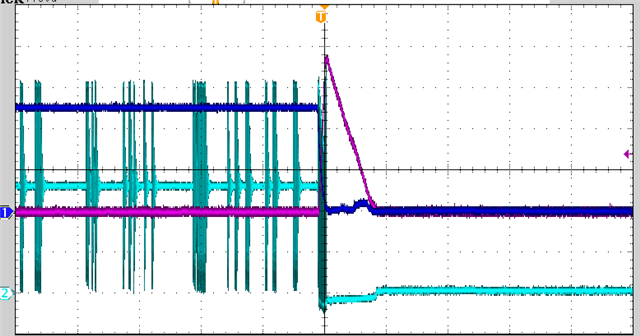
When I tested TPS5450 with a long, thin cable, firstly in the unloaded condition, and then I shorted the cable (about 7~8 meters long, so in the waveform below, the output voltage is not 0, my customer's real working condition), why hiccup mode protection did not trigger? Even the current is high as Current Limit marked.

In the waveform below, CH1_Vo, CH2_ PH, CH3_iL, the current is high at middle time of the picture, but no hiccup mode is triggered.

When I do this experiment with a short cable, the hiccup mode protection can be triggered. CH1_Vo, CH2_ PH, CH3_iL

Are there other requirements for the hiccup mode protection? Like Vsense<0.4Vref(In LMR51430)?

Thanks!

Best Regards,

Bowen

  • Hello Bowen,

    Please provide your schematic for review and help me understand what the initial setup power conditions are in your waveform (VIN, VOUT, IOUT, FSW). 

    For the device to be in hiccup mode the VOUT would need to have experienced a short circuit event (loading close to 0Ohms between VOUT and GND) and then it will enter hiccup mode.

    What do you mean by shorted the cable? You have a long 7 meter for VOUT+ and GND and shorted each cable to reduce the cable length? Or did you short the VOUT and GND power rails together and that's what you meant by that comment?

    Regards,

    Jimmy 

  • Hi Jimmy,

    Thanks for replying.

    I used the TPS5450EVM to do the test. Vin=10V, Vout=5V. And Vin is relatively stable provided by a power source.

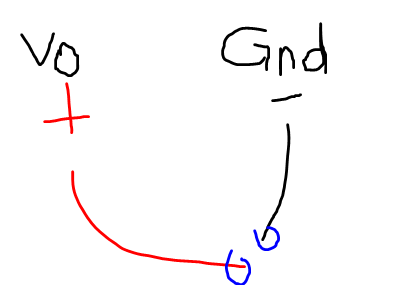
    The 7~8 meters long cable is firstly opened circuit(disconnected), and then, I shorted the terminals in blue circle as shown in the picture below. Because in the waveform with long cable, the iL should be up to be current limit for very long time and PH still switching, but TPS5450 did not enter hiccup mode, so i doubt if there is another requirement for hiccup mode protection like LMR51430?

    You mentioned the load should be close to 0Ohm, so does it mean TPS5450 will also detect Vsense to determine whether it's a real short circuit or a very heavy load (small Ro but not close to 0Ohm)? 

    Thanks!

    Best Regards,

    Bowen

  • Hi Bowen,

    While I look into this, I was wondering if it makes more sense to transition to a new device. 

    Note that the TPS5450 is in the process of being discontinued and it may make more sense to pivot to the newer process devices for future designs if you haven't already done so. 

    Regards,

    Jimmy

  • Hi Jim,

    Actually, this is a project that my customer is doing, and i am repeating their issue using TPS5450EVM, they use several million units of our TPS5450, so this issue needs to be figured out.

    Regarding to EOL, yes, the customer knew this, and is finding solutions recently, but i need to figure out this problem for their mass produced products. In datasheet that i cannot find something like Vsense<0.4Vref(In LMR51430) to enable the counter of hiccup mode? But could you please check if there are other enable functions to enter hiccup mode?

    Because in the waveform with long cable, the iL should be up to be current limit for very long time and PH still switching, but TPS5450 did not enter hiccup mode, so i doubt if there is another requirement for hiccup mode protection like LMR51430?

    Especially for the black circle part, why the overcurrent limiting protection is not triggered?

    Thanks,

    Best,

    Bowen

  • Hi Bowen,

    Update: 

    In short circuit condition, once the chip detected current limit within min Ton time for two consecutive cycles, it enters hiccup mode. However, in order to hit current limit within min Ton time for two successive cycles, it requires the load resistance to be small enough. The internal DE team had previously tested that if the load resistance was more than some value (i.e. maybe a few hundreads of milli ohm), it could not enter testmode, instead it just stay in steady state. 

    The long cable vs short cable may be impacting the load resistance here.

     Regards,

    Jimmy 

  • Hi Jimmy,

    Thanks for your feedback!

    However, in order to hit current limit within min Ton time for two successive cycles, it requires the load resistance to be small enough.

    In the picture below, tested with 8m long cable, CH1_Vo, CH2_ PH, CH3_iL, if the load resistance needs to be small enough to hit current limit, why the CH2(PH) voltage enters overcurrent limit in the middle of the waveform, why it did not enter overcurrent limit for the cycles before it?

    Could you please further confirm this with team?

    Thanks!

    Best,

    Bowen

  • Hi Bowen,

    Thanks for the zoomed in image

    I may need to go back to design on this, but looking at that waveform you circled, the two black SW nodes are not in a single consecutive cycle. There are switching behavior in between the two SW pulses. Will get confirmation on this.

    Regards,

    Jimmy

  • Hi Jimmy,

    Any updates on this waveform? Yes, the 2 black SW nodes are not consecutive, but why did the TPS5450 goes into overcurrent limiting mode at these two cycles? But not in other cycles with higher current?

    Thanks,

    Best,

    Bowen

  • Hello Bowen,

    The explanation from design I got are quoted below. 

    "

    To enter hiccup, high-side current (or IL) needs to hit current limit within min Ton window, for two successive cycles. Min Ton spec is roughly 150ns (if I remember correctly). In other words, only if high-side current hits current limit within the first 150ns for two successive cycles, the chip can enter hiccup.

    The above condition can only be met if the load resistance is small enough. If Vout is shorted by some large resistance (i.e. more than 100mohm, roughly), it will hit current limit at some point, but not within the first 150ns (for two consecutive cycles). That is why it cannot enter hiccup. Looking at the waveforms, there are two short pulses. They may or may not be narrow enough within 150ns. Even if they are, they are not consecutive, and that is why it didn’t enter hiccup." 

    From this description it looks like the device is in a "current limit" but not in "hiccup mode". 

    Regards,

    Jimmy

  • Thanks a lot Jimmy!

  • Thank you for using the E2E forum. 

    I will close this thread for now. If you have any further questions on this, please reply back and it will reopen for further assistance.