This thread has been locked.

If you have a related question, please click the "Ask a related question" button in the top right corner. The newly created question will be automatically linked to this question.

BQ25120A: Unexpected switching pattern and noise one some units

Part Number: BQ25120A


Hello,

We have the BQ25120A on 10 prototype PCBs.  8 of them work as expected, but 2 of them have much higher VSYS ripple.  This is all done at VSYS 1.75V and 100uA-300uA current (changes dynamically with device function but the problem persists regardless of current) with 2.2uH/10uF output filter.

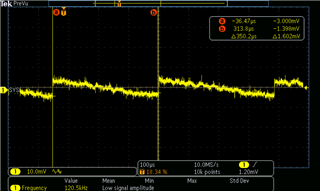
The 8 good units measure something like this:
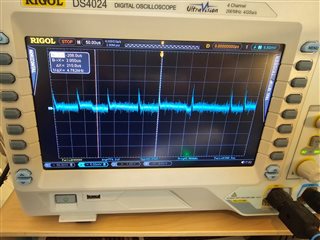
The bad units look like this:
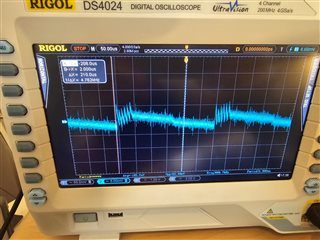
The discharge slope varies a bit between images due to the variation in current but the problem is always the same.  The "good" switching sequence is what I would expect, but the "bad" sequence seems to enable SW several times in bursts and drive VSYS much higher and then wait for larger droop before switching multiple times again.

I have tried transplanting "good" inductors and caps to the bad boards and changing pretty much all components around the BQ but it makes no difference.  I have replacement BQ parts on order so I can change those as well. The "good" waveform is what I would expect from VSYS.

Questions:

1. Is this difference in switching behavior expected?

2. What are the 2 different switching modes shown in good and bad?  I don't see the burst of "bad" SW enables in the spec sheet anywhere.

3. What causes 2 BQ parts to switch so differently under very similar conditions?

4. How can I prevent this difference in switching and lower the output ripple to always be like "good"

5. Are there hidden registers to modify this behavior so that all BQ units will behave like "good"?

Cheers

  • Hi,

    Can you please share some of the following so that we can try and determine what is going on:

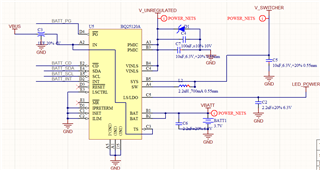
    - Is this a on your board or using the EVM, if it is your board can you please share the schematics?

    - What are your test conditions (i.e. Input voltage, input current limit, battery voltage, any loads applied to the system).

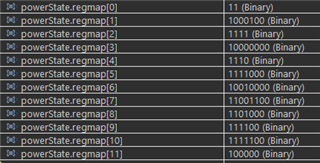
    - Can you please share the device register values on the "bad" switching parts

    I have replacement BQ parts on order so I can change those as well.

    - Please let me know if replacing the "bad" switching units changes the behavior 

    Best Regards.

  • This is on our custom board:

    Test conditions are:

    * Input/VBUS: 5V voltage source with 100mA current limit (provided by our test jig)

    * Battery:4.2V voltage source with 100mA current limit (this is provided by our test jig and BQ25 charging is disabled for these tests but at 4.2V charging will not take place anyway so I don't think that's related).

    * Load: 10uF-40uF decoupling, 1.75V @ 100uA to 300uA current (I tried reducing decoupling caps but that makes no difference).

    Registers:

    It will take some days for me to get the parts so I'm hoping for more insight before then...

    Cheers

  • I forgot to add that V_UNREGULATED load in this scenario is 10uA (a switcher running in low power mode), but changes in unregulated load up to 30mA does not affect the issue.

  • Thank you for the additional information, I'll take a look to see if I can't identify any causes or if I can replicate the behavior.

    Best Regards.

  • I managed to replace the 2 "bad" BQ25 parts with new ones and the problem went away (without any other modifications to the boards).  So it seems that some BQ25 units behave badly.  Is there a reason why the "bad" BQ25 would generate several clustered pulses and drive up the voltage so much more than the good units?

  • Hi Philip,

    It is difficult to say exactly why the ripple current looks the way that it does. It can be a function of the buck, load, capacitance, inductance, board layout and soldering. I haven't been able to recreate either of your ripple waveforms using some typical loads on a few different units.

    From looking at the second waveform you shared seems to be indicative of a heavier load towards the start (higher frequency switching) followed by a lighter load (lower frequency) for the rest of each cycle. Additionally,  Your waveform does seem to indicate a heavy load at the beginning but surprisingly little oscillation after the initial spike. These don't seem to indicate a constant load profile. This is what switching would typically look like with a No load,100 uA load and 30 mA load.

    No load:

    100 uA:

    30 mA:

    Can you please share these waveforms with the switch node also probed for comparison? Also, does the different ripple cause unwanted behavior in your final application?

    Best Regards.

  • Hi Juan.

    Agreed that this issue has a lot of variables so it's difficult to pin down.

    It appears that your waveforms are essentially the same as our first/good waveform (except for differences caused by measurement setup and some load variability in our setup). What is the vertical scale in your images?  I cannot find it your captures.  In my first "good" waveform I see about 1mV ripple and in the second waveform 5mV ripple.  In your images it appears that ripple amplitude stays pretty constant and only frequency changes (as one would expect).  Between my 2 waveform the amplitude changes 5x.

    You mean probe both sides of the inductor for comparison? The "bad" units are now fixed so I cannot take any "bad" measurements anymore. 

    The ripple does cause unwanted noise in our application because it presents itself in the 1KHz to 4Khz audio spectrum and is difficult to filter out.

    You mention our second waveform may have heavier load towards the start (thereby causing multiple consecutive pulses), but looking at the waveform in detail indicates that this is not the case. I would expect to see clustered switching pulses as shown in my second waveform if load bursts caused additional droop, but it appears that each pulse raises the voltage as expected yet the BQ25 logic triggers additional pulses on the "bad" units.  Our load is an ARM M4 so it is not constant load as in your measurements, but the odds of the load always being heavier when BQ25 starts switching is almost zero.

    The fact that on both bad units changing to a new BQ25 fixes the issue seems to indicate fundamentally different switching behavior between the good and bad BQ25 units?  The good units appear to have 1mv resolution in the switching logic while the bad units had 5mV resolution. 

  • Hi Philip,

    What is the vertical scale in your images?

    The images have a 10 mV / Div scale, with AC coupling. The DC value is about 1.8V.

    In my first "good" waveform I see about 1mV ripple and in the second waveform 5mV ripple.

    My mistake, it was a bit difficult to see the the 1mV ripple vs the load variability in the setup, that makes more sense now.

    You mean probe both sides of the inductor for comparison?

    Yes, by probing the SW side of the inductor, I was hoping to identify how the switching correlated with the ripple.

    The good units appear to have 1mv resolution in the switching logic while the bad units had 5mV resolution. 

    I'll look into the device by device variation that might be present or other factors that might be affecting this ripple. Replacing the units does seem to indicate some device variance. 

    Can you please share your schematic? 

    Best Regards,

    Juan Ospina

  • Hi Juan.

    Looking forward to what you find.  I already previously posted the schematic above...

    Cheers

  • Hi Philip,

    That's right, I'll review it to see if there's any changes that can be made to improve ripple.

    Best Regards.

  • Hi Philip,

    It appears there's a few things that can potentially be done to reduce the effect of this ripple on your application:

    changing pretty much all components around the BQ but it makes no difference.

    - I'm not sure if you tried replacing the components with the same value, but changing the inductance, maybe to around 1.5uH, may reduce ripple.

    - Adding a resistive load to the output could provide an RC constant that moves the switching frequency outside of the audio band, at the cost of some power efficiency, increasing output capacitance can also have an impact.

    If you can find any more units with the unwanted switching, it may help to probe inductor current in addition to the SW node.

    Best Regards,

    Juan Ospina

  • Hi Juan.

    I did not try a 1.5uH inductor but will do so if I encounter another bad board.

    Adding a purely resistive load is not an option due to power constraints.  Also, I don't think this will help unless considerably more power is drawn because during my tests the  problem happened in our entire 100uA to 350uA power range.

    Output capacitors somewhat filter the noise but did not affect the bad BQ25 clustered switching.  In addition to the 10uF in the schematic I posted, I added an additional 10-40uF without change in the clustered switching pattern.

    When I have additional bad units I will post here.

    In the meantime do you have any other insight as to why different BQ25 units would behave so differently?  Production or calibration variations?

    Cheers

    Philip

  • Hi Philip,

    I'm still looking into the possible cause on this device by device variation, I don't believe it would be production related so potentially calibration but I can't really confirm that currently.

    Best Regards,

    Juan Ospina