This thread has been locked.

If you have a related question, please click the "Ask a related question" button in the top right corner. The newly created question will be automatically linked to this question.

LMG1205: Output Undershoot that can be reliably sustained?

Part Number: LMG1205
Other Parts Discussed in Thread: LMG1210

Team,

We had a discussion about the output voltage undershoot already:
https://e2e.ti.com/support/power-management-group/power-management/f/power-management-forum/1138025/lmg1205-voltage-undershoot-below--0-3v/4224618#4224618
and the datasheet was supposed to be improved to clarify this aspect.

Are we able to clarify the max energy rating relative to undershoot that the LMG1205 could sustain?

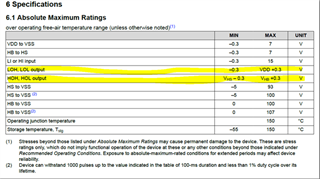
The datasheet specification have not changed to this respect (see table 6.1 below).
What has been added in rev B is section 7.3.3 (HS Negative Voltage and Bootstrap Supply Voltage Clamping).

I will share offline measurement that have been done for rising edge of HOL / HOH on the actual HW.

Thanks in advance,

Anthony

  • Hey Anthony,

    Thank you for reaching out regarding the LMG1205.

    I reviewed the scope captures and images that you sent.

    The E2E that you referenced is saying that we are improving how we spec this rating in our new products and their datasheets. We do update and revise our datasheets but at this time we are not adding any specifications to this product at this time.

    We do not have a max energy rating for undershoot. The only thing that we have is the Abs Max specification that you have highlighted above and we cannot guarantee operation outside of that.

    Looking at the scope captures and information that you sent via email, it is possible that the device is not damaged in this condition because the amount of overshoot and duration is not far beyond the spec. Again, we cannot guarantee that.

    For minimizing the undershoot that you are seeing, there are some options for helping reduce this. This includes increasing gate resistance and/or adding a Schottky clamping diode.

    Let me know if you have any questions.

    Thank you,

    William Moore

  • Hi Anthony, Hi William.

    It was me, who started the discussion. Thanks for putting this forward.

    Our problem by increasing the gate resistor is, that we stand to lose high thermal performance. And before doing that, we want to confirm, if thermal damage can occur. We once worked with schottky diodes, but they did not clamp the voltage.

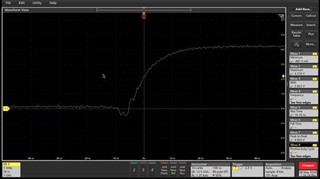
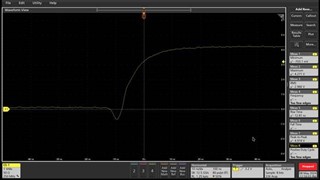
    I want to share the signals, so others can comment:

    HOL (Measured with 1Ghz scope and IsoVu TIVP1 probe)HOL (Measured with 1Ghz scope and IsoVu TIVP1 probe)

    All measured with an 1GHz scope and 1GHz active probe. (Left HOL, Right HOH).

    We would really appreciate, if we find a solution to have a better understanding about the thermal damage that can occur.

    Thank you and kind regards

    Stefan Weller

  • Hey Stefan,

    Thanks for sharing these scope plots.

    With the short instance that HOL and HOH go below 0V and beyond the -0.3V Abs Max specification, it is possible that this might not damage the gate driver. But, because this exceeds the datasheet ratings we cannot guarantee that the gate driver will survive.

    We have another half-bridge GaN driver in the LMG1210 that offers -0.5V negative rating on the output pins which is better than that of the LMG1205. The LMG1210 is also a 200V 1.5A/3A driver as opposed to the 90V 1.2A/5A rating of the LMG1205.

    We do not have a rating for the maximum energy on these pins.

    Layout is very critical for GaN gate driver circuits and we are able to review that if you are able to share either here or via email. By improving the layout, this can help reduce the undershoot that is being experienced on the outputs.

    Let me know if you have any questions.

    Thank you,

    William Moore