This thread has been locked.

If you have a related question, please click the "Ask a related question" button in the top right corner. The newly created question will be automatically linked to this question.

BQ24725A: Charger output capacitance

Part Number: BQ24725A
Other Parts Discussed in Thread: BQ24725

Tool/software:

Hello, 

I'm intending to use the BQ24725a charger in my design for charging in up to 9A charging current and voltage 12.5v. 

According to the Typical Application and also according to the EVM scheme the Cout is up to 30uF not more. It is written there that it was planned for charging in about 3A-4A. 

My question is what shall be the charger output capacitance (C-out) on the phase pin after the inductor in case of charging in about 9A-10A? 

From what I'm familiar with, usually the output capacitance of buck converter when output current is 9A-10A is around 300uF so 30uF and even 60uF looks surprising to me. 

Could you also send a tool for calculating the charger output capacitance dependent the output current/voltage ? 

Thanks, 

Ohad

  • Hello Ohad,

    We don't have a design tool for the BQ24725A.

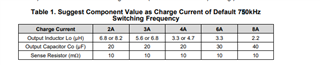
    Here is are the suggest component value for a default 750kHz switching frequency.

    From what I'm familiar with, usually the output capacitance of buck converter when output current is 9A-10A is around 300uF so 30uF and even 60uF looks surprising to me. 

    For a 9A-10A charging current I recommend using a 2.2uH inductor and Cout of around 40uF-50uF.

    Best Regards,

    Chistian.

  • Hi Christian, 

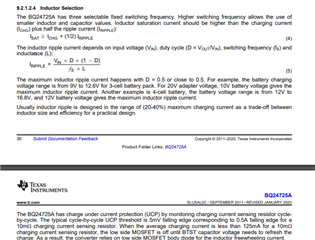
    Thanks, but consider that the current is not always 9A, it is estimated to be that rate about 50% of the time, even less... most of the time it will be between 4A to 7A and adding the fact that we work with 615KHz, from the formula for Inductor selection appears in the BQ24725A datasheet, the result was L=7uH, so I took 6.8uH. 

    Regard the Cout, still from what I'm familiar regard Buck or boost converters, usually Cout with Iout ~10A , is about hundreds of uF.. 

    That at least the case with buck/boost converters. I don't know why for chargers it is only tens of uF , however there is no formula for Cout capacitor in datasheet...

    Ohad 

  • Hello Ohad,

    Thanks, but consider that the current is not always 9A, it is estimated to be that rate about 50% of the time, even less... most of the time it will be between 4A to 7A and adding the fact that we work with 615KHz, from the formula for Inductor selection appears in the BQ24725A datasheet, the result was L=7uH, so I took 6.8uH. 

    We recommend choosing the inductor based on the maximum charge current.

    Regard the Cout, still from what I'm familiar regard Buck or boost converters, usually Cout with Iout ~10A , is about hundreds of uF.. 

    I can't speak on other buck or boost converters because I do not directly support them. However these are the values that have been chosen for the BQ24725 and we have not had any major issue so far.

    That at least the case with buck/boost converters. I don't know why for chargers it is only tens of uF , however there is no formula for Cout capacitor in datasheet...

    Best Regards,

    Christian.

  • Hi Christian, 

    So what you meant here is to use Icout=Cout x dVout/dt and from there to derive Cout ? What id the dt here ? 

    Ohad

  • Hello Ohad,

    dVout/dt is the change in voltage in respect to time.

    Best Regards,

    Christian.

  • Hi

    I know what is dvout/dt. You gave me a formula for Icout while what I asked if there is a formula for Cout. 

    So what did you exactly mean by giving a formula of Icout ? To derive Cout from it ? How ? 

    If your intention was to derive Cout from : Icout=Cout x dVout/dt than what is the dt that shall be taken here to put in the formula in order to calculate Cout ? 

    Ohad

  • Hello Ohad,

    We don't have a calculation for choosing the inductor and output capacitors. We have suggested components values based on the selected charge current.

    As you previosly mentioned, you selected the 6.8uH inductor.

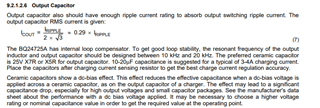
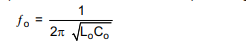
    We suggest To get good loop stability, the resonant frequency of the output inductor and output capacitor should be designed between 10 kHz and 20 kHz. Based on this information you can derive Cout from this equation.

    For a 9A-10A charging current I recommend using a 2.2uH inductor and Cout of around 40uF-50uF.

    Best Regards,

    Christian.

  • Hi Christian, 

    But If 9A-10A is only 5% to 10% of the time at the most... and the other part of 90% to 95% of the time current is up to 4.5A, still to choose Inductor according to 9A-10A ? 

    Ohad 

  • Hello Ohad,

    Why is the charge current only 9A-10A for 5%-10% of the time? Are you changing the charge current during the charge cycle?

    Best Regards,

    Christian.

  • Hi Christian,

    Not during the same cycle, I mean in general. Look, this charger is used for charging a battery in a Power bank. (x Batteries demands x chargers). Charging in 9A means charging rate of 1C. That won't be the rate all the time. Charging rate could be 0.5C, 0.2C etc..  But we need to ensure 1C (9A) is optinal. 

    Ohad

  • Hello Ohad,

    Yes, The charge current will not always be 9A. The battery will have to go through the pre-charge stange, at a lower charge current, until the battery reaches the fast charge threshold. However, if the fastcharge current is programmed at 9A, I recommend using a 2.2uH inductor and Cout of around 40uF-50uF.

    Best Regards,

    Christian.

  • Hi Christian, 

    I didn't mean that. I know about the battery charging procedure from pre-charge till fast charge. I meant that the system will usually work in a way that the batteries are charged in between 4.5A to 6.5A in its regular state after waking up from pre-charge. 

    Ohad

  • Hello Ohad,

    Thank you for the clarification. In that case I don't see any obvious issues with your chosen inductor.

    Best Regards,

    christian.