This thread has been locked.

If you have a related question, please click the "Ask a related question" button in the top right corner. The newly created question will be automatically linked to this question.

LP5813: Recommendations on ESD protection for OUT terminals

Part Number: LP5813


Tool/software:

Hello -

We are using the LP5813 to power a number of LED's.  Most concerning is 2 LED's that are integrated into an RJ45 Jack which customers will plug a CAT5/6 cable into.  We plan to use the boost converter in 3.0V default mode.

We are considering a few ESD protection options:

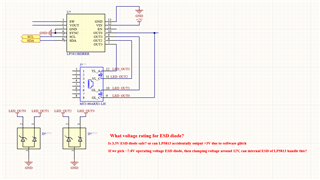
Option 1)  3.3V ESD diode - pros:  should clamp below the Abs Max 6V of the device  cons: we are concerned that if the boost regulator exceeds its programmed rating for whatever reason, the OVP wont catch till till 6V, and the ESD diode will go into thermal runaway.

Option 2) 6.5-7V ESD Diode - pros:  even if LP5813 boost converter somehow goes to its max value, the ESD diode will not conduct.  cons:  the clamping voltage will be in the 10-12V range, which well exceeds the abs max of the IC.  If this were an MCU, we would typically throw a 500-1K ohm resistor in series for reducing that current but I don't think that is an option here.

Any recommendations for how best to provide ESD protection on the LP5813? 

Thank you

Leon

  • Hi Leon,

    Thanks for reaching out!

    Can you please show me a simplify block diagram to let me understand your requirement more clearly? Thanks!

    BR, Jared

  • Please let me know if this is helpful or need more details, thanks! (I did not show inductor or EN pin yet, please focus on the outputs)

  • Hi Leon,

    Thanks for your information. I have a question about the ESD diode since I am not the system expert, so I am curious that why we need to add a ESD diode on the output, do we have any concern on that. I will ask for our system expert for help when I figure it out. Thanks for your clarify.

    Actually, the output voltage is decided by the VOUT based on your schematic since you used the TCM mode for LP5813, so the maximum output will be decided by boost VOUT. So if you decided to use 3.3V ESD diode, please make sure the boost VOUT can't exceed 3V.

    Btw, I have another question, I am curious that why you choose LP5813 for only 2 LEDs. Can you please tell me the reason? Thanks!

    BR, Jared

  • Thank you Jared.  
    - we have five versions in this product family with between 2 and 9 LEDs. So we want to use a standard part. 
    - several versions of product are battery powered from battery that goes below 2V.  so we need boost to make sure LED can still conduct. 

    the LP5813 is only product I can find with multiple LED and integrated boost. However, do you have any other recommendation? 

    thanks

    Leon

  • Hi Leon,

    Thanks for your explanation! LP5813 is just designed to fit the application you mentioned above.

    But I still don't know why you need to add a ESD diode on output since I am not an expert for whole system and based on the customer case I met before, I didn't meet such requirement.

    Or maybe can you please send your LED spec datasheet to me? Then I can judge that if you need the boost output over 3.3V. If your LED spec can work under 3.3V, then I think 3.3V ESD diode will be fine.

    BR, Jared

  • https://app.adam-tech.com/products/download/data_sheet/203899/mtj-88arx1-lp-data-sheet.pdf
    here is datasheet for RJ45 with LED built in. Unfortunately, these manufacturers do not provide detailed specification for LEDs. None of the companies I looked at give any detail, only show which side is anode or cathode.  It will work at 3V or less even I think. 

    however, my question really doesn’t concern the LED very much. really the question is: can we use 6-7V rated esd diode (clamp voltage 12V) to protect LP5813 output, and then LP5813 will be okay with the extra voutage because of its internal ESD diodes (clamp from 12V to 6V) and avoid damage for short pulse.  

    thank you

    Leon

  • Hi Leon,

    Ok, I got you and after the discussion with our expert. We both think the output can not accept this voltage since the absolute maximum rating of output is only 6V. We can't guarantee 12V is a safe voltage on output.

    BR, Jared