This thread has been locked.

If you have a related question, please click the "Ask a related question" button in the top right corner. The newly created question will be automatically linked to this question.

Quiescent/low-load current is higher than anticipated

Part Number: TPS631010
Other Parts Discussed in Thread: TPS63900

Tool/software:

Hi Forum,

We're developing a solution that uses 3x AA Alkaline batteries as power source. The expected input range is voltage 2.7V to 5.3V and the output should be 3.3V.
We expect a peak current on the 3.3V side of ~800mA, 100mA to 400mA typical.

The device will be in a deep sleep mode for 99.9% of the time which makes the deep sleep current having the biggest effect on battery lifetime which we measure in years.
During testing of a prototype, the 3.3V rail (without the TPS631010) had a deep sleep current consumption of 15µA to 20µA.

When using the TPS631010 with 5V input voltage and our load, we see the average current consumption jump to 45µA which is not acceptable for our application.
We then measured the current consumption without load at 5V (34µA), 3.3V(19.8µA) and 2.7V (20.6µA) as well.
Are those expected values?

In the datasheet, 8µA are mentioned as typical quiescent current while our values are way higher. Why could that be?

Do you have recommendations on how we can reduce the current consumption further for the given component?

As last resort we could switch to a TPS63900 even though the cost is much higher. Would we nevertheless see such a high increase in the Iq compared to the datasheet as we did for the TPS631010?


Thanks,
Lars

  • Hi  Lars,

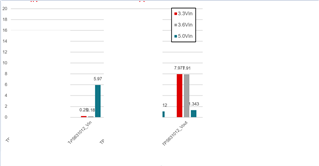
    For device itself,  8uA typical quiescent current is measured under non switching. which means no load absolutly. Please see the data below.

    Some suggestions to find out the root cause of this high consumption in your system below, please check.

    • Actual load of your downstream in your system?
    • The leakage current of external components. such as input and output capacitor and D301, leakage current of Pmos from drain to gate path.
    • To ensure measurement is trustable,  pulsed load shouled be avoided.

    Regards

    Tao

  • Hi Tao,

    thanks for your reply. I have some further questions for you.

    For device itself,  8uA typical quiescent current is measured under non switching. which means no load absolutly.

    What should be the expected overhead of the TPS631010 when the load is 15 µA to 20 µA? Is the TPS631010 the Buck-Boost you recommend for this use case?

    Actual load of your downstream in your system?

    As mentioned above, the current consumption of the 3.3V rail during deep sleep is 15µA - 20 µA. We want to optimize for that to get the most out of our batteries.

    The leakage current of external components. such as input and output capacitor and D301, leakage current of Pmos from drain to gate path.

    Thanks for the hint. We will have a look at the selected components and look for ones with reduced leakages.

    To ensure measurement is trustable,  pulsed load shouled be avoided.

    During deep sleep there is no pulsed load.

    Thanks,
    Lars

  • Hi  Lars,

    What should be the expected overhead of the TPS631010 when the load is 15 µA to 20 µA? Is the TPS631010 the Buck-Boost you recommend for this use case?

    Yes, since peak current is 800mA in your case, i think we do not have better option than TPS631010.

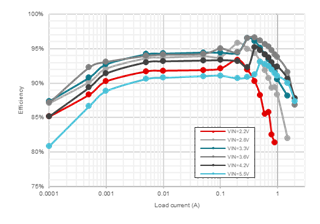
    According efficiency curve below, i think consumption you got is reasonable. 

    Regards

    Tao