This thread has been locked.

If you have a related question, please click the "Ask a related question" button in the top right corner. The newly created question will be automatically linked to this question.

TPSI31P1-Q1: Minimum average current

Part Number: TPSI31P1-Q1


Tool/software:

Hi,

I'm currently trying to set up a precharge design with the TPSI31P1-Q1 and I would like to know, what's the minimum average current I can set.
As I assume, the only chance for me to set current limits, is via the shut resistor. But increasing the value to high, results in an overheating shunt resistor.

Is it possible to set the average current down to like 500mA @400V and allow precharging over several seconds?
Or is it possible to delay the off time while switching (or implement some kind of pulse skipping)?

Best regards
Ludwig

  • Hello Ludwig,

    Thank you for reaching out to our team's E2E. The team is looking into your request and will provide input in 24hrs.

    Best regards,

    Hussain

  • Hello Ludwig,

    Thanks for reaching out to our team on E2E!

    You can certainly turn off enable in the middle of precharge or PWM enable to delay precharge. The link capacitor will just spend some more dwelling at intermediate voltage(s) before it is fully charged.

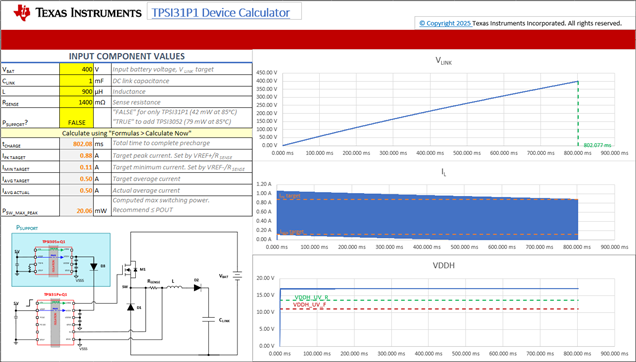
    We also have a calculator tool helpful for modifying component values and seeing how that affects the precharge behavior, TPSI31P1-CALC. We can also achieve IAVG = 500 mA with a 900 µH inductor and 1400 mΩ sense resistor.

    Best regards, 
    Tilden Chen


    Solid State Relays | Applications Engineer

  • Hi Tilden,

    Thank you for you answer.

    Unfortunately, the calculation document doesn't seem to work properly:


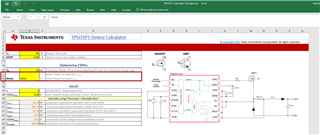
    The calculations sheet is completely grey and the graphs and some values are missing.
    Is there anything to consider when working with this calculation sheet?

    I will use your values and try my measurements again.

    Best regards,
    Ludwig

  • Hello Ludwig,

    Thank you for reaching out with this TPSI31P1-CALC question. Sorry to hear that you are having trouble viewing the calculations.

    To help debug, if you have not done so already, may you please follow the steps in the "0 INSTRUCTIONS" tab:

    From there, please move on to the "1 Determine CDIVx and Qg tab", the simplest way to use this tab is in "Solve" Mode:

    Lastly, please proceed to the "2 Model Precharge Behavior" tab and renter your desired values. Once the fields are complete, press the "Calculate Now" button:

    *Note: The example shown above has the same inputs as shared by Tilden previously.

    Thank you and let us know if there are further questions.

    Best,

    Hussain

  • Hello Ludwig,

    Thanks for your reply and sorry to hear about your issue with the calculator tool. Seems like sometimes customers who use Excel non-English version experience the same issue, I cannot effectively debug this at the moment, but I built a simulation model of the precharge circuit in QSPICE.

    One limitation here is this circuit does not model the TPSI31P1 switching power available, when simulating here I recommend manually double checking the switching power consumption at maximum switching frequency.

    Switching Power Calculation

    PSW_MAX = VDDH_UV_F × QG × [VBAT ÷ 4 ÷ L ÷ (IPEAK - IMIN)]

    PSW_MAX = 11 V × 14 nC × [400 V ÷ 4 ÷ 900 µH ÷ (0.857 A - 0.114 A)]

    PSW_MAX = 23 mW (recommend keeping this below 42 mW)

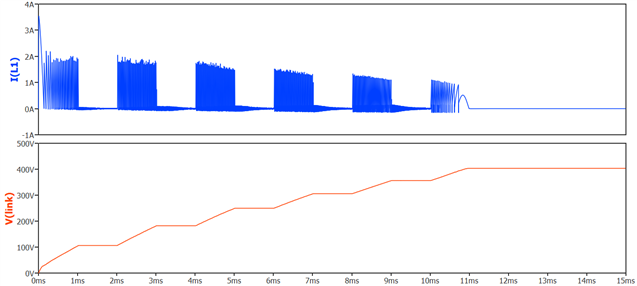
    QSPICE Simulation

    I am simulating the behavior of PWMing the TPSI31P1-Q1 EN at 0.5 kHz, 50% duty cycle (1 ms on and off). To save time, I am only simulating with CLINK = 0.01 mF. Since this circuit charges linearly, I would estimate 1 mF to require 100x the time of 0.01 mF. In this case, around 1.1 seconds. The simulation numbers seem a bit off, but this simulation model may help as a starting point to understanding PWM EN behavior.

    https://e2e.ti.com/cfs-file/__key/communityserver-discussions-components-files/196/precharge.qsch

    Best regards, 
    Tilden Chen


    Solid State Relays | Applications Engineer

  • Hello Hussain,

    thank you, for your explanation.
    Unfortunately, it didn't help. It seems that Tilden is right and the tool doesn't work with the german excel.

    Best regards,
    Ludwig

  • Hello Tilden,

    thank you very much.
    I will try with your suggested values.

    Best regards,
    Ludwig

  • Hello Ludwig,

    Thanks for your reply.

    For the Excel calculator, please also try changing your language settings to English if possible to see if this fixes the issue. Seems like different languages may have different function names, which would cause the back-end calculations to misbehave. Long-term, I will see what I can do to make it multi-language friendly if this is the root cause.

    Best regards, 
    Tilden Chen


    Solid State Relays | Applications Engineer