This thread has been locked.

If you have a related question, please click the "Ask a related question" button in the top right corner. The newly created question will be automatically linked to this question.

LM5156: Online WEBENCH Designer problem

Part Number: LM5156


Tool/software:

Hi TI,

Trying to simulate SMPS based on LM5156 and SEPIC topology I noticed that critical values such as diode RMS and peek current are not provided. Only power dissipation is listed.
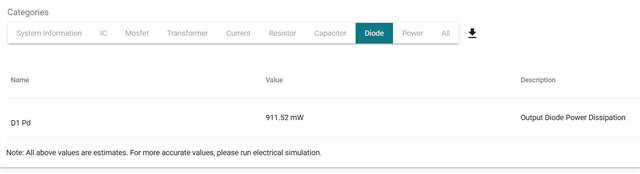
For switching transistor at least RMS current is available. Peek current would be helpful as well.

Kind regards,

Thomas

  • Hi Thomas,

    Thanks for reaching out.

    I recommend to use our power stage designer for this: https://www.ti.com/tool/POWERSTAGE-DESIGNER

    It will show all the values you are looking for.

    Best regards

    Moritz

  • Hi Moritz,

    Thank you. It is probably still worth improving WEBENCH since missing values are critically important.

    Kind regards,

    Thomas

  • Hi Moritz,

    I tried using Power Stage Designer. Although it does not calculate loop compensation components, it does have one significant advantage: it is able to calculate values ​​for single (separate) inductors, while both the online WEBENCH calculators and the official Excel LM5156 calculators do not have this valuable option.
    Needless to say, coupled inductors usually have to be custom-made and only make sense for large-scale production, unless they can be hand-wound.
    But here's an interesting observation. All three tools give significantly different inductor values ​​for the same input parameters.
    For Vin 6.5 - 35V, Vout 12V, Iout 2A, inductor current ripple ratio 30% and f=2.15MHz the following inductors are recommended:
    - Excel LM5156 calculator 2.33uH (coupled)
    - WEBENCH 4.16uH (coupled)
    - Power Stage Designer 9.95+3.61uH (coupled) or 19.91+7.22uH (single)
    - DeepSeek 1.59uH + 3.26uH (single) -> 2x 3.3uH
    - Chat GPT 1.5uH + 1.5uH (single)
    Which values should I choose for separate/single inductors?
    The results obtained with DeepSeek and Chat GPT seem to be the most convincing because they are consistent and contain all calculation steps, which cannot be said about other tools. However, these results can be wrong.

    Kind regards,

    Thomas

  • Hi Thomas, 

    Although it does not calculate loop compensation components,

    It does. After filling in the design parameter, choose "Loop calculator" in the upper left corner.

    Power Stage Designer 9.95+3.61uH (coupled)

    For coupled inductors, there is only one inductance value. Its a bit misleading in power stage designer, but you can see that when selecting coupled inductors, the field for Inductance L2 will grey out. 

    Now to the different values:

    The reason is the rippple current you select. The powerstage ddesigner will stay below the selected riple for the whole input voltage range. So it selects the 9.9u with respect to the 35V input. 

    In the excel tool you have to input a typical supply value. It whill take this for the inductor calculation with respect to the ripple. For the max. input voltage the ripple will be higher then (you can see and check this in the power stage designer)

    I dont know what webench takes into account, most likely also the typical value. 

    For Chat GPT and Deep seek i cannot tell you how they calculate, but for sure the ripple will be way higher than selected. I will be around the selected 30% only for the min. input voltage.

    Best regards

    Moritz

  • Hi Moritz,

    Thank you for pointing out the above.

    Can I simply assume that the value of the coupled inductor calculated by the LM5156 Excel spreadsheet should simply be doubled if single inductors are to be used?

    Perhaps in such a case I can also assume that the peak current of L2 is 50% of the peak current of L1 -or- the value of L2 may be 50% of the value of L1.

    Kind regards,

    Thomas

  • Hi Thomas,

    Yes, when using single inductors, twice the indutance is needed compared to the coupled ones. 

    However, the advantage of using single inductors is, that you are free to choose two different values. So you could adjust the ripple of both inductors independently. 

    Best regards

    Moritz

  • Hi Moritz,

    Thank you. I want to select to different inductors since this way L2 can be smaller and footprint size is my concern.
    I have one more question regarding loop compensation, but I believe it deserves a separate topic.

    Kind regards,

    Thomas

  • Both DeepSeek and ChatGPT produce results that closely match TI's Power Stage Designer tool. However, unlike Power Stage Designer, these AI platforms provide detailed step-by-step equations and calculations, which I find extremely valuable for understanding the design process.
    To get the most accurate results from AI, be very specific with your requests. For example:
    please calculate value of inductors for SMPS power supply in SEPIC topology and the following parameters: Vin 6.5 - 35V, Vout 12V, Iout 2A and f=2.15MHz? I want to use two separate inductors and maintain max L1 inductor current ripple ratio 30% and L2 40% for the entire Vin range 6.5 - 35V

  • Hi Thomas,

    Thanks for the comment!

  • I have to say ChatGPT convinced me that for such wide Vin range (6.5-35V) there is no one correct L1/L2 solution since certain tradeoffs have to be made.