This thread has been locked.

If you have a related question, please click the "Ask a related question" button in the top right corner. The newly created question will be automatically linked to this question.

BQ24010: Charging current issue

Part Number: BQ24010

Hello,

We want to charge a 1-cell Li-Po Battery with 250mA charging current through a USB 2.0 input. Issue is that as the battery charges the charging current reduces.

With C4 (Capacitor at Vcc pin)= 100nF 

 Batt=3.5 Charging current=161mA

Batt=3.304 Charging current=176mA

Batt=3.165 Charging current=223mA


With C4 (Cap at Vcc pin)=10uF

Batt=4V  Charging current=138mA 

Batt=3.402 Charging current=223mA

Batt=3.256 Charging current=250mA

Batt=3.068 Charging current=253mA

What can be the reason that charging current doesnt stay constant? 

Please find the schematic below:
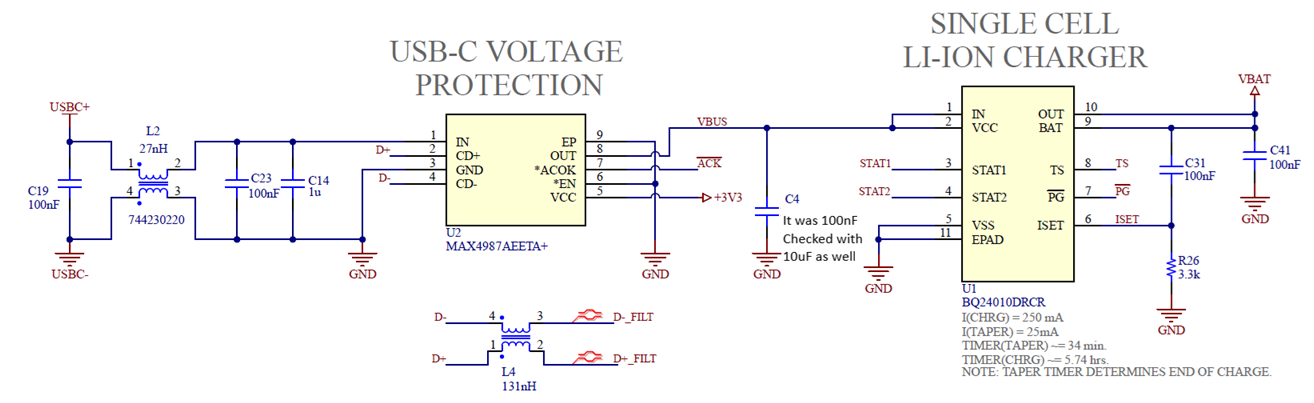
image.png

  • We are celebrating New Years and will get back to you tomorrow. 

  • Hello,

    As the battery voltage increases more power is transferred. It is possible there is another load on the USB line that is consuming power and limiting the amount of power available to the charger?

    Regards,

    Mike Emanuel

  • Hi Michael,

    Thanks for your suggestion. Checked with the current consumption on USB. There was improvement, but still we are observing that input current at L2 as well as charging current is reducing when the battery is charging. 

    Sharing one of the readings. You can reference to the schematic shared above. 

    Battery charging current=138mA

    Choke current (L2)=145mA

    Batt Voltage=3.986V 

    The charging current is set to 250mA by 3.3k resistor.

    Can you help with this?

    Any reason why its limiting the current?

    Thanks and Regards,

    Urmi

  • Hi Urmi,

    A key question was not answered. Is there another load on the USB that is not going into the BQ24010?

    If the device is not in CV mode and the voltage is increasing, I would expect the charge current to potentially increase as the LDO dropout voltage is lower. What does the actual BAT pin measure? If the device is in CV, the charge current will start decreasing. You can experiment with this by lowering the BAT voltage. However, keep in mind, the larger the difference between the input voltage and output voltage, the more likely full charge current will not be realized due to LDO dropout.

    However, can you please measure the temperature of the BQ24010? I am wondering if the layout is not ideal and the BQ24010 is getting too hot.

    Regards,

    Mike Emanuel

  • Hello Mike,

    Answering your first question. Other circuit was taking current from USB, but that issue is now solved. Apart from charger only 8mA current is drawn from USB now. 

    As mentioned the battery voltage is 3.9V , charging current is 138mA.  As per charging profile it must be in CC Mode. 

    USB =5.1V . How much is LDO voltage dropout? I will check with temperature and come back.

  • This part acts an LDO from input voltage to output voltage. Any extra power not used by the battery is dissipated as heat.

  • Hi Mike,

    Checked with temperature at TS pin as well as IC temperature. It is not getting hot, that can effect the charging current.

    Attaching layout snap below. Do let me know if anything else is required. We have 1oz copper on all layers. Trace widths are 6 mil.

    Thanks and Regards,

    Urmi

  • Hi Urmi,

    When you say the battery voltage is 3.986V, is this the battery pack voltage or the BAT pin voltage itself? If the battery pack voltage is 3.986V, it is possible the actual BAT pin may be in CV.

    Regards,

    Mike Emanuel

  • Hi Michael,

    As it is a single cell battery, so BAT pin and battery voltage are the same. 

     This IC has a drop out voltage Max 0.790V (Nominal: 0.650V), and  we are using 5V USB as input for charging . Is there any effect of dropout voltage on Charging current? If yes, do we have a graph for it?

    For any  charging current  set via ISET pin, the current reduces as the battery voltage increases. Is this normal?

    At ISET pin we observed voltage around 1.5V. Is this correct? 

  • We are celebrating MLK day and will return tomorrow. 

  • Hi Urmi,

    That is not exactly the case. The BAT pin and the battery terminal voltage will be different when charging due to the resistive drops to the battery from BAT and the internal battery resistance. Please check both the BAT pin voltage and the battery terminal voltage when charging.

    The higher the input voltage, the higher the drop out voltage. The higher the dropout voltage, the more power is dissipated from the IC to charge at a higher current. From looking in the datasheet there is no thermal regulation, but there is thermal shutdown that will stop charge if the device gets too hot.

    Again, we need to check to see what the BAT pin voltage is and what the terminal battery voltage is. If the BAT pin is in CV regulation, the charge current will start to decrease.

    No the ISET voltage should be 2.50V as shown in the D/S. Can you perform an ABA swap to confirm the operation of the chip?

    Regards,

    Mike Emanuel