TPS65219: Programming TPS65219 in final application

Part Number: TPS65219

Hi,

I a using the TPS65219. 

In the NVM programming guide (www.ti.com/.../slvucm5.pdf

it is stated as follows :
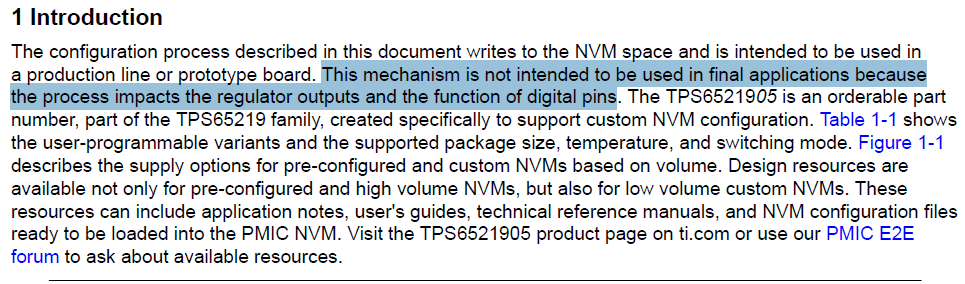
image.png

What exactly does that mean ? Is there a risk to have an overvoltage on one of the buck output when programming in final application ?

If yes, is there a way to programm in final application ?


Best

  • Hi Thomas, 

    This wording in the NVM programming guide is referring to the re-configuration of  TPS65219xx devices (excluding the TPS6521905)
    when rewriting/burning over the pre-configured NVM settings for prototyping purposes. 
    It is not necessarily an overvoltage risk, it is more of a risk of starting up with the default values, prior to any adjustments being made, and therefore damaging the system. 
    For final applications, the TPS6521905 specifically is recommended for programming use. 

    The TPS6521905 comes with mostly blank registers, and is designed to be used for user-programmable purposes. 
    This is so that there is not a risk of starting up with unintended voltages before the configuration is able to be reprogrammed, especially if programming on-board. 

    For example, if re-confguring a pre-configured device, such as the TPS6521901.
    The device must be powered in order to reconfigure the NVM.
    However, the TPS6521901 will start up to the default NVM values upon power being supplied, due to the First-Supply Detection (FSD) being enabled.
    So any changes to the voltage/timing/digital pin functions cannot be made on-board before the first power-on. 

    If done off-board in the socket EVM, then this would be the same process as the TPS6521905.

    For production use, we recommend using the TPS6521905 device and programming this in your own production flow or via a third-party programming service for larger volumes, since it is specifically designed to be reprogrammed in this way. 

    Let me know if anything needs further clarification, or if you have any follow up questions.

    Best Regards,
    Sarah

  • Hi Sarah, 

    Thanks for your clarification, it helps me a lot.