This thread has been locked.

If you have a related question, please click the "Ask a related question" button in the top right corner. The newly created question will be automatically linked to this question.

TPS54383, 24V->12V burns at no load

Other Parts Discussed in Thread: TPS54383

Hello,

we are developing a DC DC converter with the TPS54383. In first test runs the circuit worked fine but lately a TPS54383 burned down two times at no load. We have used a boot capacitor of 33nF and a boot strap resistor of 3Ohm.

If we measure the SW1 voltage we have voltage peeks up to 31V with a Duration of approx. 10ns. In the datasheet the max. voltage for SW1 is rated with 31V. So first the question if this voltage (supplied by the boot capacitor ?) is a Problem for the TPS as it's rated up to Vcc max. 28V ?


What could be a possible problem that we have killed the TPS ? We are using a 47uH coil.


Best regards,

Stephan Wille


  • Hi Stephan,

    The SW1 pin is rated for a maximum of 31V with a 50ns transient, so 10ns is fine. In general, devices are more sensitive to over voltage then over current so this is the likely cause. A few questions an comments.

    1. Do you know the input voltage at the time of the failure? Any other specifics for the operating conditions may help.
    2. Is there a specific pin which appears to be damaged, such as a SW1 short circuit to GND or a short circuit between PVDD1 and SW1?
    3. Can you post a screenshot of the measurement on the SW1 pin? Be sure the measurement is taken with the highest bandwidth setting and the GND connection to the probe is minimized to reduce any parasitic coupling.
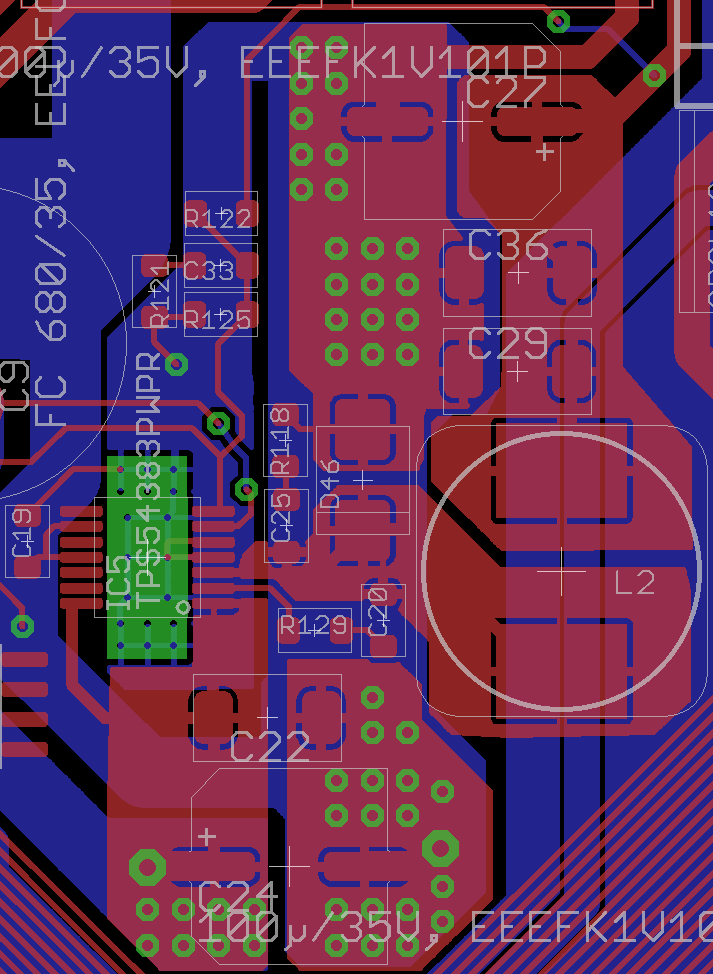
    4. Can you also post a picture of the layout?

    Thanks!

    Best Regards,
    Anthony

  • Hello Anthony,

    thanks for your help!

    We have 3 of the TPS54383 on the PCB. We had now some more faults, most time with the attached circuit. The one with the most failures is used only with one active output. Attached you'll find the schematics. layout and a screenshot of the voltage at the probe measuring the voltage between GND and the inductor at SW1.

    The voltage we supplied was 26V. The circuit will later be used at 24V.

    At one of the faults the TPS burned down totaly and destroyed the PCB. This happend at no load at the outputs so there must have been an internal short circuit. We haven't measured the defect TPS right now, I hope we still have them.

    Thanks,

    Stephan

  • Digital scope screenshot of SW1 measured at GND to inductor.

    As you can see the voltage in this case reached more than 32V. So what can we do to keep it bellow 31V? We supplied 26V in this case.

  • Hi Stephan,

    Thank you for sharing the details. Let me know if you can find the damaged parts to test for any pin shorts to ground. Based on your description it sounds like there will be.

    I didn't find anything clear to cause failures looking through the layout and schematic. Based on the feedback resistors, is the output voltage for the design with more failures 22V? This is above the minimum max duty cycle limit of 90% with a 24V input although typical designs may work fine. Please see the section called Operating Near Max Duty Cycle on page 26 of the datasheet.

    Do you know if the failures occurred immediately when powering up or did they occur after the circuit had been operating for a time period? If it occurred during start up, is it possible there is some input voltage overshoot from the input supply?

    I have doubts the ringing is the issue because the time duration above 31V is <5ns but we cannot completely rule it out yet. One thing which can be tried to reduce the overshoot is optimizing the snubber for the layout of your specific board with the following process: http://www.ti.com/ww/en/analog/power_management/snubber_circuit_design.html. Specifically increasing the size of the capacitor in the snubber may help.

    Anthony