This thread has been locked.

If you have a related question, please click the "Ask a related question" button in the top right corner. The newly created question will be automatically linked to this question.

TPS40210 doesn't follow a cyclic load.(Again)

Other Parts Discussed in Thread: TPS40210

Unintentionally I closed my question before solving. Then I post again.

----------------------------------------------------------------------------------------------

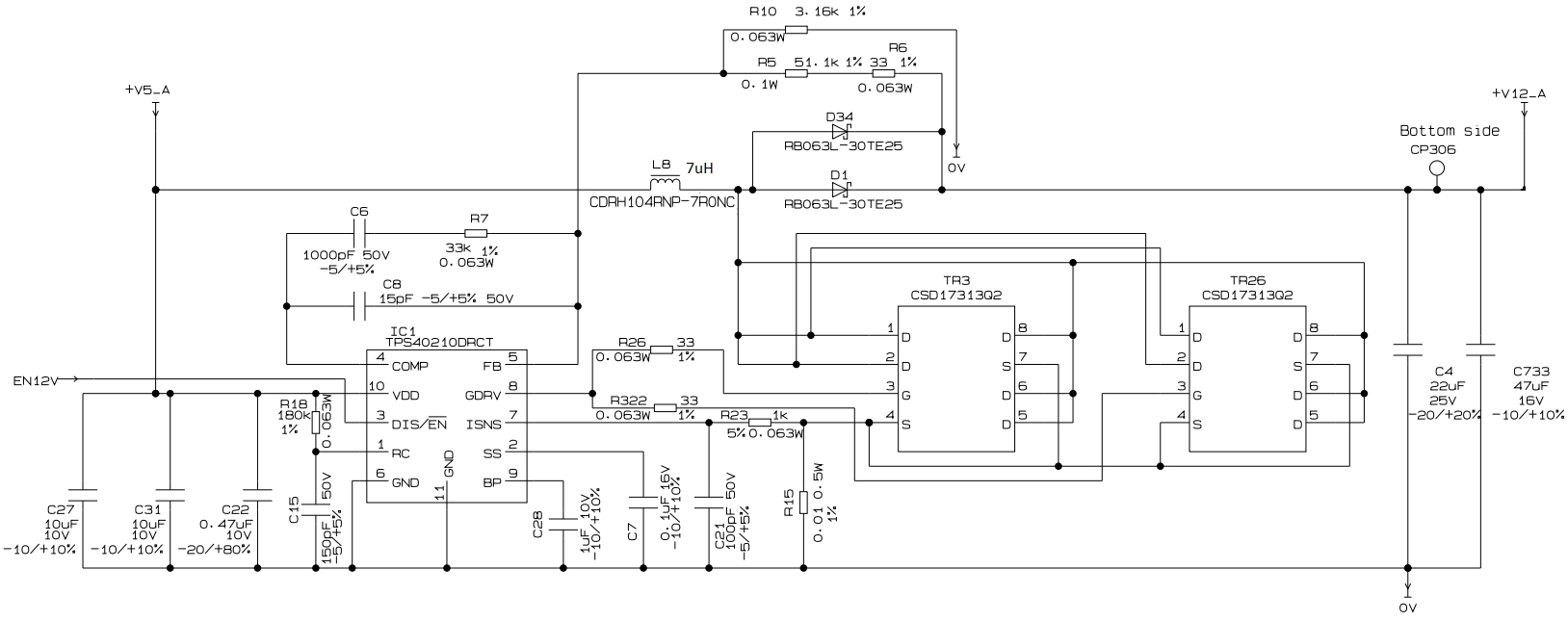
Hi, I'm using TPS40210DRCT for 12V regulation circuit from 5V.

The load is approx. 2A but cyclic (F=200Hz).

It repeats like below.

2A (2ms) -> 0A(3ms) -> 2A (2ms) -> 0A(3ms) -> 2A (2ms) -> ...

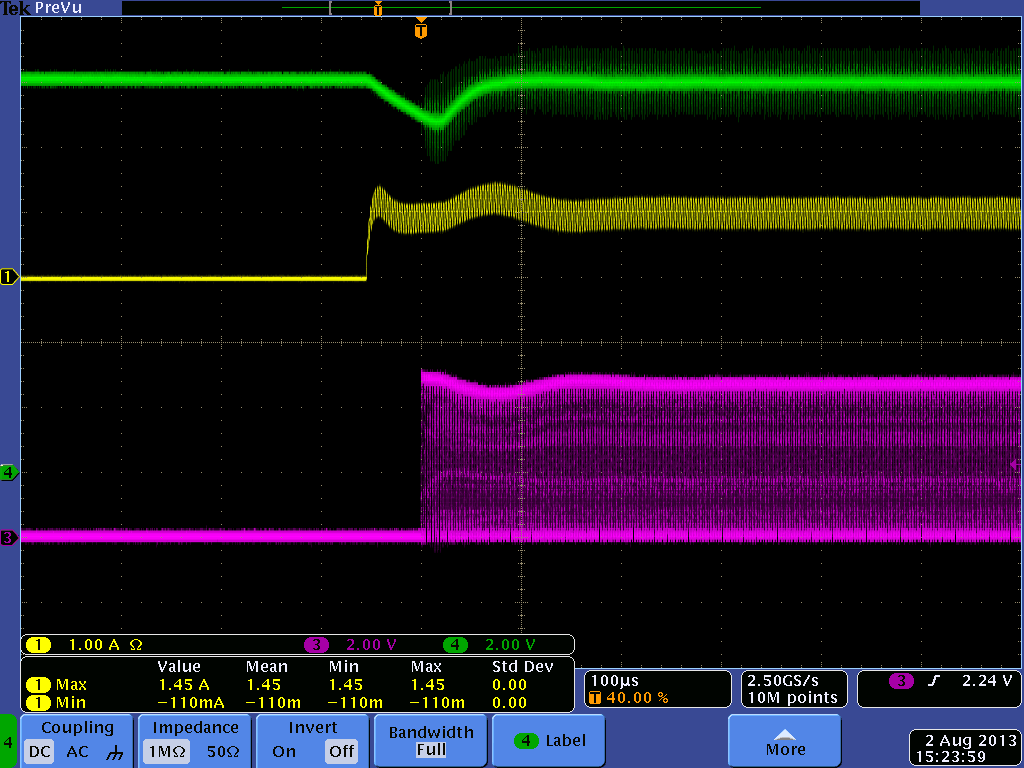
But when the load gets active, GDRV doesn't react immediately. It starts driving after 50us from load gets active.

Then during no regulation period (50us), 12V drops to less than 11V. And after 50us, GDRV starts toggling.

But in order to compensate dropped voltage, an inductor current gets much higher than usual, around 9A like inrush current.

In consequence, the inductor sounds at 200Hz.

Do someone know the reason why GDRV doesn't start regulation for 50us, even 12V drops so much?

[Schematic]
[Waveform]

4.Green: 12V

1.Yellow: Load (it is not 2A but 1A.)

3.Red: GDRV
 Post

  • Is it possible to add a load to the 12V output so the TPS40210 is at least switching before the 2A load is applied? This is only a guess but it looks like the output has not discharged after the overshoot of removing the 2A load. The dummy load will discharge the output so the TPS40210 is regulating again. If this is the case the dummy load will improve the transient response.

    The other thing to do is double check stability using switcherpro.

  • Actually I added some load with 12V output, and with 3.3k ohm resistor, inrush current reduced. (But still inductor sounds.)

    If possible, could you explain the reason why TPS40210 looks like take a rest more than necessary when the load is very small?

  • I am guessing the removal of the load is causing an overshoot on the output. If the output is too high the TPS40210 will stop switching until it discharges. The delay in switching is also caused by the loop response. In non synchronous converters the loop bandwidth is very low at light loads when operating in DCM.

    The audible noise is not surprising because the load is varying the audible range. This causes mechanical vibrations leading to the sound. It also looks like you are using ceramic output capacitors. Are you sure it's not these making the noise?

    One thing you can do to get rid of the noise is to pot the inductor and/or ceramic capacitors to reduce the mechanical vibration. You can find more information by searching the web for potting electronics. One check you could do is replace some of the ceramic capacitors with a properly rated aluminum electrolytic. These generally do not vibrate as much

    Best Regards,
    Anthony

  • Thank you for your explanation. I understand the low bandwidth causes such delay. I'll add a certain dummy load.

    About noise, I checked all suspicious parts including output capacitors with my IC recorder and earphones (instead of a microphone). And the source was the inductor of the converter. I understand your proposal, but it is not realistic to pot the inductor in my case for some reasons. Firstly I'll change the load frequency. It may change the sound loudness, hopefully smaller. 

  • By the way, to minimize the dummy load consumption, do you know any general methods or value itself for TPS40210?

    If I define it by an experiment under certain condition, it may not be able to work well under other conditions.

    And I'd like to avoid that just in case define the value twice or 3 times higher consumption based on the experiment.

    Could you answer to my question?

  • There are a couple ways you could find a theoretical value for a dummy load. The first would be to use the steady state transient model for the TPS40210 to see how it reacts to the load step.

    The second would be to estimate the load resistance using I=C*dV/dt. When the load is removed there is an overshoot on Vout which would the dV. The time it takes to discharge the overshoot would be the dt, the 3 ms of 0 load current. C would be the output capacitance that needs to be discharged. It would then be the output voltage divided by the dummy load resistance. The end equation is then R=Vout*dt/(C*dV).