This thread has been locked.

If you have a related question, please click the "Ask a related question" button in the top right corner. The newly created question will be automatically linked to this question.

Type 2 compensation component calculation for Buck converter

Dear all,

I have designed a buck converter of:

Vin=50V

Vout=12V

Iout=30A

Fsw=50KHz

How do i calculate the type 2 compensation for this buck converter.

Vikas Dabas

India

  • Not enough info to design compensation. What converter IC are you using? What is the output filter? What is the operating frequency? You may or may not be able to use type 2. You may need type 3. You might just want to use Webench to complete your design.
  • Dear John,
    I want type 2 voltage mode feedback compensation. IC does not matters. I need theory of Type 2 compensation.
    Output filter are as follows:
    Cin=470uF
    Lout=17uH @ 30A
    Cout=6800uF/25V
    Cesr=40mOhm
    Operating frequency is already mentioned:50KHz

    And about webench: I have seen various threads about compensation, all of them indicates same thing. that webench returns same results, even you change input or output.

    Vikas Dabas
    India
  • Of course the IC matters as you will need to know the power stage gain.  For voltage mode control you will get a double pole at the LC resonant frequency.  In your case 468 Hz.  The ESR zero is at 585 Hz.  The phase reduces by 180 degrees due to the double pole.  Your ESR zero will cancel one pole.  You can place the zero of your compensator network at or below the LC resonant frequency to cancel the other pole.  You can place the compensator pole two decades above that,

  • Dear John,
    What i understand from Power Gain means Gain of transconductance amplifier gain. (Please correct me if i am wrong).
    I am making digital power supply. so i have to calculate the component values in analog world, than convert them to digital using discrete theory.(This procedure is mentioned in Digital Power reff design)
    Now, I need to calculate the Type 2 component without any hardware or IC specific.
    VIkas Dabas
    India
  • Please see this app note. It should answer your questions:

    www.ti.com/.../slva662.pdf
  • Dear John,

    I have already studied this note. it shows type 2 and type 3 compensation using simple and OTA. But when it comes to an example, it only shows example of "Type 2 compensation using OTA".

    For my application, i am using simple opamp. it is not OTA. Kindly suggest how to calculate or assume the frequency of pole and zero for type 2 compensation.

    also How to assume the value of first R1 in FP0 for calculation to start.

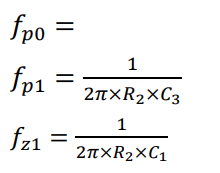
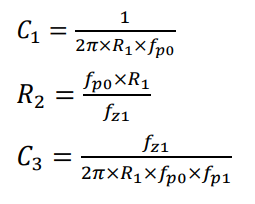
    One more thing to clear here is: following values are calculated for OTA, are these frequency same as Fp1 and Fz1 for simple feedback? if not than please suggest how to calculate them? if yes, still i need to calculate the Fp0.

    Also one more thing( do not mix with above question):

    You have mentioned something in previous post:  "Your ESR zero will cancel one pole.  You can place the zero of your compensator network at or below the LC resonant frequency to cancel the other pole.  You can place the compensator pole two decades above that"

    What about the third pole which is produced by the compensation? where should it be placed?

  • By definition the crossover frequency occurs where the gain of the compensated error amplifier is equal and opposite of the gain of the power stage.  So you have to know the power stage gain to calculate the integrator.  Placing the zeros and poles can be done many different ways.   The above example places the zero and pole symmetrically about the crossover frequency.  That approach gives maximum phase boost.  I previously suggested a method that uses zero / pole cancellation.  It is just another way to do it.  There are a few other techniques as well.  here is some additional literature:

    And another app note for voltage mode control.  It uses type 3 compensation, but thee principles are similar:

    www.ti.com/.../slva104