This thread has been locked.

If you have a related question, please click the "Ask a related question" button in the top right corner. The newly created question will be automatically linked to this question.

TPS54360: Not suitable for 58V input?

Part Number: TPS54360
Other Parts Discussed in Thread: LM5576, , LM5005

Hey there,

unfortunately, my circuit with the TPS54360 keeps dying.

Following setup: I have a battery with voltage between 46 to 58V as  souce and I need 7V and 24V for my application. The webbench suggensted the TPS54360, which looks pretty good to me. We designed a test board for the application that keeps dying. More specifically, the TPS54360 dies, the rest of the circuit is fine. At first I thought it was getting too hot, but the case temperature was at about 70°C, measured with a thermal imaging camera. Additionally, the over-temperature-protection should prevent that case.

At second thought, its probably the transient voltage that kills the chip. I looked Vin during operation, but the maximum voltage spike i could find was about 0.5V. During the test the circuit was powered through a power supply and not the battery. I could measure a voltage spike at Vin of around max 2V when turning various things like the soldering station on/off. (Propagation over the power grid through the power supply). I doubt that that this was the cause of the failure, because nobody was in the room when the damage happended.

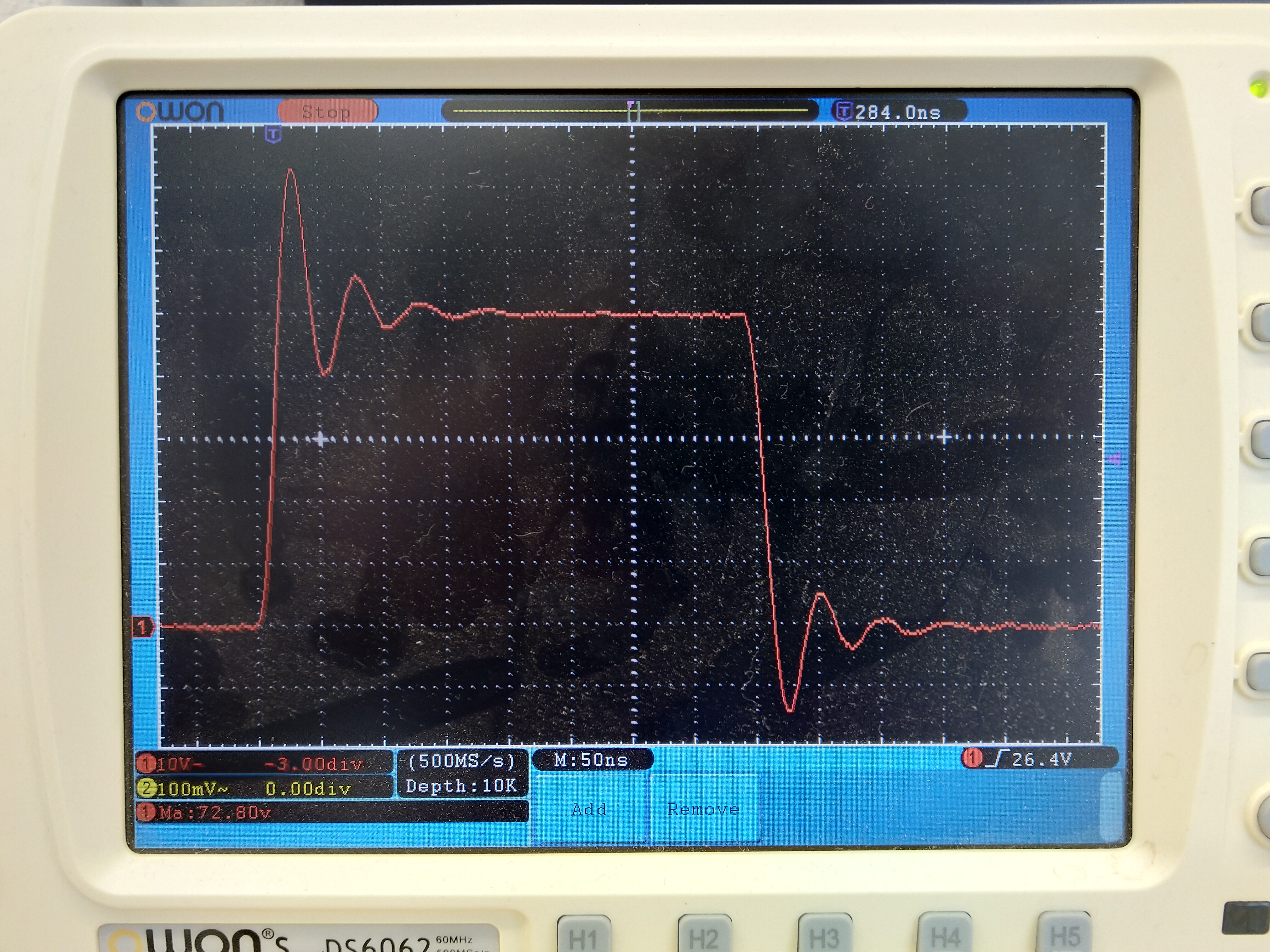
The left over thing is the voltage at SW, which has a transient spike when switching. To my surprise, it has a absolute maximum rating of only 65V, even the 10ns transient is not higher. I measured a transient spike of 72.8V, which explains the failure of the chip.
So my question is: is the TPS54360 suitable for my application? A bad layout could also cause the troubles, so I attached mine below. I tired to minimize the di/dt loop as suggested with the layout in the data sheet. All Components were chosen with the limits from the webbench. If you think that the other components are the problem, i provide the Part numbers/ parameters of those.
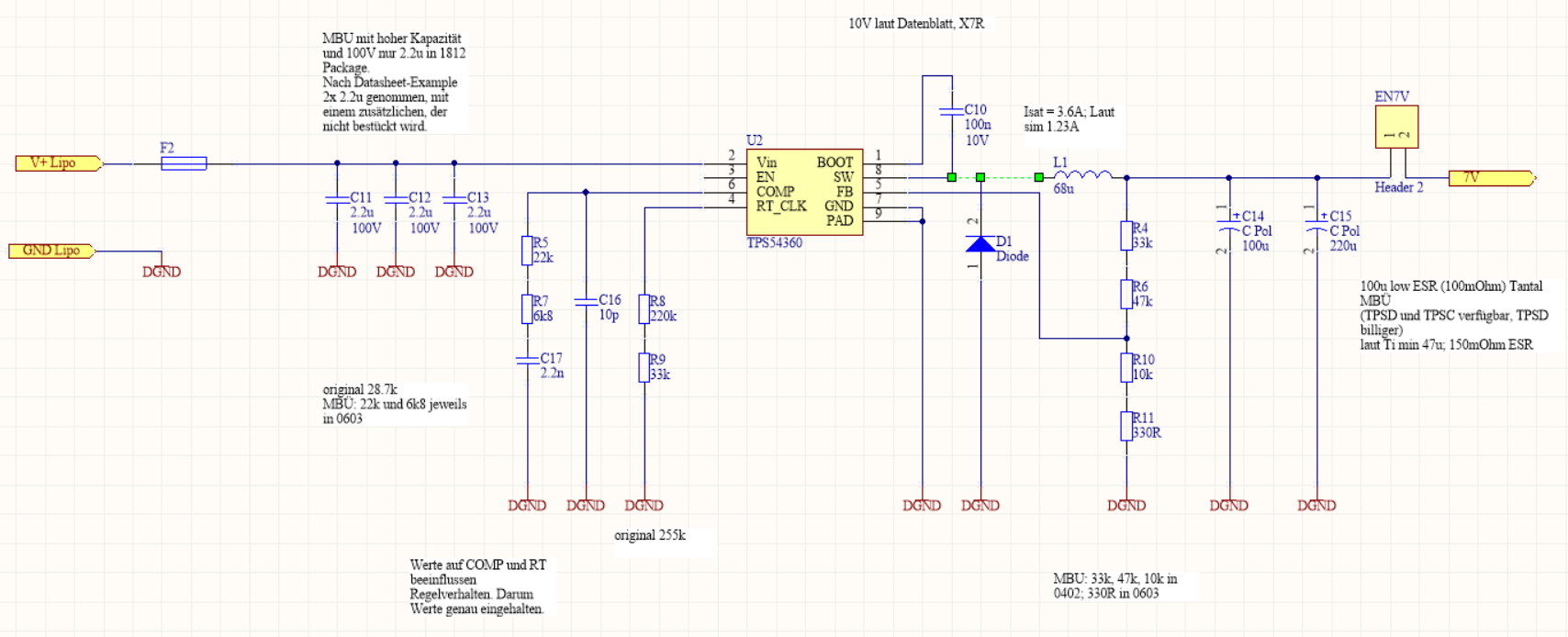
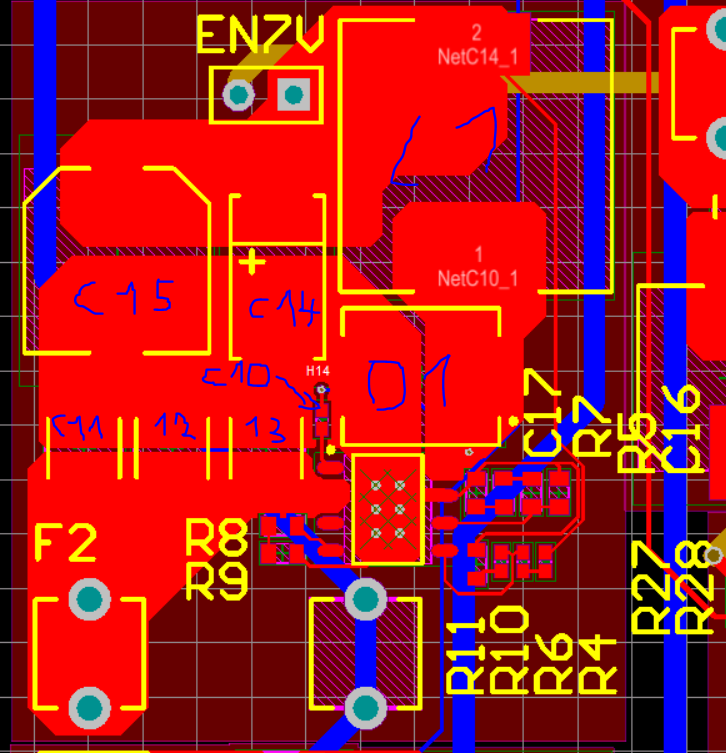
Thank you so much for you help!

  • Hello Dominik,

    Overshoot such as that shown in your oscillogram can drastically reduce the TPS54360’s service life. My primary recommendation would be to use a higher voltage device such as the LM5576. If this is not practical, the next step for the TPS54360 would be to add a snubber and further clean up layout. If you wish to pursue the TPS54360 but feel that too much confidential information concerning your IP will be necessary to use a public forum, please email me at Robert.blattner@TI.com. Also, the ringing frequency in your oscillogram appears low, ~20 MHz, possibly indicating that you need to shorten the ground loop on your scope probe.

    Note that there are other possible causes for the failure that would require addition information to investigate.

    Final note: please change to the TPS54360B if you pursue the TPS54360. The older TPS54360 is not recommended for new designs. The TPS54360B has identical pin out and specifications but has better performance in high noise environments and should have improved reliability.

    Regards, Robert
  • Hello Robert,

    thanks  for your answer! In that case, I'll switch to another device like you suggested. But honestly, the 75V of the LM5776 will also be very likely succeeded during the ringing-overshoot. The question is, how to tell how much margin i have to calculate for those modules? I find i hard to tell, when it is stated "60V Input" (at the product page and in the webbench), but you really cannot use them with that voltage.

    You stated that i could further cleanup the layout. Could you give me a hint where to start with that?

    Regards, Dominik

  • Hello Dominik,

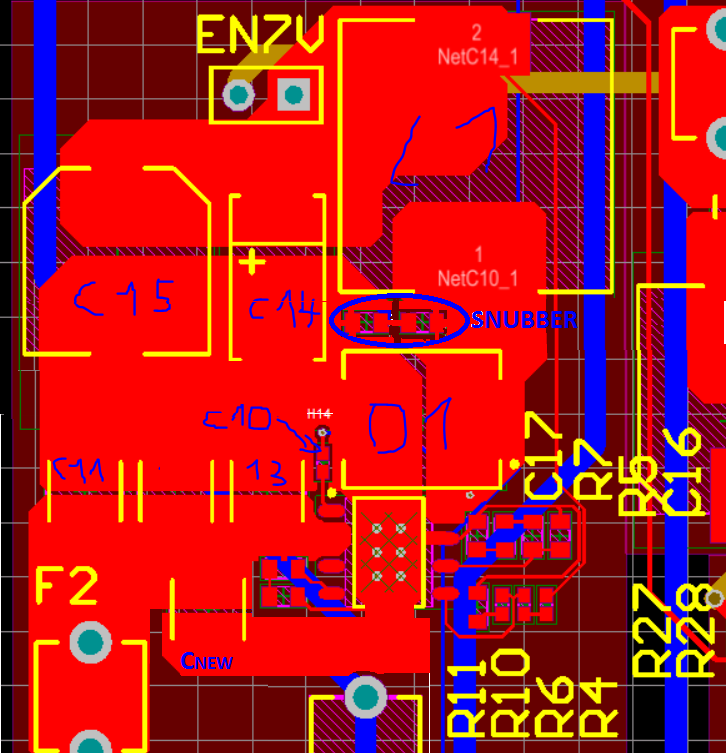
    I am sorry for taking so long to get back to you.  I have marked up your screen capture to add two features:

    1) A snubber has been added circled in blue and called snubber.

    2) A second input loop has been added to further reduce input inductance.

    For snubber components, start with 50 nF and 5 Ohms.  

    Also, the ringing frequency in your plots is suspiciously low indicating that it may be introduced by measurement.   Please make sure the ground connection to your probe is very short.  

    Regards, Robert

  • Hello Robert,

    no problem, thank you very much for the effort! I took your advice from the last post and switchted to the LM5005, which fits my requirements also very good. You also were right concerning probing.
    Again, I really appreciate your efforts helping me out.

    Cheers,
    Dominik