This thread has been locked.

If you have a related question, please click the "Ask a related question" button in the top right corner. The newly created question will be automatically linked to this question.

UCC27531: INPUT-Level-Mismatch

Part Number: UCC27531
Other Parts Discussed in Thread: SN65LVELT23,

Hello, 

I am having trouble with the Input high and low level for my Driver. I would like to use the Output of an Up-Counter (MC100EP016A -Vcc: 3.3V) as the Input for my Gate-Driver. The Counter has an PECL-Level Output, which means, its Output-Levels are as following:

Vouthigh: 2155mV (min) -2280mV (typ)- 2405mV (max)

Voutlow: 1355mV (min) - 1480mV (typ)- 1605mV (max)

The threshold Voltages of the Input (of the Driver) are Independent of VDD supply Voltage. These are :

Vinhigh: 1.8V (min) - 2V (typ)- 2.2V (max)
Vinlow: 0.8V (min)- 1V (typ)- 1.2V (max)

In one Line of the Datasheet it is said : "The input threshold of UCC2753x is based on TTL and CMOS compatible low-voltage logic, which is fixed and independent of VDD supply voltage."
Thats why I started to look for an PECL to LVTTL/LVCMOS Translator/Converter. But all I could find delivers me an Output-Low-Level of max. 0.5V which is way below my 0.8V(min).

Is there a Device, which I can use for Level-Shifting, which fits the requirements for the Output of my Counter and the Input of my Driver?  

Thanks in advance,

Yeliz 

  • Hi Yeliz,

    Thanks for your interest in our part, my name is Mamadou Diallo, I am the AE supporting low-side drivers.

    SN65LVELT23 should get the job done by using one channel ground the .

    Copied below is the datasheet:

    www.ti.com/.../slls929.pdf

    You may also find more devices at:

    www.ti.com/.../overview.html

    Please let us know if you further questions or press the green button if this addressed your concerns.

    Regards,

    -Mamadou
  • Hello Mamadou Diallo,

    thanks for your response.  

    But the SN65LVELT23 has an Output Low Voltage: 0.5V (max)  and Output High Voltage: 2.4V(min) .
    Both of these Levels don't match with my Input threshold Voltage of : Vinlow 0.8V(min)-1.2V(max) ; Vinhigh 1.8V(min)-2.2V(max).

    So I still need a Part which really matches the required Input-Levels for the UCC27531.

    Hoping for more help - thanks in advance

    Yeliz 

  • Hi Yeliz,

    Thanks for your feedback.

    Can you tell me a bit more about your application? Is there a reason you're using an up counter instead of a traditional MCU?
    What is the UCC27531 driving?

    Have you considered implementing this level shifting discretely with npn transistors and powering it off of the 3.3V rail?

    Thanks.

    Regards,

    -Mamadou
  • Hello Mamadou, 

    In my application I am going to switch on and off a SiC-Mosfet to create Pulses. The Mosfet I am using is a Power-Mosfet with Vds=1700V. To Drive this Mosfet, I was going to use the UCC27531. But I guess I need to Change my Driver and look for another one, because I need to handle high Frequencies (Input Freq. up to 800MHz) and I am not sure if the UCC27531 would be the right choise. Other than that, I didn't want to use a MCU because I am not good with programming. Therefore I wanted to create a logical way to do that. 

    But still, I think I will need Level-shifting after my counter anyway (even if I take another Gate-Driver). 
    I am not sure, If I do the Level shifting discretely like you said, if it would be able to be that fast as I would need it to be. 

    Thank you again for your support.

    Yeliz 

  • Hi Yeliz,

    Thanks for the additional information.

    You're correct! Using the level-shifter would certainly introduce prop delay in your circuit whether you implement it discretely or using an IC.

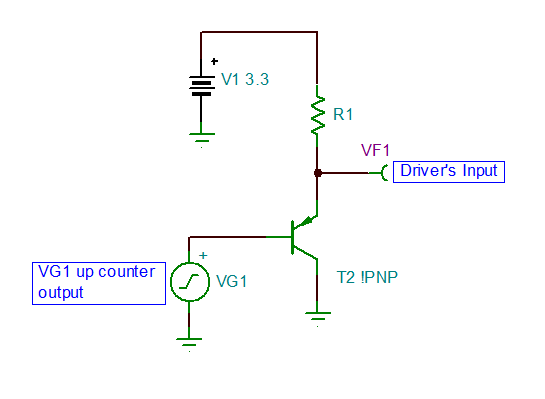
    A simple discret level-shifter below may be implemented using a pnp transitor powered off the 3.3V rail as shown below: Depending on your choice of transistor and R1, you can limit the prop delay introduced to negligible levels. 


    800MHz seem pretty high!  you may be exceeding the power dissipation ratings at the junction of the driver. The power dissipated within the driver is influenced by switching frequency, gate charge and supply range from the equation: Ptot = [Iq * VDD] + [0.5 * Qg * VDD * 2 * Fsw] assuming worst case conditions (no gate resistor). Knowing your operating frequency, I would calculate the expected power dissipation to determine the junction temperature rise and make sure maximum allowed junction temperature of the driver is not reached.

    You may also want to consider using our SiC -MOSFET drivers (find below) however the input level thresholds are still the same.

    Please let us know if you further questions.

    Regards,

    -Mamadou