This thread has been locked.

If you have a related question, please click the "Ask a related question" button in the top right corner. The newly created question will be automatically linked to this question.

LM66100: ST signal state when power supply disconnected

Part Number: LM66100


Hello, 

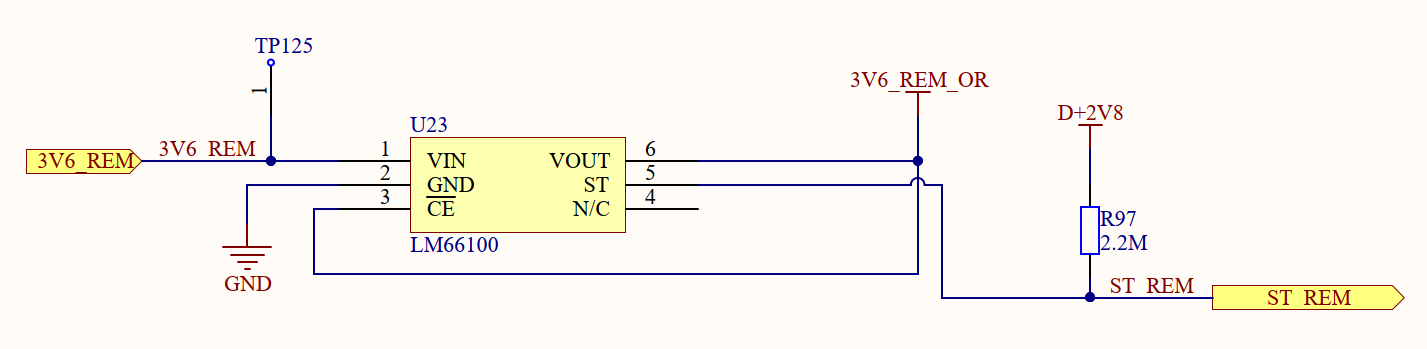
Per the LM66100, for the use case of "Always-ON Reverse Current Blocking (RCB)" circuits which specified in section 8.3.2 of datasheet, and a supercap at the output of LM66100 used for short time power supply disconnection sustaining in my case, and ST is pulled up to the output. If I want to use the ST to indicate the MCU immediately when the input(3V6 battery supply) is disconnected from LM66100, what can I do? 

I tested the circuit as below as specified in 8.3.2, ST is high when power supply pluged in, but still high when it's disconnected. can I put a resistor (for example 2.2Mohm) at the input to GND to avoid floating connection when power supply is disconnected to make ST turns from high to low immediately? do you have a better solution? thanks a lot.  


  • Besson,

    This behavior is correct. ST pin will be High-z if channel is conducting, so that output will pulled-up.

    When 3V6_REM is disconnected, U23 is unpowered, which means that that ST pin is no longer controlled, and continues to be High-z, So it is not suitable to be use ST pin for your need, especially if you are only using 1x LM66100.

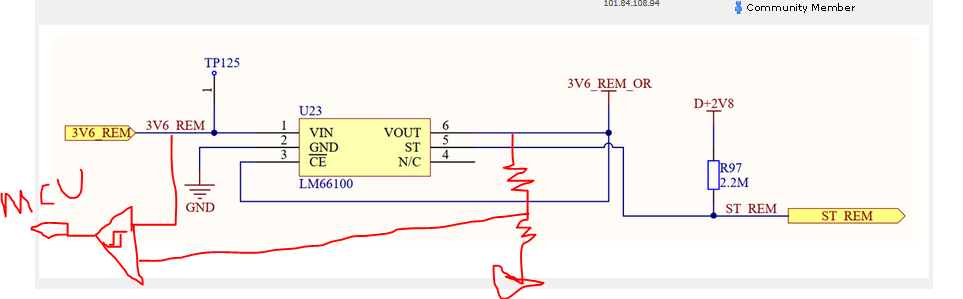
    One possible solution is as follows. Use a comparator against VIN and 50% (or your selected level based on R ratio) of VOUT from a resistor ladder, for example, below.

    You can power this COMP from 3V6_REM_OR.

    There are other solutions which are mentioned in the datasheet which rely on using either a second LM66100, or an external FET to accomplish ORing of two supplies. If you used these, you would be able to rely on ST pin to relay channel status back to the MCU but since you are placing the supercap on OUTPUT these are not suitable for your application.

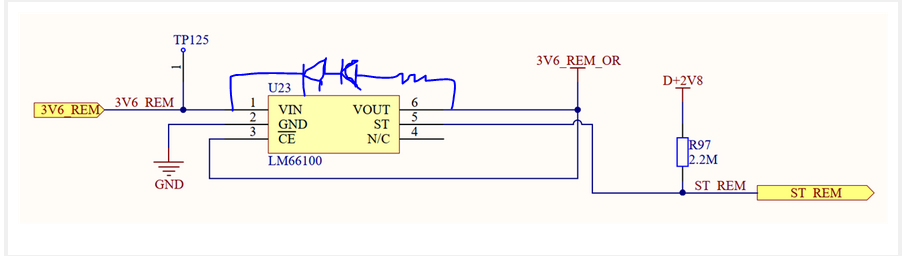
    It is not the best idea to try to power LM6610 from the output-side, even through diodes in order to use the internal /CE comparator to change ST status.

    doing this can causes reverse current which may be unacceptable to you.

    However, If 3V6_REM line doesn't have any other circuit on it  which you wish to remain unpowered when the line is not present, you should be able to use this solution as the Reverse current case is not a possibility.

    This can be accomplished with 1+ diodes fro VOUT to VIN as follows. This will be able to power-device off 3V6_REM_OR when 3V6_REM is not present, but because of the 1+ diode forward voltage drop, /CE internal comparator will change ST pin to LOW when 3V6_REM becomes floating. 

    Like i said, external comparator solution appears to be the best solution for this case.

    Please let me know if this is OK for you, and if you want to discuss further please dont hesistate to let me know here. If this answers your question, could you let me know by pressing the green button?

    Best

    DImitri

    Hopefully this answers your question,

  • Hi Dimitri

    Thanks a lot for your detailed response first.

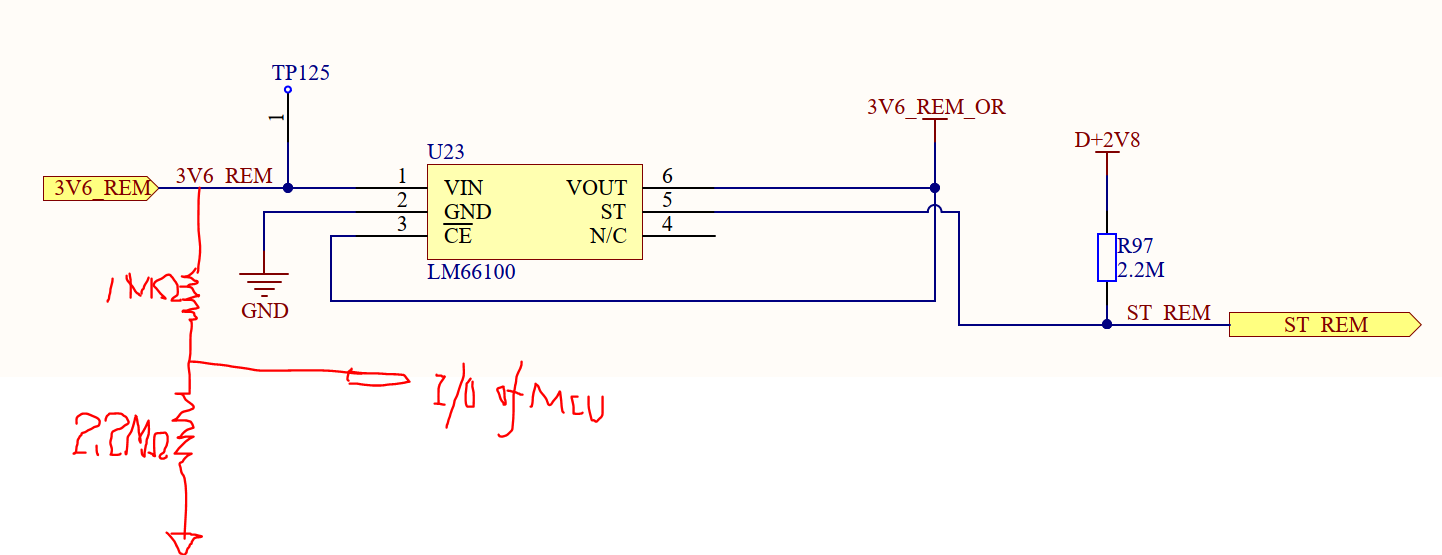
    For the schematic you drew with an external comparator added, I guess that it means 3V6_REM will be low to zero (at least will be lower than the voltage from 3V6_REM_OR and determined by R ratio ) when the battery is disconnected from 3V6_REM, and then the output of comparator will flip at this moment. is that correct? if yes, then it means the Vout (voltage is sustaining cause the Sup-cap) of LM66100 will not pass thru to Vin when the battery is disconnected or it's floating(connection to input of comparator means almost floating). if case likes that, then I would like to use a simple circuitry to do the same function as below:

     But actually I tested the floating Vin of LM66100 (without pull-down resistor to GND) when battery is disconnected from it, it's still at 3.6V for a while after the disconnection. so how to understand this phenomenon?

    is that means the PMOS is still ON when Vin is disconnected?

    Best Regards

    Besson


  • Besson,

    Besson said:
    But actually I tested the floating Vin of LM66100 (without pull-down resistor to GND) when battery is disconnected from it, it's still at 3.6V for a while after the disconnection. so how to understand this phenomenon?

    From when CE>VIN threshold is reached, the delay from this to LM66100 turning off is ~2us as listed in d/s (toff). This does not include fall time.

    VIN voltage may not drop immediately, especially if you have large capacitance on 3V6_REM How long are you seeing VIN dwell?

    Besson said:
    is that means the PMOS is still ON when Vin is disconnected?

    PMOS could potentially be ON for a very short time. FOr esxample, if you have large cap on 3v6_rem it will take extra time to exhaust the charge there before the internal comparator triggers the device to turn off.

    Your circuit can also work but expect the rise/fall to be slowed by your large pulldown resistance at "IO of MCU", and it will limit your VIH/VIL. Using the resistor divider on 3v6_rem_or along with comparator is what i prefer because that rail is always powered, so the resistors can be large to minimize quiescent current without impacting rise/fall time.

    With a comparator, you dont even need the resistor divder at al actually.

    Other option is to use a second LM66100 with supercap at VIN. This may or may not work for you on the systemlevel

    Let me know if you have additional questions on this.

    Best

    Dimitri

  • Hi Dimitri 

    Great thanks for your support. 

    it's clear that there is no big capacitance over the input (3V6_REM) in my case. the voltage dwell on Vin is almost several tens of second. 

    I agree with you that the simple circuits will not work immediately when power supply disconnected. The only concern about the comparator circuits you suggested is that the leakage voltage dwell on Vin will slow down the flip of the output of comparator when power supply disconnected. 

    So, could you please help to do a quick test with this circuits with the demo board of LM66100? I realy want to do a trail but without a demo board in my hand. 

    Best regards

    Besson

  • Besson,

    I may not be able to build the comparator test board and i dont think its necessary.

    Do you want me to test the effect of VIN becoming floating? and whether ST pin actually goes high?

    I can test a pulldown resistance effect on ST status as well.

    Is this all the test result you are looking for?

    Best

    Dimitri