This thread has been locked.

If you have a related question, please click the "Ask a related question" button in the top right corner. The newly created question will be automatically linked to this question.

TPS25947EVM: TPS25947 – Inrush current question

Part Number: TPS25947EVM
Other Parts Discussed in Thread: TPS25947

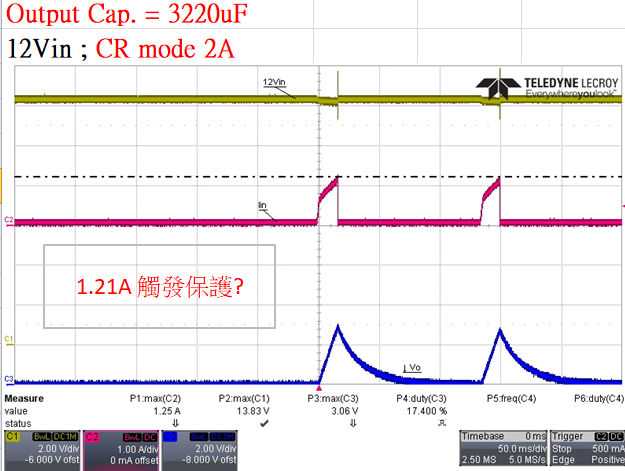
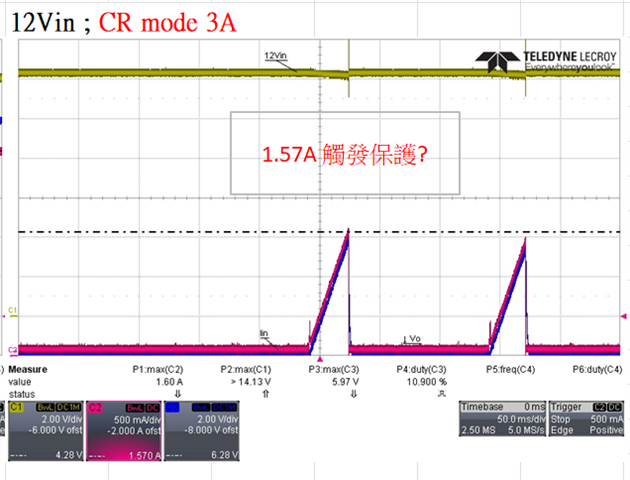
We use TPS25947EVM to test the inrush current. We find the peak current will limit at 1.57A and 1.21A, not our OCP setting 4.44A. Below shows the test waveform with test condition. Please have your advice. Thanks

OCP set-point=4.44A ; rising time set 60mS

If we change the output cap, we got different OCP point.

  1. Output with 220uF ; CR mode 3A OCP
  2. Output with 3220uF ; CR mode 2A OCP

BR, Gary
  • Hi Gary,

    Thanks for reaching out. I will get back to you by tomorrow.

    Regards

    Kunal Goel

  • Hi Goel,

    Do you have any recommend for that? Thanks

    BR, Gary

  • Hi Gary,

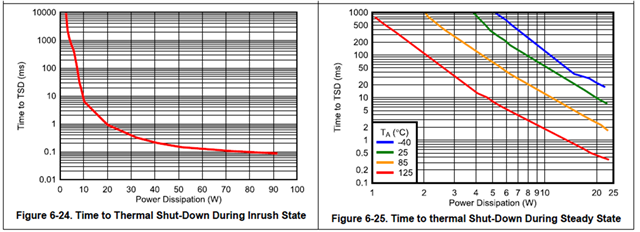
    The device is hitting thermal shutdown because the power dissipation across it is causing the thermal shutdown time to be less than charge time. 

    TPS25947  uses a thermal shutdown mechanism to protect itself from damage at all times. This behavior is characterized on the EVM and will be available in datasheet with part release.   As you can see, the higher the power dissipation inside the part, the faster is the time to shutdown.

        The device follows two different curves in the startup phase. The curve on the left shows the time taken to thermal shutdown till the VIN-VOUT is higher than ~6V. This is the most stressful part of the device startup as the effect of any load current is amplified by the VIN-VOUT difference, causing the part to hit thermal shutdown faster, as compared to during steady state, where the part can carry much higher currents without hitting thermal shutdown, as shown in the figure on the right.

    We can calculate the average power consumption (combination of capacitive and resistive load) and then estimate the time to thermal shutdown using the above curves. As long as the time to charge up the output cap fully is lower than the estimated time to thermal shutdown, the system will startup successfully.  We have also developed a design calculator available on web which tries to model this behavior and predict whether the system will hit thermal shutdown with the given supply voltage and load combination. 

    When there is large load present during startup other than capacitive load try reducing the CDVDT cap, load value  to achieve successful startup.

    Regards

    Kunal Goel

  • Thanks for your help.

    BR, Gary