This thread has been locked.

If you have a related question, please click the "Ask a related question" button in the top right corner. The newly created question will be automatically linked to this question.

BQ24105: Charging NiMH battery process.

Part Number: BQ24105


Dear Supporter,

We use BQ24105 for charging NiMH battery, we've question as the list below.

1.How much mA for charging NiMH battery in automative ? Do you have any suggestion for value that use with vehicle device ?

2. as -> https://www.ti.com/lit/an/slua843/slua843.pdf?ts=1612436002861&ref_url=https%253A%252F%252Fwww.google.com%252F datasheet, 
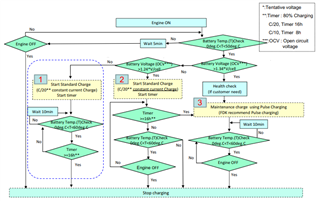
For stop charging process, How can we do with stop charging process ?

3.as this schematic

Could you help us check RT1 and RT2 is correct or not please ? we use schematic for charging but not found status full charging  on stat1 and stat2. There is some wrong ? please suggest us

Thank you.

  • Hello,

    1. The attached Application Report from Question 2 demonstrates how to use 0.1C and 0.05C charging rates to charge the battery. NiMH manufacturers have supported up to 0.5C using this safety timer method, however I would encourage you to check with your battery manufacturer. Higher charge currents require dV/dt and dT/dt schemes.

    2. I do not understand your question. The flow chart outlines the charge algorithm and stop conditions.

    3. You need to make sure you bias the TS pin correctly. This biasing puts the TS pin at 98% of the biasing voltage, putting it in the cold range and suspending charge. The resistor divider you designed assumes that you have a 10kOhm thermistor in parallel with the lower resistor. The goal of the thermistor is to go on the battery back and its resistance will change as the battery changes temperature. This enables the battery to automatically stop charge current based on battery temperature. If you do not want this feature, you just need to permanently bias the TS in the correct range.

    Thanks,

    Mike Emanuel

    Please click "Resolved" if this answers your question.