This thread has been locked.

If you have a related question, please click the "Ask a related question" button in the top right corner. The newly created question will be automatically linked to this question.

TDA3XEVM : I want to use DCAN RX on TDA3xx board.

Part Number: TDA3XEVM

i don't know how dcan's lib is used. (dcan's lib -> utils_dcan.c, utils_dcan.h, system_dcan.c)

i made a code in

/** \brief Used for enabling board-to-board DCAN */
#define ENABLE_B2B_DCAN_TEST (1U)

but dcan do not work.

if anyone knows on dcan, please help me.. OR give me the example and your code.

Thank you.


  • Hi James,

    Can you give little more background on this? What SDK version are you using? Also the changes that you have made? And what behavior you are observing during failure?

    Thanks & Regards,
    Vivek Dhande.
    Texas Instruments (India) Pvt Ltd
  • Hi, Vivek. thank for your reply :).

    sdk version i use is version 03.02.

    i just want to receive can data including CAN id, DLC, IDE, DATA etc.

    also i transmit can data through EasySync(Can Bus Program) and i check print msg from TDA3xx to UART.

    As i told you, i did change 0U -> 1 in system_dcan.c

    /** \brief Used for enabling board-to-board DCAN */
    #define ENABLE_B2B_DCAN_TEST (1)

    and i transmit CAN id "C1", DLC "8" and data "1111111111111111" using EasySync.

    but i could not check any print msg.

    Are there another things that i have to in besides above action?

    i don't know how i'm using dcan lib(system_dcan.c, utils_dcan.c, utils_dcan.h) exactly.

    i would like to get more information about dcan to finish my project.

    for example, i don't know whether one of dcan function in lib has to be in While loop. 

    dcan.zip

    thank you.

    ----------------------------------------------------------------------

    TODAY there is plus posting about dcan.

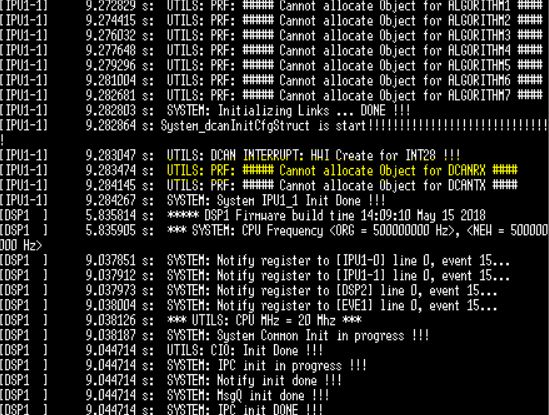
    i found this printf message, UTILS: PRF: #####Cannot allocate object for DCANRX ####.

    i don't know why this message is shown.

    Could i give this plus question Vivek?

  • Hi James,

    Are you writing a new use-case for DCAN or using existing one?
    If not, can you try with existing one first?
    You can enable existing DCAN use-case by changing from "DCAN_INCLUDE=no" to "DCAN_INCLUDE=yes" in respective '.mk' file.

    Thanks & Regards,
    Vivek Dhande.
    Texas Instruments (India) Pvt Ltd
  • Hi, Vivek.

    yes, i've already changed make file on  what you said.

    I can check Loopback mode of dcan.

    but Normal mode can't.

    there is solution on this case?

  • Hi James,

    Are you doing changes(changing DCAN_INCLUDE to yes) in '<sdk_install_path>\vision_sdk\apps\configs\tda3xx_evm_bios_all\cfg.mk' only?
    This is the only change needed to enable DCAN use-case.
    Can you please do only this change and try?

    This application is validated like that and it is working fine.

    Thanks & Regards,
    Vivek Dhande.
    Texas Instruments (India) Pvt Ltd

  • Hi Vivek,

    if i do As you told you, CAN LOOPBACK is OKAY, but CAN NOMAL is not.

    I don't know why it doesn't work.

    if i transmit CAN SIGNAL to TDA3 board, it happens CAN BUS OFF ERROR!

    I check pin mux, CROSSBAR something like that.

    I can't find right way.

    Is there anything else to get some help?

  • Hi James,

    After doing suggested changes(in my previous reply), EasySync(which is sender here) goes into Bus Off state. Is my understanding correct?
    Is EasySync able to receive any message from TDA3xx?

    DCAN application flow is like:
    1. TDA3xx will send a periodic message(ID:0xC2) with interval of 10 sec.
    2. When TDA3xx receives a message with ID:0xC1, it responds back with a message(ID:0xC4)

    Configured bitrate is 1MBits/s.

    Can you please check following:
    1. EasySync is configured with above bitrate of 1Mbps.
    2. Make sure CAN bus connections are proper and firm. Connections are as follows:
    - TDA3xx->EasySync
    - J6109/CANBUS1 pin 1 -> CAN_H
    - J6109/CANBUS1 pin 2 -> GND
    - J6109/CANBUS1 pin 3 -> CAN_L

    Thanks & Regards,
    Vivek Dhande.
    Texas Instruments (India) Pvt Ltd