This thread has been locked.

If you have a related question, please click the "Ask a related question" button in the top right corner. The newly created question will be automatically linked to this question.

Linux/PROCESSOR-SDK-AM335X: NAND not detected on custom board

Part Number: PROCESSOR-SDK-AM335X
Other Parts Discussed in Thread: AM3352

Tool/software: Linux

Hello,

My custom board with am3352 main chip, and the nand flash is "micron  mt29f1g08abaeawp".

I follow the document from u-boot step to enable the nand flash, but still cannot detect it in uboot,

which means the command "nand info" and "nand device" has nothing...

I found some weird on the custom board schematic, the NAND flash SMI_WP pin connect to GPMC_CLK,

is that correct?

here is the part of  schematic:
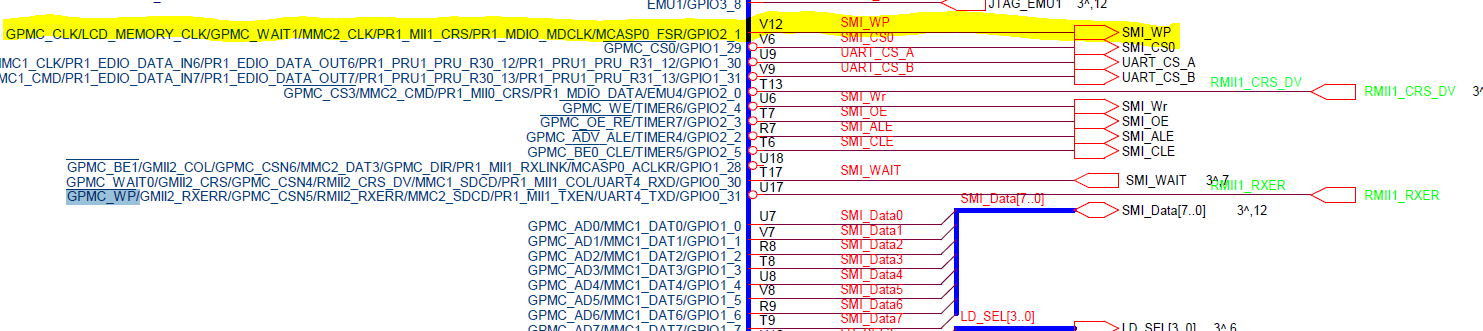
 

And the NAND flash schematic:


from the TRM, the GPMC_WP pin connect to NAND flash WP pin, but we connect to RMII phy, is it cause that the board cannot detect the nand flash?

  • Hi,

    This connection definitely is not correct. However you can eliminate it for the moment by removing the jumper. I don't think this is the reason the NAND doesn't work. What Linux version are you using?
  • Thanks for reply,
    for now, I just live in u-boot, try to boot via sd-card and write MLO to nand, so I need to do_nand_init fine,
    So if I disconnect the SMI_WP pin, the nand "should" be detected?
  • What is the U-boot version? Where did you take it from?
  • The SDK form Ti website version 2.00, and the u-boot-2015.07.xxxxx

    In my trace path, the entrance is drivers/mtd/nand/nand.c

    static void nand_init_chip(int i)
    {
        struct mtd_info *mtd = &nand_info[i];
        struct nand_chip *nand = &nand_chip[i];
        ulong base_addr = base_address[i];
        int maxchips = CONFIG_SYS_NAND_MAX_CHIPS;
    
        if (maxchips < 1)
            maxchips = 1;
    
        mtd->priv = nand;
        nand->IO_ADDR_R = nand->IO_ADDR_W = (void  __iomem *)base_addr;
    
        if (board_nand_init(nand)){
            printf("board_nand_init failed! return...");
            return;
        }
    
        if (nand_scan(mtd, maxchips)){   //Failed here
            printf("nand_scan failed! return...");
            return;
        }
    
        printf("goto nand_register..\n");
        nand_register(i);
    }
    

    The nand_scan is failed.. so cannot goto nand_register

    here is my pin mux:

    board/ti/am335x/mux.c

    #ifdef CONFIG_NAND
    static struct module_pin_mux nand_pin_mux[] = {
        {OFFSET(gpmc_ad0),  (MODE(0) | PULLUDDIS | RXACTIVE)}, /* AD0  */
        {OFFSET(gpmc_ad1),  (MODE(0) | PULLUDDIS | RXACTIVE)}, /* AD1  */
        {OFFSET(gpmc_ad2),  (MODE(0) | PULLUDDIS | RXACTIVE)}, /* AD2  */
        {OFFSET(gpmc_ad3),  (MODE(0) | PULLUDDIS | RXACTIVE)}, /* AD3  */
        {OFFSET(gpmc_ad4),  (MODE(0) | PULLUDDIS | RXACTIVE)}, /* AD4  */
        {OFFSET(gpmc_ad5),  (MODE(0) | PULLUDDIS | RXACTIVE)}, /* AD5  */
        {OFFSET(gpmc_ad6),  (MODE(0) | PULLUDDIS | RXACTIVE)}, /* AD6  */
        {OFFSET(gpmc_ad7),  (MODE(0) | PULLUDDIS | RXACTIVE)}, /* AD7  */
    #ifdef CONFIG_SYS_NAND_BUSWIDTH_16BIT
        {OFFSET(gpmc_ad8),  (MODE(0) | PULLUDDIS | RXACTIVE)}, /* AD8  */
        {OFFSET(gpmc_ad9),  (MODE(0) | PULLUDDIS | RXACTIVE)}, /* AD9  */
        {OFFSET(gpmc_ad10), (MODE(0) | PULLUDDIS | RXACTIVE)}, /* AD10 */
        {OFFSET(gpmc_ad11), (MODE(0) | PULLUDDIS | RXACTIVE)}, /* AD11 */
        {OFFSET(gpmc_ad12), (MODE(0) | PULLUDDIS | RXACTIVE)}, /* AD12 */
        {OFFSET(gpmc_ad13), (MODE(0) | PULLUDDIS | RXACTIVE)}, /* AD13 */
        {OFFSET(gpmc_ad14), (MODE(0) | PULLUDDIS | RXACTIVE)}, /* AD14 */
        {OFFSET(gpmc_ad15), (MODE(0) | PULLUDDIS | RXACTIVE)}, /* AD15 */
    #endif
        {OFFSET(gpmc_wait0),    (MODE(0) | PULLUP_EN | RXACTIVE)}, /* nWAIT */
    //  {OFFSET(gpmc_wpn),  (MODE(7) | PULLUP_EN)},        /* nWP */
        {OFFSET(gpmc_clk),  (MODE(7) | PULLUP_EN)}, // the wired pin
        {OFFSET(gpmc_csn0), (MODE(0) | PULLUP_EN)},        /* nCS */
        {OFFSET(gpmc_wen),  (MODE(0) | PULLDOWN_EN)},      /* WEN */
        {OFFSET(gpmc_oen_ren),  (MODE(0) | PULLDOWN_EN)},      /* OE */
        {OFFSET(gpmc_advn_ale), (MODE(0) | PULLDOWN_EN)},      /* ADV_ALE */
        {OFFSET(gpmc_be0n_cle), (MODE(0) | PULLDOWN_EN)},      /* BE_CLE */
        {-1},
    };


    the wired pin is WP, according my schematic, I should choose gpmc_clk, right?

    BTW my NAND flash is micron mt29f1g08abaeawp(SLC) , x8 width

  • I have forwarded this to the software team. They will respond here.
  • Many many many thanks!
  • Hi Phil,

    1. If you removed the jumper as Biser suggested, you should've disabled the write protect of your nand chip and should be able to detect the nand flash. However in this case you need to verify that your GPMC is configured to work in asynchronous mode. You should verify that
    GPMC_CONFIG1_x[27]WRITETYPE = 0h => Write Asynchronous
    GPMC_CONFIG1_x[29]READTYPE = 0h => Read Asynchronous
    x = 0..6, depending on which cs you use.
    And if this is not the case try setting the above bit fields to 0x0.

    2. If you didn't remove the jumper, then the following line:
    {OFFSET(gpmc_clk), (MODE(7) | PULLUP_EN)}, // the wired pin ==> sets the pin as GPIO and configures its level to 0x1 (pullup).
    will enable the write protect and you will lock your nand. So you should try to output 0x0 on the gpio.

    Best Regards,
    Yordan
  • Many thanks Yordan & Biser
    After check, follow:
    GPMC_CONFIG1_x[27]WRITETYPE = 0h => Write Asynchronous
    GPMC_CONFIG1_x[29]READTYPE = 0h => Read Asynchronous
    It's work, Thanks again!