This thread has been locked.

If you have a related question, please click the "Ask a related question" button in the top right corner. The newly created question will be automatically linked to this question.

MEP step size for High Resolution configuration in eHRPWM?

Other Parts Discussed in Thread: OMAPL138, OMAP-L138

 Dear all,

      I have been trying to implement the High Resolution feature of  eHRPWM module. I wanted to test the example configuration given in the ehrpwm user guide [1]. In the example configuration, 100 MHZ Time Base (= System Clock) clock is used to generate 1.25 MHZ pwm waveform , 40.5% duty. Thus the period of  Time base clock and PWM waveform are 10ns and 800ns respectively.  40.5% duty corresponds  to 324 ns, which  cannot be generated by conventional pwm as the minimum clock period is 10 ns. HR  feature is employed to produce the remaining 4 ns delay.  With 180 ps as MEP step size, CMPAHR value is calculated to be 23 (considering only the MSB) .

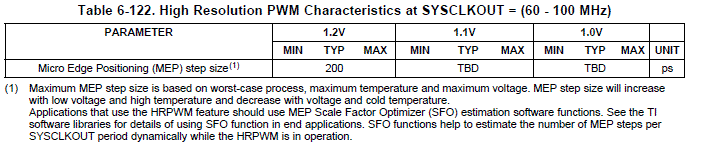
    But,  under  the same configuration with 180 PS step size , I am getting only 1.4 ns delay and not 4 ns . So, I made a quick calculation (1.4/22)  and found the step size to be 63 ns.  This value differs greatly  from the typical MEP size (200) given in the omapl138 application guide [2] (Page.No 231). I am able to obtain the exact  edge positioning various duty cycle with this MEP value (63). I would like to know if this is the correct value or is there any formula  to arrive at the MEP step size?.

If anyone has tested the High Resolution feature  please let me know.

Regards,

N.Sugumar

[1] . http://www.ti.com/litv/pdf/sprufl3b

[2]. http://www.ti.com/lit/gpn/omap-l138

  • Sugumar Natarajan said:
    I wanted to test the example configuration given in the ehrpwm user guide [1]. In the example configuration, 100 MHZ Time Base (= System Clock) clock is used to generate 1.25 MHZ pwm waveform , 40.5% duty. Thus the period of  Time base clock and PWM waveform are 10ns and 800ns respectively.

    The example configuration provided in the user guide is to show how to do the calculations.  Each system/device will be slightly different (time base frequency, MEP sizes, etc).

    Sugumar Natarajan said:
    I would like to know if this is the correct value or is there any formula  to arrive at the MEP step size?.

    The method you described is a correct way to figure out the MEP sizes.  The MEP size normal distribution will fall around 200ps, but is not limited to that region (hence no min/max values).  Therefore, it should not be surprising to find MEP sizes, other than 200ps.

    --Christina

  • Hi,

        Could you please give a way how to find the MEP size?  If I use oscilloscope to calibrate it, it is very difficult to  catch the small time duration. 

       Your help is appreciated.

    Thanks