A related question is a question created from another question. When the related question is created, it will be automatically linked to the original question.
If you have a related question, please click the "Ask a related question" button in the top right corner. The newly created question will be automatically linked to this question.
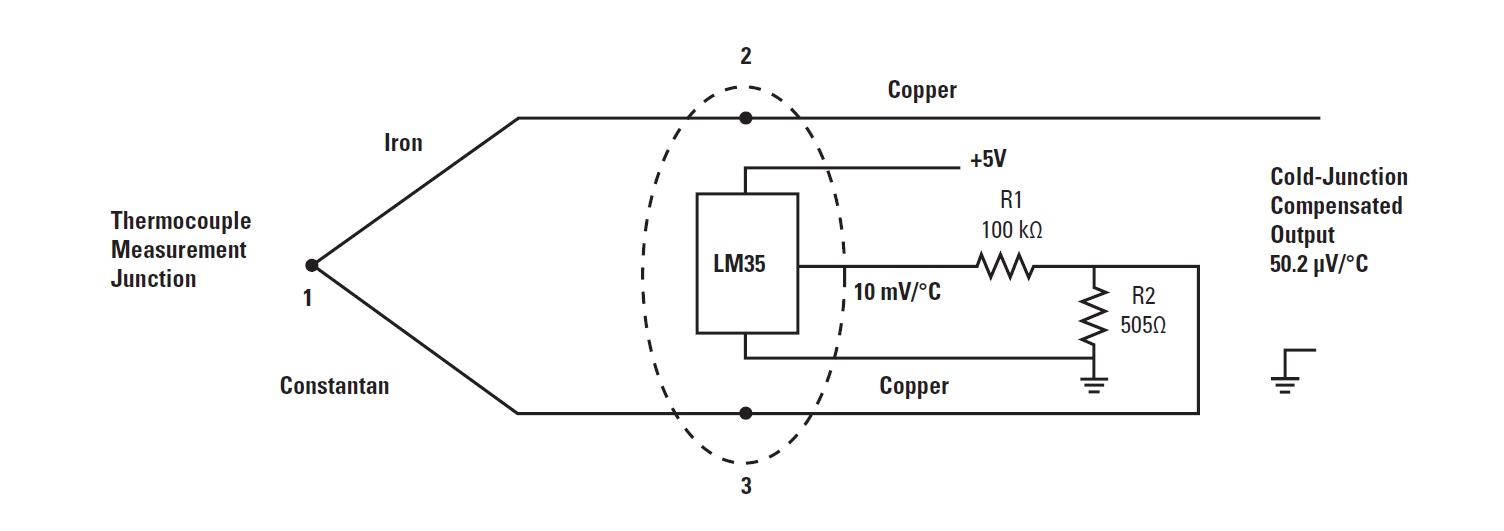
I intend to use LM35 to measure the cold junction temperature of thermocouple.Will the connection in the attached file be sufficient?I have got it from the datasheet.
I intend to use LM35 to measure the cold junction temperature of thermocouple.Will the connection in the attached file be sufficient?I have got it from the datasheet.
I think you can use the LM35 to measure the cold junction temperature of the thermocouple; however, the configuration below is only supported above 2°C to 150°C. If you go below 2°C, you need a resistor to V- as you mentioned on the previous posted. You could also use the ADS1118 as well it includes the AFE for amplifying the thermocouple signal. Please refer to attached block diagram below.
For information on ADS1118, please refer to this literature number below.
In the above circuit , the resistors R1and R2 will change for different thermocouples,right?How is it possible to modify the above circuit so as to be used with all thermocouple types(like ,for a universal thermocouple interface)?Is it effective to use a PGA at the output of LM35
Thermocouples have a non-linear transfer function but for a limited temperature you can assume a linear transfer function. I would like to refer you to an old app note AN225. In Appendix A page 8 you will see a method for calculating a linear Seebeck coefficient for a limited temperature range. You will need to know the temperature range of your cold junction. The more limited this range is the less error you will see. Once you calculate this coefficient you can use it to determine the resistance value for R2. I would probably keep R1 at 100k. The figure we show is for a type J thermocouple and for the cold junction temperature compensation the slope used was 50.5uV/C from taking 505/100k*10mV/C. You should consult the manufacturer of your cable to get the thermoelectric voltage table as manufacturing impurities can affect the slope slightly. Also make sure that the output of the thermocouple is going to a high impedance low bias current amplifier as the bias current can cause additional error (especially if it has a temperature coefficient usually doubles every 10C or so for some cases).