


Dear all,
I'm writing to as some information to improve the performance of the TMUX7219 at high switching speeds. In our application, we need the switch to operate with pulses (off-on-off) transition of about 1 us.
To test the devices, we implemented the simple schematic described below on a breadboard. Basically, the circuit switches a simple DC signal of 1V.

- VDD = 10 V;
- VSS = - 10 V;
- VD = 1 V (DC);
- The VSEL signal is generated by an AWG with output impedance of 50 Ω;
VSEL= square wave with amplitude 3.3V, switching frequency from 1kHz to 1MHz; - RL1 = 100Ω;
- RL2 = 47Ω;
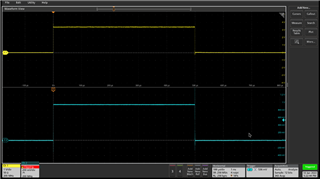
The results are really satisfactory at low frequencies, with except of a fast spike near commutation (yellow curve is the control signal and blue curve is Output 1)
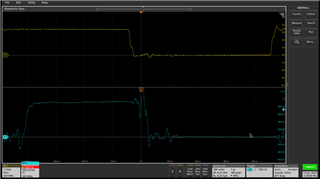
At high frequency, the transition between on state and off state is not negligible, as presented in the figure below. Please note that the amplitude of the positive spike is quite high, and in part is reflected on the input signal.
We tried to compensate this phenomenon by adding some parallel capacitance to the output (ranging from few pF to nF), but the only results is a worsening of the response times
Do you have any suggestion on how improve the performances on fast transitions?
Thanks in advance and best regards,
Manuel
