This thread has been locked.

If you have a related question, please click the "Ask a related question" button in the top right corner. The newly created question will be automatically linked to this question.

TMUX1574: May I have some question regarding TMUX1574?

Part Number: TMUX1574
Other Parts Discussed in Thread: SN74CB3Q3257

Tool/software:

Dear SIR:

May I have some question regarding TMUX1574?

Question:

Should resistors (pull high  or pull down) be placed TMUX1574's  input and output ?

change another word:

If Host side have pull up or pull down  resistor then connect  to TMUX1574's  input ,the TMUX1574's output need add the  pull up or pull down resistor ?

(Or the TMUX1574's output no need add the  pull up or pull down resistor ,The TMUX1574 can be considered a resistor(2Ω) mounted and un-mounted according to TMUX1574's spec. mention Low on-resistance: 2 Ω)

because side Host have pull up or pull down  resistor already , for example: JTAG or I2C/smbus application condition )

thanks 

  • Hello Alex,

    Pull ups and downs need to be placed according to the protocol the mux is being used. 

    JTAG and I2C require pull ups on both side, so the line won't be floating. They will need to be placed on both sides of the mux as mentioned in your other thread.

    Thanks,

    Nir 

  • Dear Sir:

    Thanks for your reply.

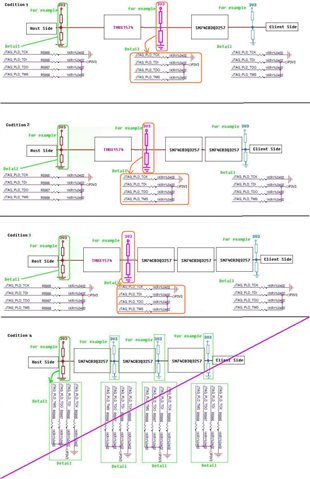
    Yes, the question  is confirming TMUX1574's output need add the  pull up or pull down resistor or not,detail as Image1 and Image 2's condition 1,2,3 .

    orange box (image 1 : TMUX1574's output no need add the  pull up or pull down resistor ,The TMUX1574 can be considered a resistor(2Ω) mounted and un-mounted according to TMUX1574's spec. mention Low on-resistance: 2 Ω

    Image 2:TMUX1574's output need add the  pull up or pull down resistor) 

    {other thread is confirming SN74CB3Q3257 (cascading the multiplexers)}

    Thanks

    Image 1:

    Image 2:

  • Hello Alex,

    If the protocol requires pull ups and downs, then yes.

    The resistors need to be connected as shown in the first image conditions 1, 2, and 3.

    Thanks,

    Nir