


Hi,
I would like to ask a question on CCS.
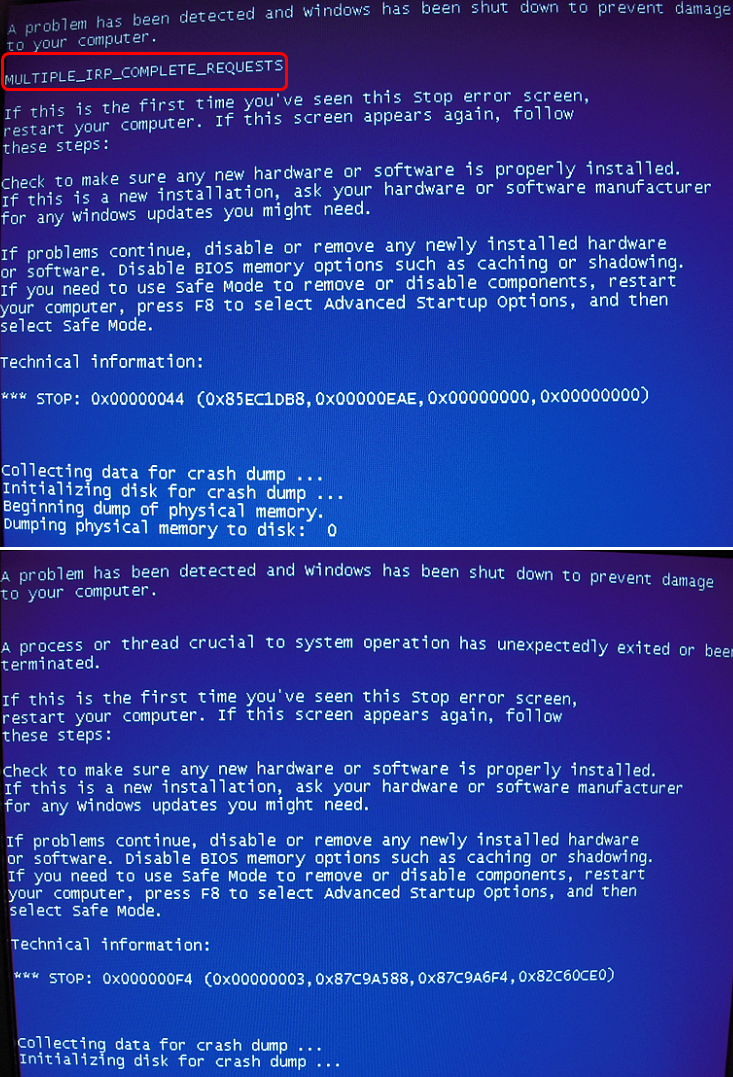
I experienced Windows 7 (32-bit, home basic) system blue screen with during CCS session. The screenshot is shown above.
Symptom:
1. At first, CCS hangs and stops to response. The CCS IDE windows is “dimmed” with a grayish layer overlaid on it, as commonly seen in other problems when stopping to respond.
2. Then, a short time after, or when I forced cc_app.exe’s termination from Windows task manager, blue screen appears and I have to do a machine reboot.
Conditions:
1. I am certain that this relates to improper memory placement which causing difficulty in halting the DSP (DM6437) because I store all data and program in L1P/L1D; if data and code are stored in L2 or DDR2, the CCS hang and this blue screen never happens.
2. Another potential culprit which might contribute, or have aggravated the situation is the WLAN driver associated with a TPLINK 300Mbps 802.11n adapter. Windows event viewer frequently logs error relating to it, including
|
Level |
Event ID |
Description |
|
Error |
10000 |
WLAN Extensibility Module has failed to start.
Module Path: C:\Windows\system32\athExt.dll |
|
Warning |
4001 |
WLAN AutoConfig service has successfully stopped. |
3. The emulator is SEED XDS560, not Spectrum’s.
Diagnostics:
As shown above, MULTIPLE_IRP_COMPLETE_REQUESTS problem is detected.
· What does this suggest? Which IRPs are “multiple”? Do they all come from CCS, or some are from WLAN adapter or other PC peripherals?
Question:
I place data/code in L1 to improve the speed of certain interrupt service routines. But even if it is done improperly, such as necessary memory configuration has not been made, how could the DSP’s problem even transmit to CCS, and even the Windows system?
And is there a solution to the problem?
Zheng

