This thread has been locked.

If you have a related question, please click the "Ask a related question" button in the top right corner. The newly created question will be automatically linked to this question.

LP-AM263P: CCS Debugger treatment of Load and Run adresses

Part Number: LP-AM263P
Other Parts Discussed in Thread: UNIFLASH

Tool/software:

Hello TI experts,

Running into some issues regarding load and run adress settings in CCS.

With the current TI toolchain, when a .appimage/.MCELF is generated, the physical/load adress is ignored, sections are a) ordered by RAM/run adress and b) merged together into a single 'blob' of data, which is then flashed to a particular flash offset.

To give some purpose/aim behind the question, essentially we want to control where certain sections end up in the .mcelf and subsequently in flash memory, especially calibration sections. This is to be able to do checksums/hashing on individual sections. Ideally this would be done through control of the load adress for each section.

When I try configuring flash-based load adresses in CCS for sections, the CCS debugger seems to interpret these as the RAM/run adresses, causing CCS debugger to not work.

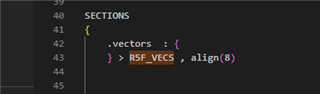
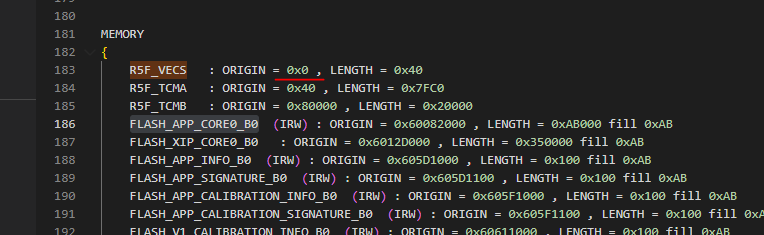
For example, if I use the default load/run adresses for the vector table (0x0 into TCMA), the CCS debugger can program this section as required:
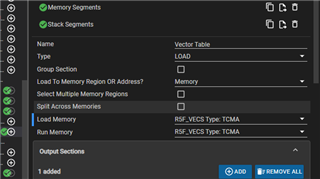
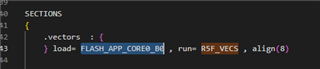
Linker:
Running CCS debugger:
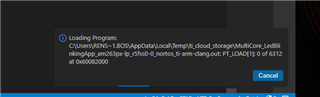
If I update the load adress to be flash-based:
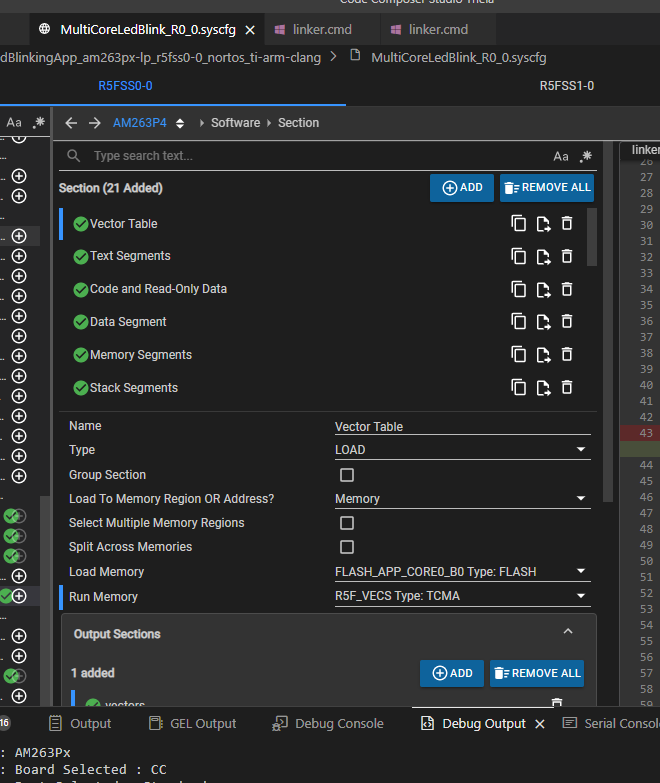
Running CCS debugger:
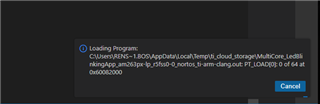
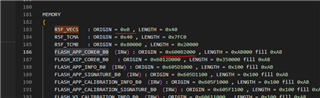
As visible, for option 2 (i.e setting the load adress to be flash-based), CCS debugger now cannot program the Vectors section (PT_LOAD[0]) anymore. Looking at memory map:
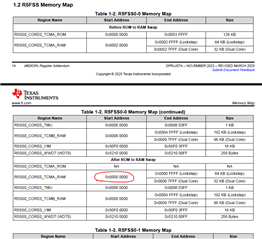
presumably as now the section is not placed into R5SS0_CORE0_TCMA_RAM anymore.

So it seems to me like CCS debugger uses section load adresses as the adress where a section needs to be run. Which would seem counterintuitive, as this essentially makes the 'load adress' option for all sections useless - as CCS debugger doesn't work.

Is this assumption correct? Is there a reason for CCS debugger not using the RAM/run adress for debug purposes? Is there anyway to make CCS debugger use run adresses instead of load adresses for debug?

Thanks,

Rens

  • So it seems to me like CCS debugger uses section load adresses as the adress where a section needs to be run. Which would seem counterintuitive, as this essentially makes the 'load adress' option for all sections useless - as CCS debugger doesn't work.

    Is this assumption correct? Is there a reason for CCS debugger not using the RAM/run adress for debug purposes? Is there anyway to make CCS debugger use run adresses instead of load adresses for debug?

    The CCS debugger will use whatever run address is in the debug symbols. So assuming the executable is compiled correctly with the correct load/run addresses and the applicable code is copied from the load and run address, then the debugger should be able to properly debug the code executing from the run address.

    Running CCS debugger:

    The error in the screenshot below is a flashing failure. The flash algorithm failed to execute. I get this also when I change the load memory to flash (even if the run address is also set to the same). I'll bring this thread to the attention of the device experts for further comment.

  • As mentioned in AM263Px MCU+ SDK: Enabling XIP or eXecute In Place, the application entry point, interrupt vectors and initial code upto main() should still execute from RAM. After main() the code can execute from flash. I see that you're trying to place R5F_VECS into flash instead of RAM. Only the .text and .rodata needs to be stored into flash.

  • Thanks for your comments. Perhaps I did not make the example very clear. I only used R5F_VECS section as an example of the CCS debugger behaviour changing when load adress changes, I'm aware xip has other requirements.

    As we want to control section placement in the generated mcelf and subsequently in flash, ideally the load adress for each section would be flash based (0x6xxx) as then I can use the physical adress to order segments before they're written into the mcelf. Each section of course still has its RAM-based run adress (0x7xxx).

    However, as I understand it, the issue with this approach is that CCS debugger also utilises the load adress for each section for debugging sessions, not the run adress - as for a normal debug session we want to load the program to RAM. If I set a flash-based adress for the load adress, CCS debugger will not be able to load to this as it's not a location in ram. Does this sound correct?

    I was hoping there might be a workaround for CCS debugger where we can force the debugger to always utilise the run adress for each section to load section data to instead of the load adress. This would mean you could specify different load/run adresses and the debugger would still work. This is probably wishful thinking.. from the sound of it this is not possible?

  • However, as I understand it, the issue with this approach is that CCS debugger also utilises the load adress for each section for debugging sessions, not the run adress - as for a normal debug session we want to load the program to RAM. If I set a flash-based adress for the load adress, CCS debugger will not be able to load to this as it's not a location in ram. Does this sound correct?

    No, this should not be the case assuming that the correct information regarding the load and run addresses are in the debug symbols for the executable. The CCS debugger should parse the debug symbols and use the load address there for the address to load to and use the run address in the symbols for debugging. 

    This would mean you could specify different load/run adresses and the debugger would still work. This is probably wishful thinking.. from the sound of it this is not possible?

    This should already work - again assuming the above mentioned conditions.

  • Ok thank you for the clarification - much appreciated!

    In that case, as you say the current issue I've got then is finding reason for the flasher not working.

    Follow up questions:

    1: Are there any limitations on section format for CCS debugger? Things which come to mind are a) maximum section size or b) alignment - do all sections need to be page-aligned to the flash device (in this case 256 bytes)

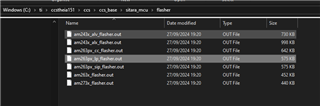
    2: Presumably the following executables (depending on board type) handle loading sections into either flash/ram memory. Is there more information available on the source of these? Would be very useful to know the setup differences between e.g. am263px_cc_flasher.out, am263px_lp_flasher.out and am263px_sip_flasher.out. Afaik, flash driver setup should be very similar across cc and lp

    3: From where in the process is the am263px_cc_flasher.out called? Looking through all the .gel files, it appears we pass through most of the init steps in the general AM263Px.gel setup, but I'm struggling to find a gel function which calls this loader. Or is this defined elsewhere?

    Thanks for your patience on this one..

  • These are questions I will defer to the device experts on.

  • Just to ask for an update - have the device experts come to any conclusions? Thanks

  • Apologies for the delay.


    2: Presumably the following executables (depending on board type) handle loading sections into either flash/ram memory. Is there more information available on the source of these? Would be very useful to know the setup differences between e.g. am263px_cc_flasher.out, am263px_lp_flasher.out and am263px_sip_flasher.out. Afaik, flash driver setup should be very similar across cc and lp

    You're right, this is the flash writer application. The source can be found at {SDK_PATH}/tools/flasher/jtag_uniflash. The source code is same for all the boards, the difference is the flash reset mechanism that is captured in board.c file of the project. In case of SIP board, even the flash configuration varies which is modified via syscfg. 

    3: From where in the process is the am263px_cc_flasher.out called? Looking through all the .gel files, it appears we pass through most of the init steps in the general AM263Px.gel setup, but I'm struggling to find a gel function which calls this loader. Or is this defined elsewhere?

    The executable is called from a prebuilt library "FlashSitaraMCU.dll" in Windows and "libFlashSitaraMCU.so" in Linux. 

    1: Are there any limitations on section format for CCS debugger? Things which come to mind are a) maximum section size or b) alignment - do all sections need to be page-aligned to the flash device (in this case 256 bytes)

    I am not sure if there is a maximum section size limit, but yes the sections need to be page aligned. Let me check about the maximum size and get back to you.

    Best Regards,
    Aswathi

  • Thanks for the confirmation Aswathi. In that case, page alignment is probably contributing to the issue at the moment.

    When you change load address to be flash-based for any (page-aligned) section, are you able to get flashing through CCS debugger working?

  • Hi Rens,

    Yes for any XIP application ,we keep load address and run address as flash- based and it works. But if I change the run address to any other it would not work unless Imake sure during runtime a piece of code would copy the same code to my run address.