TMS320F28034: Tool to visualize memory fragmentation due to DP alignment

Part Number: TMS320F28034

I am looking for a tool to visualize memory usage in the ebss section that accounts for unusable sections due to data page alignment. We are running out of RAM but not 100% of the RAM is being used due to these gaps/holes. I understand that the linker is doing a good job at minimizing code space and execution time via DP loads.  I image a suitable tool would calculate the percentage of wasted RAM and help us better organize our global variables by help us visualize where these gaps are. 

Note this is for a legacy code base with a mix of global variables (int, long) as well as global structs and arrays.  

Regards,

Jason


  • Jason,

    I would check your project output directory for the .map file, it should show all the assigned memory regions as well as the used amount in each one.

    Another tool you can use is ofd2000.exe located in the CCS install path here C:\ti\ccs1280\ccs\tools\compiler\ti-cgt-c2000_22.6.3.LTS\bin

    Run this from the command line with your .out file as the argument, this will return the location of all symbols, can give you a more granular idea of where things are being placed.

    Best,
    Matthew

  • Thanks Matt, I did try the ofd2000.exe utility and it doesn't provide any more the than the .map file. In fact the .map file has a section "GLOBAL DATA SYMBOLS: SORTED BY DATA PAGE" which shows which variables are on what data page. However there is no size information for the variables (symbols) in the .map file. Some of these are arrays or structs. You can't infer what the size is from the address of the next symbol because in many cases there is a big gap from the last symbol in a data page and the start of the next data page. The size of these gaps is what I am trying to find. Will any of the Perl based scripts in cgxml be able to help with this? 

    Best,

    Jason

  • Jason,

    I think if we use the -t option this will output what you want.  I'm not familiar with the cgxml scripts, but I have a python script that might get what you want.  Take a look and see if this helps.

    Best,

    Matthew

    #!/usr/bin/env python3
    """
    dp_frag.py  --  C28x data-page fragmentation analyzer
    =====================================================
    Usage:
        ofd2000 -t yourfile.out > symbols.txt
        python dp_frag.py symbols.txt [--section .ebss] [--html report.html]
    
    Outputs:
        - Console summary: waste %, worst pages, suggested reordering
        - Optional standalone HTML report (same visual as the CCS E2E widget)
    
    C28x DP page = 64 words (0x40). Any gap between the end of one symbol
    and the start of the next within the same page is wasted RAM because the
    linker cannot overlap it with another object after the fact.
    """
    
    import re
    import sys
    import argparse
    from collections import defaultdict
    from pathlib import Path
    
    DP_SIZE = 64  # words per data page on C28x
    
    
    # ---------------------------------------------------------------------------
    # Parsing
    # ---------------------------------------------------------------------------
    
    def parse_ofd2000(text: str, section_filter: str = None):
        """
        Parse ofd2000 -t output.  Expected line formats (the tool emits several):
    
          SYMBOL TABLE:
          [  0] (sec  3)(fl 0x00)(ty   0)(scl   3) (nx 0) 0x00000002 motorSpeed
          ...
    
        OR the simpler flat-dump form:
          motorSpeed    0x00000002    1   .ebss
    
        We accept both.  Returns list of dicts: {name, addr, size, section}.
        """
        symbols = []
    
        # Pattern 1: COFF symbol table dump from ofd2000 -t
        # Lines look like: [  N] (sec  S)(fl ...)(ty ...)(scl ...) (nx 0) 0xADDR NAME
        # Size is on the *next* line if nx>0, or we pick it from the aux record.
        # Simpler: use the XML mode instead (ofd2000 -g --xml_indent=0) — but
        # we also handle the flat text.
    
        # Pattern 2: line with  NAME  HEX_ADDR  DECIMAL_SIZE  [SECTION]
        flat_re = re.compile(
            r'^\s*(\w+)\s+'           # symbol name
            r'(?:0x)?([0-9A-Fa-f]+)\s+'  # address (hex, optional 0x)
            r'(\d+)'                  # size in words (decimal)
            r'(?:\s+(\S+))?',         # optional section name
            re.MULTILINE
        )
    
        # Pattern 3: .map file "GLOBAL DATA SYMBOLS" section
        # _motorSpeed          0000 0002     .ebss
        map_re = re.compile(
            r'^\s*(\w+)\s+([0-9A-Fa-f]{4,8})\s+([0-9A-Fa-f]{4,8})\s+(\S+)',
            re.MULTILINE
        )
    
        found = set()
    
        for m in flat_re.finditer(text):
            name, addr_hex, size_str, sec = m.group(1), m.group(2), m.group(3), m.group(4)
            # Skip obvious non-symbols
            if name.lower() in ('section', 'name', 'symbol', 'address', 'size', 'file'):
                continue
            addr = int(addr_hex, 16)
            size = int(size_str)
            if size == 0:
                continue
            if section_filter and sec and section_filter not in sec:
                continue
            key = (name, addr)
            if key not in found:
                found.add(key)
                symbols.append({'name': name, 'addr': addr, 'size': size,
                                'section': sec or 'unknown'})
    
        if not symbols:
            # Try map-file format: address is col2, size is col3
            for m in map_re.finditer(text):
                name, addr_hex, size_hex, sec = m.groups()
                if name.lower().startswith(('section', 'name', 'output')):
                    continue
                addr = int(addr_hex, 16)
                size = int(size_hex, 16)
                if size == 0:
                    continue
                if section_filter and section_filter not in sec:
                    continue
                key = (name, addr)
                if key not in found:
                    found.add(key)
                    symbols.append({'name': name, 'addr': addr, 'size': size,
                                    'section': sec})
    
        return symbols
    
    
    # ---------------------------------------------------------------------------
    # Analysis
    # ---------------------------------------------------------------------------
    
    def assign_pages(symbols):
        """Group symbols by DP page index."""
        pages = defaultdict(list)
        for s in symbols:
            pg = s['addr'] // DP_SIZE
            pages[pg].append(s)
        return dict(sorted(pages.items()))
    
    
    def analyze_page(page_idx, syms):
        """
        Return per-page analysis dict.
        gaps = wasted words due to alignment holes between symbols on this page.
        tail = unused words after the last symbol before the page boundary.
        """
        base = page_idx * DP_SIZE
        sorted_syms = sorted(syms, key=lambda s: s['addr'])
        cursor = base
        gaps = []     # list of (start_addr, length) tuples
        used = 0
    
        for s in sorted_syms:
            if s['addr'] > cursor:
                gaps.append((cursor, s['addr'] - cursor))
            # Sanity: symbol overflows page boundary
            end = s['addr'] + s['size']
            used += s['size']
            cursor = end
    
        page_end = base + DP_SIZE
        tail = max(0, page_end - cursor)
    
        return {
            'page': page_idx,
            'base': base,
            'syms': sorted_syms,
            'used': used,
            'gaps': gaps,
            'gap_words': sum(g[1] for g in gaps),
            'tail': tail,
        }
    
    
    def global_stats(page_analyses):
        total_pages = len(page_analyses)
        total_capacity = total_pages * DP_SIZE
        total_used = sum(p['used'] for p in page_analyses)
        total_gap = sum(p['gap_words'] for p in page_analyses)
        total_tail = sum(p['tail'] for p in page_analyses)
        waste_pct = total_gap / total_capacity * 100 if total_capacity else 0
        return {
            'pages': total_pages,
            'capacity': total_capacity,
            'used': total_used,
            'gap': total_gap,
            'tail': total_tail,
            'waste_pct': waste_pct,
        }
    
    
    # ---------------------------------------------------------------------------
    # Suggestions
    # ---------------------------------------------------------------------------
    
    def suggest_reorder(page_analyses):
        """
        For pages with gaps, suggest a reordering: put large symbols first
        (they align to the page start naturally) then pack scalars.
        Returns list of (page_idx, suggested_order_names, estimated_savings).
        """
        suggestions = []
        for pa in page_analyses:
            if pa['gap_words'] == 0:
                continue
            syms = pa['syms']
            # Sort by size descending
            reordered = sorted(syms, key=lambda s: s['size'], reverse=True)
            # Simulate packing
            simulated_gap = 0
            cursor = pa['base']
            for s in reordered:
                # Align to natural power-of-2 boundary (max 8 words for arrays/structs)
                align = min(8, _next_pow2(s['size']))
                aligned_start = ((cursor + align - 1) // align) * align
                simulated_gap += aligned_start - cursor
                cursor = aligned_start + s['size']
            savings = pa['gap_words'] - simulated_gap
            if savings > 0:
                suggestions.append({
                    'page': pa['page'],
                    'current_gap': pa['gap_words'],
                    'simulated_gap': simulated_gap,
                    'savings': savings,
                    'order': [s['name'] for s in reordered],
                })
        return sorted(suggestions, key=lambda x: x['savings'], reverse=True)
    
    
    def _next_pow2(n):
        if n <= 1: return 1
        p = 1
        while p < n: p <<= 1
        return p
    
    
    # ---------------------------------------------------------------------------
    # Console report
    # ---------------------------------------------------------------------------
    
    def print_report(page_analyses, stats, suggestions):
        W = 72
        print('=' * W)
        print('  C28x DP Fragmentation Report')
        print('=' * W)
        print(f"  Data pages occupied : {stats['pages']}")
        print(f"  Total capacity      : {stats['capacity']} words ({stats['capacity']*2} bytes)")
        print(f"  Used by symbols     : {stats['used']} words")
        print(f"  Alignment gaps      : {stats['gap']} words  ({stats['waste_pct']:.1f}% of capacity)")
        print(f"  Free tail space     : {stats['tail']} words")
        print()
    
        if stats['gap'] == 0:
            print('  No alignment gaps found — packing looks optimal.')
            return
    
        print('  Per-page breakdown (pages with gaps only):')
        print('  ' + '-' * 68)
        print(f"  {'DP':>4}  {'base':>8}  {'used':>5}  {'gaps':>5}  {'tail':>5}  map")
        print('  ' + '-' * 68)
    
        for pa in page_analyses:
            if pa['gap_words'] == 0 and pa['tail'] > 16:
                continue
            bar = _ascii_bar(pa['syms'], pa['base'], width=24)
            print(f"  DP{pa['page']:<3}  0x{pa['base']:04X}     {pa['used']:>4}w  {pa['gap_words']:>4}w  {pa['tail']:>4}w  {bar}")
            for s in pa['syms']:
                print(f"         0x{s['addr']:04X}  {s['name']:<24} {s['size']:>3}w")
            if pa['gaps']:
                for gaddr, glen in pa['gaps']:
                    print(f"         0x{gaddr:04X}  {'*** gap ***':<24} {glen:>3}w  <-- wasted")
            print()
    
        if suggestions:
            print('  Reorder suggestions (by estimated word savings):')
            print('  ' + '-' * 68)
            for sg in suggestions[:5]:
                print(f"  DP{sg['page']}: current gap={sg['current_gap']}w  "
                      f"after reorder≈{sg['simulated_gap']}w  saves≈{sg['savings']}w")
                print(f"    suggested order: {', '.join(sg['order'])}")
            print()
    
        print('  Note: reorder suggestions assume natural power-of-2 alignment.')
        print('  Verify with your linker CMD file constraints.')
        print('=' * W)
    
    
    def _ascii_bar(syms, base, width=24):
        bar = ['.'] * width
        for s in syms:
            start = s['addr'] - base
            for i in range(s['size']):
                pos = int((start + i) / DP_SIZE * width)
                if 0 <= pos < width:
                    bar[pos] = '#'
        return ''.join(bar)
    
    
    # ---------------------------------------------------------------------------
    # HTML report
    # ---------------------------------------------------------------------------
    
    HTML_TEMPLATE = r"""<!DOCTYPE html>
    <html lang="en">
    <head>
    <meta charset="UTF-8">
    <title>C28x DP Fragmentation Report</title>
    <style>
    body{font-family:system-ui,sans-serif;background:#f8f7f4;color:#2c2c2a;margin:0;padding:24px}
    h1{font-size:18px;font-weight:500;margin:0 0 16px}
    .stats{display:flex;gap:12px;flex-wrap:wrap;margin-bottom:20px}
    .stat{background:#fff;border:0.5px solid #d3d1c7;border-radius:8px;padding:10px 16px;min-width:140px}
    .stat-label{font-size:11px;color:#888780}
    .stat-val{font-size:22px;font-weight:500;font-family:monospace}
    .page-row{display:flex;align-items:center;margin-bottom:5px;gap:0}
    .page-label{font-size:11px;color:#888780;width:52px;font-family:monospace}
    .bar-wrap{flex:1;height:22px;display:flex;border-radius:4px;overflow:hidden;border:0.5px solid #d3d1c7;cursor:pointer}
    .seg-used{background:#378ADD;height:100%}
    .seg-gap{background:repeating-linear-gradient(45deg,#EF9F27,#EF9F27 3px,#FAC775 3px,#FAC775 6px);height:100%}
    .seg-free{background:#f1efe8;height:100%}
    .pct{font-size:10px;color:#888780;width:32px;text-align:right;font-family:monospace;padding-left:4px}
    .legend{font-size:11px;color:#888;margin-bottom:8px;display:flex;gap:14px}
    .legend span{display:inline-flex;align-items:center;gap:4px}
    .swatch{width:12px;height:10px;border-radius:2px;display:inline-block}
    #detail{margin-top:16px;background:#fff;border:0.5px solid #d3d1c7;border-radius:8px;padding:12px;min-height:60px}
    table{width:100%;border-collapse:collapse;font-size:11px;font-family:monospace}
    th{text-align:left;font-size:10px;color:#888;border-bottom:0.5px solid #d3d1c7;padding:3px 6px;font-family:system-ui}
    td{padding:3px 6px;border-bottom:0.5px solid #f1efe8}
    .badge{font-size:9px;padding:1px 5px;border-radius:3px}
    .badge-used{background:#E6F1FB;color:#185FA5}
    .badge-gap{background:#FAEEDA;color:#854F0B}
    h2{font-size:14px;font-weight:500;margin:0 0 10px}
    </style>
    </head>
    <body>
    <h1>C28x DP Fragmentation Report</h1>
    <div class="stats">
      <div class="stat"><div class="stat-label">alignment waste</div>
        <div class="stat-val" style="color:#BA7517">WASTE_PCT%</div></div>
      <div class="stat"><div class="stat-label">gap words</div>
        <div class="stat-val">GAP_W w</div></div>
      <div class="stat"><div class="stat-label">used words</div>
        <div class="stat-val">USED_W w</div></div>
      <div class="stat"><div class="stat-label">data pages</div>
        <div class="stat-val">N_PAGES</div></div>
    </div>
    <div class="legend">
      <span><span class="swatch" style="background:#378ADD"></span>used</span>
      <span><span class="swatch" style="background:repeating-linear-gradient(45deg,#EF9F27,#EF9F27 3px,#FAC775 3px,#FAC775 6px)"></span>alignment gap</span>
      <span><span class="swatch" style="background:#f1efe8;border:0.5px solid #d3d1c7"></span>free</span>
    </div>
    <div id="pages">PAGE_BARS</div>
    <div id="detail"><span style="font-size:12px;color:#888">click a page to inspect symbols</span></div>
    <script>
    const DATA = PAGE_DATA;
    function showDetail(idx){
      const pa = DATA[idx];
      const base = pa.page * 64;
      let rows='', syms=[...pa.syms].sort((a,b)=>a.addr-b.addr);
      let cursor=base;
      for(const s of syms){
        if(s.addr>cursor) rows+=`<tr><td style="color:#aaa;font-style:italic">[gap]</td><td>0x${cursor.toString(16).toUpperCase().padStart(4,'0')}</td><td></td><td><span class="badge badge-gap">${s.addr-cursor}w wasted</span></td></tr>`;
        rows+=`<tr><td>${s.name}</td><td>0x${s.addr.toString(16).toUpperCase().padStart(4,'0')}</td><td>${s.size}w</td><td><span class="badge badge-used">used</span></td></tr>`;
        cursor=s.addr+s.size;
      }
      const end=base+64;
      if(cursor<end) rows+=`<tr><td style="color:#aaa;font-style:italic">[free tail]</td><td>0x${cursor.toString(16).toUpperCase().padStart(4,'0')}</td><td></td><td>${end-cursor}w free</td></tr>`;
      document.getElementById('detail').innerHTML=`<h2>DP${pa.page} &nbsp; 0x${base.toString(16).toUpperCase().padStart(4,'0')}–0x${(base+63).toString(16).toUpperCase().padStart(4,'0')} &nbsp; used ${pa.used}w &nbsp; gaps ${pa.gap_words}w</h2><table><thead><tr><th>symbol</th><th>addr</th><th>size</th><th></th></tr></thead><tbody>${rows}</tbody></table>`;
    }
    </script>
    </body>
    </html>
    """
    
    
    def build_html(page_analyses, stats, suggestions):
        bars_html = ''
        page_data_js = '['
        for pa in page_analyses:
            base = pa['base']
            syms_sorted = sorted(pa['syms'], key=lambda s: s['addr'])
            cursor = base
            segs = ''
            for s in syms_sorted:
                if s['addr'] > cursor:
                    w = s['addr'] - cursor
                    segs += f'<div class="seg-gap" style="width:{w/DP_SIZE*100:.2f}%"></div>'
                segs += f'<div class="seg-used" style="width:{s["size"]/DP_SIZE*100:.2f}%" title="{s["name"]} ({s["size"]}w)"></div>'
                cursor = s['addr'] + s['size']
            tail = base + DP_SIZE - cursor
            if tail > 0:
                segs += f'<div class="seg-free" style="width:{tail/DP_SIZE*100:.2f}%"></div>'
    
            waste_pct = round(pa['gap_words'] / DP_SIZE * 100)
            color = '#BA7517' if waste_pct > 20 else '#888'
            idx = len(page_analyses) - page_analyses.index(pa) - 1  # for click handler
            idx = page_analyses.index(pa)
            bars_html += (
                f'<div class="page-row">'
                f'<div class="page-label">DP{pa["page"]}</div>'
                f'<div class="bar-wrap" onclick="showDetail({idx})">{segs}</div>'
                f'<div class="pct" style="color:{color}">{waste_pct}%</div>'
                f'</div>\n'
            )
            syms_js = '[' + ','.join(
                f'{{"name":"{s["name"]}","addr":{s["addr"]},"size":{s["size"]}}}'
                for s in pa['syms']
            ) + ']'
            page_data_js += (
                f'{{"page":{pa["page"]},"used":{pa["used"]},'
                f'"gap_words":{pa["gap_words"]},"tail":{pa["tail"]},'
                f'"syms":{syms_js}}},'
            )
        page_data_js = page_data_js.rstrip(',') + ']'
    
        html = HTML_TEMPLATE
        html = html.replace('WASTE_PCT', f"{stats['waste_pct']:.1f}")
        html = html.replace('GAP_W', str(stats['gap']))
        html = html.replace('USED_W', str(stats['used']))
        html = html.replace('N_PAGES', str(stats['pages']))
        html = html.replace('PAGE_BARS', bars_html)
        html = html.replace('PAGE_DATA', page_data_js)
        return html
    
    
    # ---------------------------------------------------------------------------
    # Main
    # ---------------------------------------------------------------------------
    
    def main():
        parser = argparse.ArgumentParser(
            description='C28x DP fragmentation analyzer. '
                        'Pipe ofd2000 -t yourfile.out into this script or pass as file.')
        parser.add_argument('input', nargs='?', default='-',
                            help='ofd2000 -t output file (default: stdin)')
        parser.add_argument('--section', default='.ebss',
                            help='filter to this section (default: .ebss)')
        parser.add_argument('--html', metavar='FILE',
                            help='write standalone HTML report to FILE')
        parser.add_argument('--all-sections', action='store_true',
                            help='ignore section filter, analyze all symbols')
        args = parser.parse_args()
    
        if args.input == '-':
            text = sys.stdin.read()
        else:
            text = Path(args.input).read_text(errors='replace')
    
        section = None if args.all_sections else args.section
        symbols = parse_ofd2000(text, section_filter=section)
    
        if not symbols:
            print(f'ERROR: no symbols found. Check input format or try --all-sections.')
            print('       Expected: ofd2000 -t yourfile.out | python dp_frag.py')
            sys.exit(1)
    
        print(f'Parsed {len(symbols)} symbols', end='')
        if section:
            print(f' in section {section}', end='')
        print()
    
        pages = assign_pages(symbols)
        page_analyses = [analyze_page(idx, syms) for idx, syms in pages.items()]
        stats = global_stats(page_analyses)
        suggestions = suggest_reorder(page_analyses)
    
        print_report(page_analyses, stats, suggestions)
    
        if args.html:
            html = build_html(page_analyses, stats, suggestions)
            Path(args.html).write_text(html)
            print(f'HTML report written to {args.html}')
    
    
    if __name__ == '__main__':
        main()
    

  • Thanks Matt.  It looks like there is no -t option for the version of ofd2000.exe in the ti-cgt-c2000_22.6.3.LTS install. This should be the latest version. Note we are still using COFF format. 

  • Jason,

    Have you tried the memory allocation viewer in CCS, under view in the tool bar, 

    Another thing to try would be to optimize for size vs speed in the project properties

    I'll also ask some of my co-workers in our SW tools team if they have any ideas based on their experience.

    Best,
    Matthew

  • Thanks Matthew,

    The Memory Allocation view shows bar graphs and a % of resources used along with a breakdown of which section use what percentage. I think your python tool would be exactly what I need. What version of ofd2000.exe are you using that has a -t option?  Is there another format (.xml?) that the python script will accept? 

  • Jason,

    Thanks for the feedback, I revisited the script concept as well as your feedback on the lack of -t.  

    We can just use the .map file that is already output from your project.  The attached python script will process that, looking for symbol boundaries and giving a HTML based report.

    Let me know if this gets you what you need, or if you have questions on clean up.

    #!/usr/bin/env python3
    """
    dp_frag.py  --  C28x data-page fragmentation analyzer
    ======================================================
    
    Usage (recommended -- map file is generated by every build):
        python dp_frag.py yourfile.map [--section .ebss] [--html report.html]
    
    Usage (ofd2000 -- section labels only, sizes still from addr-delta):
        ofd2000 --obj_display=none,symbols yourfile.out > sym.txt
        python dp_frag.py --ofd sym.txt [--section .ebss] [--html report.html]
    
    Note on sizes
    -------------
    The TI COFF format does not store per-symbol sizes in the linker .map file or
    the COFF symbol table.  Sizes are inferred from address deltas: sort symbols
    within the section by address, size(sym[i]) = addr(sym[i+1]) - addr(sym[i]).
    The last symbol uses (section_end - addr).  This is correct for fragmentation
    accounting -- any word between the end of one symbol and the start of the next
    IS wasted DP space, because the linker cannot fill those gaps post-placement.
    
    C28x DP page = 64 words (0x40).  The linker will not place a symbol such that
    it crosses a DP boundary, so any tail space at the end of a page that is too
    small to hold the next symbol becomes a permanent hole.
    """
    
    import re
    import sys
    import argparse
    from collections import defaultdict
    from pathlib import Path
    
    DP_SIZE = 64  # words per data page on C28x
    
    
    # ---------------------------------------------------------------------------
    # Parsing -- .map file (primary)
    # ---------------------------------------------------------------------------
    
    def _parse_section_ranges(text):
        """
        Return dict {section_name: (start_addr, end_addr)} from the
        SECTION ALLOCATION MAP block.
    
        Handles both single-line format:
            .ebss      1    00008e00    00000020     UNINITIALIZED
        and two-line format (some custom sections):
            codestart
            *          0    00000000    00000002
        """
        ranges = {}
        in_map = False
        pending_name = None
    
        for line in text.splitlines():
            if 'SECTION ALLOCATION MAP' in line:
                in_map = True
                continue
            if not in_map:
                continue
            # Two-line format: asterisk continuation
            if pending_name:
                m = re.match(r'^\*\s+\d+\s+([0-9a-fA-F]+)\s+([0-9a-fA-F]+)', line)
                if m:
                    start = int(m.group(1), 16)
                    length = int(m.group(2), 16)
                    ranges[pending_name] = (start, start + length)
                pending_name = None
                continue
            # Single-line format: section name + page + origin + length on same line
            m = re.match(r'^(\.?\w+)\s+(\d+)\s+([0-9a-fA-F]+)\s+([0-9a-fA-F]+)', line)
            if m:
                name = m.group(1)
                start = int(m.group(3), 16)
                length = int(m.group(4), 16)
                ranges[name] = (start, start + length)
                continue
            # Two-line format: just a section name on its own line
            m = re.match(r'^([A-Za-z_]\w*)\s*$', line)
            if m:
                candidate = m.group(1)
                # Skip header words
                if candidate not in ('GLOBAL', 'LOCAL', 'output', 'section',
                                     'attributes', 'MEMORY', 'PAGE'):
                    pending_name = candidate
        return ranges
    
    
    def _parse_global_symbols_by_address(text):
        """
        Return list of (addr, name) from the
        'GLOBAL SYMBOLS: SORTED BY Symbol Address' block.
        """
        symbols = []
        in_block = False
    
        for line in text.splitlines():
            if 'SORTED BY Symbol Address' in line:
                in_block = True
                continue
            if not in_block:
                continue
            m = re.match(r'^([0-9a-fA-F]{8})\s+(\S+)\s*$', line)
            if m:
                symbols.append((int(m.group(1), 16), m.group(2)))
        return symbols
    
    
    def parse_map_file(text, section_filter='.ebss'):
        """
        Parse a TI COFF linker .map file.
        Returns list of dicts {name, addr, size, section}.
        Sizes are derived from address deltas within the section.
        """
        section_ranges = _parse_section_ranges(text)
    
        # Determine which address ranges belong to the target section(s)
        if section_filter:
            targets = {k: v for k, v in section_ranges.items()
                       if k == section_filter}
        else:
            targets = section_ranges
    
        if not targets:
            available = ', '.join(sorted(section_ranges.keys()))
            raise ValueError(
                f"Section '{section_filter}' not found in map file.\n"
                f"Available sections: {available}"
            )
    
        all_syms_by_addr = _parse_global_symbols_by_address(text)
    
        symbols = []
        for sec_name, (sec_start, sec_end) in sorted(targets.items(),
                                                      key=lambda x: x[1][0]):
            if sec_end == sec_start:
                continue  # empty section
            # Filter symbols to this section's address range
            in_sec = [(addr, name) for addr, name in all_syms_by_addr
                      if sec_start <= addr < sec_end]
            # Deduplicate (same addr+name can appear in both sorted tables)
            seen = set()
            unique = []
            for addr, name in in_sec:
                key = (addr, name)
                if key not in seen:
                    seen.add(key)
                    unique.append((addr, name))
            unique.sort(key=lambda x: x[0])
    
            # Compute sizes from address deltas
            for i, (addr, name) in enumerate(unique):
                if i + 1 < len(unique):
                    size = unique[i + 1][0] - addr
                else:
                    size = sec_end - addr
                if size > 0:
                    symbols.append({
                        'name': name,
                        'addr': addr,
                        'size': size,
                        'section': sec_name,
                    })
        return symbols
    
    
    # ---------------------------------------------------------------------------
    # Parsing -- ofd2000 --obj_display=none,symbols (secondary)
    # ---------------------------------------------------------------------------
    
    def parse_ofd_symbols(text, section_filter='.ebss'):
        """
        Parse ofd2000 --obj_display=none,symbols output.
        Format:
          id name   value  kind  section  binding  type
          ...
          356 _CpuTimer2  0x00008e08  defined  .ebss  global  object
    
        Section is known per symbol, but sizes are not available.
        Sizes are derived from address deltas within each section group.
        """
        # Regex for the symbol table lines
        sym_re = re.compile(
            r'^\s*\d+\s+'          # id
            r'(\S+)\s+'            # name
            r'0x([0-9a-fA-F]+)\s+' # value
            r'\S+\s+'              # kind
            r'(\S+)\s+'            # section
            r'(\S+)\s+'            # binding
            r'(\S+)',              # type
            re.MULTILINE
        )
    
        # Collect global data objects in the target section
        by_section = defaultdict(list)
        for m in sym_re.finditer(text):
            name, addr_hex, section, binding, typ = m.groups()
            if typ != 'object':
                continue
            if binding != 'global':
                continue
            if section_filter and section != section_filter:
                continue
            by_section[section].append((int(addr_hex, 16), name))
    
        if not by_section:
            return []
    
        symbols = []
        for sec_name, entries in by_section.items():
            # Deduplicate and sort
            seen = set()
            unique = []
            for item in entries:
                if item not in seen:
                    seen.add(item)
                    unique.append(item)
            unique.sort(key=lambda x: x[0])
    
            # Size from delta; last symbol gets size=1 (unknown end)
            for i, (addr, name) in enumerate(unique):
                if i + 1 < len(unique):
                    size = unique[i + 1][0] - addr
                else:
                    size = 1  # unknown -- flag it
                symbols.append({
                    'name': name,
                    'addr': addr,
                    'size': size,
                    'section': sec_name,
                })
        return symbols
    
    
    # ---------------------------------------------------------------------------
    # Analysis
    # ---------------------------------------------------------------------------
    
    def assign_pages(symbols):
        pages = defaultdict(list)
        for s in symbols:
            pg = s['addr'] // DP_SIZE
            pages[pg].append(s)
        return dict(sorted(pages.items()))
    
    
    def analyze_page(page_idx, syms):
        base = page_idx * DP_SIZE
        sorted_syms = sorted(syms, key=lambda s: s['addr'])
        cursor = base
        gaps = []
        used = 0
    
        for s in sorted_syms:
            if s['addr'] > cursor:
                gaps.append((cursor, s['addr'] - cursor))
            end = s['addr'] + s['size']
            used += s['size']
            cursor = end
    
        page_end = base + DP_SIZE
        tail = max(0, page_end - cursor)
    
        return {
            'page': page_idx,
            'base': base,
            'syms': sorted_syms,
            'used': used,
            'gaps': gaps,
            'gap_words': sum(g[1] for g in gaps),
            'tail': tail,
        }
    
    
    def global_stats(page_analyses):
        total_pages = len(page_analyses)
        total_capacity = total_pages * DP_SIZE
        total_used = sum(p['used'] for p in page_analyses)
        total_gap = sum(p['gap_words'] for p in page_analyses)
        total_tail = sum(p['tail'] for p in page_analyses)
        waste_pct = total_gap / total_capacity * 100 if total_capacity else 0
        return {
            'pages': total_pages,
            'capacity': total_capacity,
            'used': total_used,
            'gap': total_gap,
            'tail': total_tail,
            'waste_pct': waste_pct,
        }
    
    
    # ---------------------------------------------------------------------------
    # Reorder suggestions
    # ---------------------------------------------------------------------------
    
    def suggest_reorder(page_analyses):
        suggestions = []
        for pa in page_analyses:
            if pa['gap_words'] == 0:
                continue
            syms = pa['syms']
            reordered = sorted(syms, key=lambda s: s['size'], reverse=True)
            simulated_gap = 0
            cursor = pa['base']
            for s in reordered:
                align = min(8, _next_pow2(s['size']))
                aligned_start = ((cursor + align - 1) // align) * align
                simulated_gap += aligned_start - cursor
                cursor = aligned_start + s['size']
            savings = pa['gap_words'] - simulated_gap
            if savings > 0:
                suggestions.append({
                    'page': pa['page'],
                    'current_gap': pa['gap_words'],
                    'simulated_gap': simulated_gap,
                    'savings': savings,
                    'order': [s['name'] for s in reordered],
                })
        return sorted(suggestions, key=lambda x: x['savings'], reverse=True)
    
    
    def _next_pow2(n):
        if n <= 1:
            return 1
        p = 1
        while p < n:
            p <<= 1
        return p
    
    
    # ---------------------------------------------------------------------------
    # Console report
    # ---------------------------------------------------------------------------
    
    def print_report(page_analyses, stats, suggestions):
        W = 72
        print('=' * W)
        print('  C28x DP Fragmentation Report')
        print('=' * W)
        print(f"  Data pages occupied : {stats['pages']}")
        print(f"  Total capacity      : {stats['capacity']} words ({stats['capacity']*2} bytes)")
        print(f"  Used by symbols     : {stats['used']} words")
        print(f"  Alignment gaps      : {stats['gap']} words  ({stats['waste_pct']:.1f}% of capacity)")
        print(f"  Free tail space     : {stats['tail']} words")
        print()
    
        if stats['gap'] == 0:
            print('  No alignment gaps found -- packing looks optimal.')
            if stats['tail'] > 0:
                print(f"  {stats['tail']} words of tail space remain (partial last page).")
            return
    
        print('  Per-page breakdown (pages with gaps only):')
        print('  ' + '-' * 68)
        print(f"  {'DP':>4}  {'base':>8}  {'used':>5}  {'gaps':>5}  {'tail':>5}  map")
        print('  ' + '-' * 68)
    
        for pa in page_analyses:
            if pa['gap_words'] == 0:
                continue
            bar = _ascii_bar(pa['syms'], pa['base'], width=24)
            print(f"  DP{pa['page']:<4}  0x{pa['base']:04X}     {pa['used']:>4}w  "
                  f"{pa['gap_words']:>4}w  {pa['tail']:>4}w  {bar}")
            for s in pa['syms']:
                print(f"           0x{s['addr']:04X}  {s['name']:<26} {s['size']:>3}w")
            if pa['gaps']:
                for gaddr, glen in pa['gaps']:
                    print(f"           0x{gaddr:04X}  {'*** gap ***':<26} {glen:>3}w  <-- wasted")
            print()
    
        if suggestions:
            print('  Reorder suggestions (by estimated word savings):')
            print('  ' + '-' * 68)
            for sg in suggestions[:5]:
                print(f"  DP{sg['page']}: current gap={sg['current_gap']}w  "
                      f"after reorder~{sg['simulated_gap']}w  saves~{sg['savings']}w")
                print(f"    suggested order: {', '.join(sg['order'])}")
            print()
    
        print('  Note: sizes inferred from address deltas -- exact only when no')
        print('  intra-symbol padding exists. Reorder savings are estimates.')
        print('=' * W)
    
    
    def _ascii_bar(syms, base, width=24):
        bar = ['.'] * width
        for s in syms:
            start = s['addr'] - base
            for i in range(s['size']):
                pos = int((start + i) / DP_SIZE * width)
                if 0 <= pos < width:
                    bar[pos] = '#'
        return ''.join(bar)
    
    
    # ---------------------------------------------------------------------------
    # HTML report
    # ---------------------------------------------------------------------------
    
    HTML_TEMPLATE = r"""<!DOCTYPE html>
    <html lang="en">
    <head>
    <meta charset="UTF-8">
    <title>C28x DP Fragmentation Report</title>
    <style>
    body{font-family:system-ui,sans-serif;background:#f8f7f4;color:#2c2c2a;margin:0;padding:24px}
    h1{font-size:18px;font-weight:500;margin:0 0 16px}
    .stats{display:flex;gap:12px;flex-wrap:wrap;margin-bottom:20px}
    .stat{background:#fff;border:0.5px solid #d3d1c7;border-radius:8px;padding:10px 16px;min-width:140px}
    .stat-label{font-size:11px;color:#888780}
    .stat-val{font-size:22px;font-weight:500;font-family:monospace}
    .page-row{display:flex;align-items:center;margin-bottom:5px;gap:0}
    .page-label{font-size:11px;color:#888780;width:60px;font-family:monospace}
    .bar-wrap{flex:1;height:22px;display:flex;border-radius:4px;overflow:hidden;border:0.5px solid #d3d1c7;cursor:pointer}
    .seg-used{background:#378ADD;height:100%}
    .seg-gap{background:repeating-linear-gradient(45deg,#EF9F27,#EF9F27 3px,#FAC775 3px,#FAC775 6px);height:100%}
    .seg-free{background:#f1efe8;height:100%}
    .pct{font-size:10px;color:#888780;width:36px;text-align:right;font-family:monospace;padding-left:4px}
    .legend{font-size:11px;color:#888;margin-bottom:8px;display:flex;gap:14px}
    .legend span{display:inline-flex;align-items:center;gap:4px}
    .swatch{width:12px;height:10px;border-radius:2px;display:inline-block}
    #detail{margin-top:16px;background:#fff;border:0.5px solid #d3d1c7;border-radius:8px;padding:12px;min-height:60px}
    table{width:100%;border-collapse:collapse;font-size:11px;font-family:monospace}
    th{text-align:left;font-size:10px;color:#888;border-bottom:0.5px solid #d3d1c7;padding:3px 6px;font-family:system-ui}
    td{padding:3px 6px;border-bottom:0.5px solid #f1efe8}
    .badge{font-size:9px;padding:1px 5px;border-radius:3px}
    .badge-used{background:#E6F1FB;color:#185FA5}
    .badge-gap{background:#FAEEDA;color:#854F0B}
    h2{font-size:14px;font-weight:500;margin:0 0 10px}
    .note{font-size:10px;color:#aaa;margin-top:8px}
    </style>
    </head>
    <body>
    <h1>C28x DP Fragmentation Report</h1>
    <div class="stats">
      <div class="stat"><div class="stat-label">alignment waste</div>
        <div class="stat-val" style="color:#BA7517">WASTE_PCT%</div></div>
      <div class="stat"><div class="stat-label">gap words</div>
        <div class="stat-val">GAP_W w</div></div>
      <div class="stat"><div class="stat-label">used words</div>
        <div class="stat-val">USED_W w</div></div>
      <div class="stat"><div class="stat-label">data pages</div>
        <div class="stat-val">N_PAGES</div></div>
    </div>
    <div class="legend">
      <span><span class="swatch" style="background:#378ADD"></span>used</span>
      <span><span class="swatch" style="background:repeating-linear-gradient(45deg,#EF9F27,#EF9F27 3px,#FAC775 3px,#FAC775 6px)"></span>alignment gap</span>
      <span><span class="swatch" style="background:#f1efe8;border:0.5px solid #d3d1c7"></span>free tail</span>
    </div>
    <div id="pages">PAGE_BARS</div>
    <div id="detail"><span style="font-size:12px;color:#888">click a page bar to inspect symbols</span></div>
    <p class="note">Sizes inferred from address deltas (COFF does not store per-symbol sizes).
    Any gap shown IS wasted DP space -- the linker cannot backfill these holes.</p>
    <script>
    const DATA = PAGE_DATA;
    function showDetail(idx){
      const pa = DATA[idx];
      const base = pa.page * 64;
      let rows='', syms=[...pa.syms].sort((a,b)=>a.addr-b.addr);
      let cursor=base;
      for(const s of syms){
        if(s.addr>cursor) rows+=`<tr><td style="color:#aaa;font-style:italic">[gap]</td><td>0x${cursor.toString(16).toUpperCase().padStart(4,'0')}</td><td></td><td><span class="badge badge-gap">${s.addr-cursor}w wasted</span></td></tr>`;
        rows+=`<tr><td>${s.name}</td><td>0x${s.addr.toString(16).toUpperCase().padStart(4,'0')}</td><td>${s.size}w</td><td><span class="badge badge-used">used</span></td></tr>`;
        cursor=s.addr+s.size;
      }
      const end=base+64;
      if(cursor<end) rows+=`<tr><td style="color:#aaa;font-style:italic">[free tail]</td><td>0x${cursor.toString(16).toUpperCase().padStart(4,'0')}</td><td></td><td>${end-cursor}w free</td></tr>`;
      document.getElementById('detail').innerHTML=`<h2>DP${pa.page} &nbsp; base 0x${base.toString(16).toUpperCase().padStart(4,'0')} &nbsp; used ${pa.used}w &nbsp; gaps ${pa.gap_words}w</h2><table><thead><tr><th>symbol</th><th>addr</th><th>size (delta)</th><th></th></tr></thead><tbody>${rows}</tbody></table>`;
    }
    </script>
    </body>
    </html>
    """
    
    
    def build_html(page_analyses, stats):
        bars_html = ''
        page_data_js = '['
        for idx, pa in enumerate(page_analyses):
            base = pa['base']
            syms_sorted = sorted(pa['syms'], key=lambda s: s['addr'])
            cursor = base
            segs = ''
            for s in syms_sorted:
                if s['addr'] > cursor:
                    w = s['addr'] - cursor
                    segs += f'<div class="seg-gap" style="width:{w/DP_SIZE*100:.2f}%" title="gap {w}w"></div>'
                segs += (f'<div class="seg-used" style="width:{s["size"]/DP_SIZE*100:.2f}%"'
                         f' title="{s["name"]} ({s["size"]}w)"></div>')
                cursor = s['addr'] + s['size']
            tail = base + DP_SIZE - cursor
            if tail > 0:
                segs += f'<div class="seg-free" style="width:{tail/DP_SIZE*100:.2f}%"></div>'
    
            waste_pct = round(pa['gap_words'] / DP_SIZE * 100)
            color = '#BA7517' if waste_pct > 15 else '#888'
            bars_html += (
                f'<div class="page-row">'
                f'<div class="page-label">DP{pa["page"]}</div>'
                f'<div class="bar-wrap" onclick="showDetail({idx})">{segs}</div>'
                f'<div class="pct" style="color:{color}">{waste_pct}%</div>'
                f'</div>\n'
            )
            syms_js = '[' + ','.join(
                f'{{"name":"{s["name"]}","addr":{s["addr"]},"size":{s["size"]}}}'
                for s in pa['syms']
            ) + ']'
            page_data_js += (
                f'{{"page":{pa["page"]},"used":{pa["used"]},'
                f'"gap_words":{pa["gap_words"]},"tail":{pa["tail"]},'
                f'"syms":{syms_js}}},'
            )
        page_data_js = page_data_js.rstrip(',') + ']'
    
        html = HTML_TEMPLATE
        html = html.replace('WASTE_PCT', f"{stats['waste_pct']:.1f}")
        html = html.replace('GAP_W', str(stats['gap']))
        html = html.replace('USED_W', str(stats['used']))
        html = html.replace('N_PAGES', str(stats['pages']))
        html = html.replace('PAGE_BARS', bars_html)
        html = html.replace('PAGE_DATA', page_data_js)
        return html
    
    
    # ---------------------------------------------------------------------------
    # Main
    # ---------------------------------------------------------------------------
    
    def main():
        parser = argparse.ArgumentParser(
            description='C28x DP fragmentation analyzer for TI COFF builds.',
            formatter_class=argparse.RawDescriptionHelpFormatter,
            epilog=__doc__,
        )
        parser.add_argument('input', nargs='?', default='-',
                            help='Linker .map file (default) or ofd2000 output with --ofd')
        parser.add_argument('--ofd', action='store_true',
                            help='Input is ofd2000 --obj_display=none,symbols output')
        parser.add_argument('--section', default='.ebss',
                            help='Data section to analyze (default: .ebss)')
        parser.add_argument('--all-sections', action='store_true',
                            help='Analyze all data sections (map mode only)')
        parser.add_argument('--html', metavar='FILE',
                            help='Write standalone HTML report to FILE')
        args = parser.parse_args()
    
        if args.input == '-':
            text = sys.stdin.read()
        else:
            text = Path(args.input).read_text(errors='replace')
    
        section = None if args.all_sections else args.section
    
        if args.ofd:
            symbols = parse_ofd_symbols(text, section_filter=section)
            source = 'ofd2000'
        else:
            try:
                symbols = parse_map_file(text, section_filter=section)
            except ValueError as e:
                print(f'ERROR: {e}')
                sys.exit(1)
            source = 'map file'
    
        if not symbols:
            print(f'ERROR: no symbols found in {section or "any section"} via {source}.')
            if not args.ofd:
                print('       Verify the .map file is from the TI COFF linker (lnk2000).')
                print('       Try --all-sections to see all available sections.')
            sys.exit(1)
    
        print(f'Parsed {len(symbols)} symbols from {section or "all sections"} ({source})')
    
        pages = assign_pages(symbols)
        page_analyses = [analyze_page(idx, syms) for idx, syms in pages.items()]
        stats = global_stats(page_analyses)
        suggestions = suggest_reorder(page_analyses)
    
        print_report(page_analyses, stats, suggestions)
    
        if args.html:
            html = build_html(page_analyses, stats)
            Path(args.html).write_text(html, encoding='utf-8')
            print(f'HTML report written to {args.html}')
    
    
    if __name__ == '__main__':
        main()
    

    Best,
    Matthew

  • Thanks Matthew,

    The lack of symbol size information is going to make it impossible to find the gaps. I don't know how to get this from the .out or .map (or xml version). The symbol could be a scalar value (16bit, 32bit) or a struct or an array. Note the .map file does NOT contain the local variables in the .ebss section unless your use --mapfile_contents = sym_defs option

    I am current figuring this out this manually by post processing the .out file with; 

    nm2000 -n OutFileName.out >symlst1.txt

    Then calculate the symbol size from the address delta in the symblst.txt file . I then have to manually check anything that looks suspicious by finding the variable definition in the C code (scalar, struct, array). For structs and arrays I am looking at the variable in the debugger to see the start and end point to find the actual size and compare this with the size from the delta address in the symbol table to find the size of the hole. The biggest hole I have found so far was over 60 words in file that had a large struct and a few scalar variables. I had to move the scalars out to another file and then the linker was able to fill the gap.

    There must be some tool available to get the symbol list with size information from the .out file or map file or linker xml output file. 

    Regards,

    Jason 

  • Jason,
    I'm going to loop in some folks from the tools team to comment.  Let's see if they have some ideas.

    Best,
    Matthew

  • Jason,

    OK, I went back in with your feedback and have a new solution/proposal.  It looks like we can get what we what with the combination of the .out file(will contain dwarf and word sizes) and the map file(layout and symbol addresses).  Here are the steps we need to add to your build process

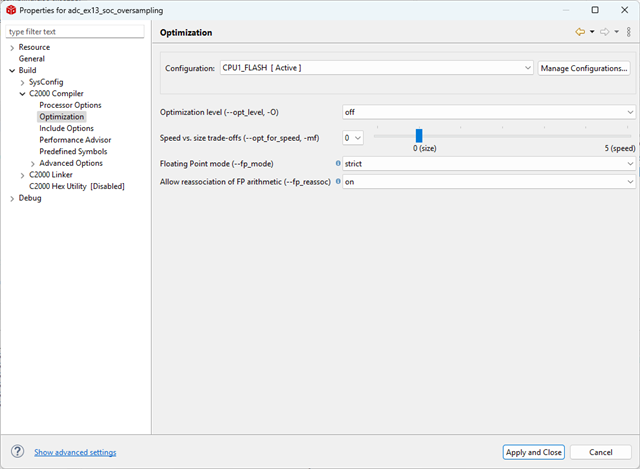
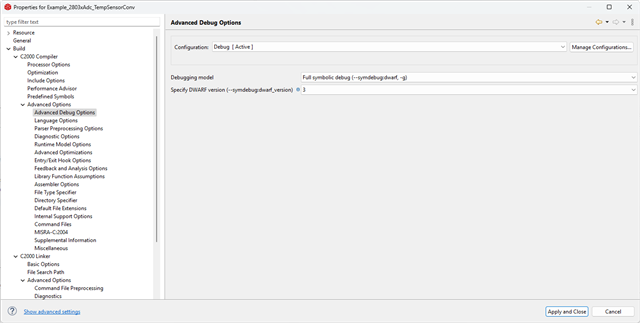
    1)Make sure that -g option is present in the compiler options; in our examples this is set but we need that info in the .out file for below to work.  I've added screen shot at the end of this post to show where that is in the build options of CCS(right click on the project and select properties to bring up this dialogue)

    2)We will use the XML based "map" file.  Tools team has advised that this format is more reliable for parsing vs just the .map file.  Again, this is enabled already in our examples, but I've shown where this is(in the linker options) in case you don't have it

    -Most likely both #1 and #2 are already in place for your build, based on our example usage, but I don't want to assume anything.

    3)I've attached an updated python file that take both the .out and the .xml file and parses for orphaned sections, but also gives the name of all the locals so you can go back and modify your code.  I'm placing the syntax of the python call below; for now since we are most concerned with DP usage I've set the option of --section .ebss.  If this is left blank the script will operate on the full output.

    4)Usage note:  This is more for others, currently this script will only work for the .coff based outputs like on F2803x(Gen1 and Gen2 C2000 MCUs).  I need to do some more work to support ELF outputs as those changed the reference formats.

    Python usage: 

    python dp_frag.py --xml myproject_link.xml --out myproject.out --section .ebss --html report.html

    -g option:

    -xml option

    Example HTML output for reference:

    #!/usr/bin/env python3
    """
    dp_frag.py  --  C28x data-page fragmentation analyzer  (v3)
    =============================================================
    
    Recommended usage (XML + .out for maximum accuracy):
        python dp_frag.py --xml yourfile_link.xml --out yourfile.out [--section .ebss] [--html report.html]
    
    Map file fallback (less robust format, same accuracy):
        python dp_frag.py yourfile.map --out yourfile.out [--section .ebss] [--html report.html]
    
    Address-delta only (cannot detect intra-page gaps -- not recommended):
        python dp_frag.py yourfile.map [--section .ebss]
    
    How to generate the XML:
        Add  --xml_link_info=yourfile_link.xml  to the linker command line (lnk2000 / cl2000 -z).
        The XML is generated every build alongside the .map file.
    
    Why XML over .map?
    ------------------
    The text .map format is not guaranteed stable across TI toolchain versions -- column
    layout and section headers can change.  The --xml_link_info XML has a documented
    schema, is machine-parseable without fragile regex, and has been stable across CCS
    versions.  The map file parser is kept as a fallback only.
    
    Why you need --out
    ------------------
    Neither the XML nor the .map file contains per-symbol sizes.  They only have addresses.
    Address-delta sizing (size = next_addr - this_addr) = actual_size + gap_after -- it
    CANNOT distinguish the symbol from the gap following it.
    
    When --out is supplied the script reads DWARF debug info via ofd2000.  DWARF stores
    the exact C type of every variable; DW_AT_byte_size gives the true size in 16-bit
    words (C28x native unit).  True gaps are then:
        gap = next_addr - (this_addr + dwarf_size)
    
    Requires the .out to be built with -g (debug info on).
    
    ofd2000 search order:
        1. --ofd-path argument
        2. PATH
        3. Common CCS install locations under C:\\ti\\ccs*
    
    C28x DP page = 64 words.  The linker will not split a symbol across a DP boundary,
    so any tail too small for the next symbol becomes a permanent hole.
    """
    
    import re
    import sys
    import os
    import shutil
    import subprocess
    import argparse
    import xml.etree.ElementTree as ET
    from collections import defaultdict
    from pathlib import Path
    
    DP_SIZE = 64  # words per data page on C28x
    
    
    def _dedup_sorted(pairs):
        """Deduplicate (addr, name) pairs and return sorted by addr."""
        return sorted(set(pairs), key=lambda x: x[0])
    
    
    # DWARF tags that carry no size themselves — size resolved by following type_ref chain
    _FORWARD_TAGS = frozenset({
        'typedef', 'const_type', 'volatile_type', 'restrict_type',
        'TI_far_type', 'TI_restrict_type',
    })
    
    
    # ---------------------------------------------------------------------------
    # ofd2000 discovery and DWARF extraction
    # ---------------------------------------------------------------------------
    
    def _find_ofd2000():
        """Search PATH then common CCS install locations for ofd2000."""
        found = shutil.which('ofd2000')
        if found:
            return found
        ti = Path('C:/ti')
        if ti.is_dir():
            candidates = sorted(ti.glob('ccs*/ccs/tools/compiler/ti-cgt-c2000_*/bin/ofd2000.exe'),
                                reverse=True)
            if candidates:
                return str(candidates[0])
        return None
    
    
    def run_ofd2000_dwarf(out_file, ofd_path=None):
        """
        Run ofd2000 with DWARF .debug_info + type display on out_file.
        Returns (text, error_string).  error_string is None on success.
        """
        exe = ofd_path or _find_ofd2000()
        if not exe:
            return None, (
                'ofd2000 not found.  Install CCS or pass --ofd-path.\n'
                'Running without DWARF: sizes will be address-delta estimates.'
            )
    
        cmd = [
            exe, '-g',
            '--dwarf_display=dinfo,'
            'nodabbrev,nodaranges,nodframe,nodline,nodloc,'
            'nodmacinfo,nodpubnames,nodpubtypes,nodranges,nodstr,nodtypes,'
            'noregtable,types',
            str(out_file),
        ]
        try:
            result = subprocess.run(cmd, capture_output=True, text=True, timeout=60)
            text = result.stdout + result.stderr
            if not text.strip():
                return None, f'ofd2000 produced no output for {out_file}'
            return text, None
        except FileNotFoundError:
            return None, f'ofd2000 not found at: {exe}'
        except subprocess.TimeoutExpired:
            return None, 'ofd2000 timed out'
    
    
    # ---------------------------------------------------------------------------
    # DWARF text parser
    # ---------------------------------------------------------------------------
    
    # Line patterns
    _DIE_RE = re.compile(
        r'^\s+([0-9a-f]+)\s+\d+\s+DW_TAG_(\S+?)(?:\s+\((\.[^\)]+)\))?$'
    )
    # Attribute line has many spaces where the abbrev number would be
    _ATTR_RE = re.compile(r'^\s+[0-9a-f]+\s{5,}(DW_AT_\S+)\s+(.*)')
    _TYPEREF_RE = re.compile(r'\+\s*0x([0-9a-f]+)')
    _ADDR_RE = re.compile(r'DW_OP_addr\s+0x([0-9a-f]+)')
    
    
    def _parse_dwarf(text, section='.ebss'):
        """
        Single-pass DWARF text parser.
    
        Builds type_table = {offset_int: die_dict} for all DIEs and collects
        variable entries for the requested section.
    
        Returns (type_table, var_list) where
          var_list = [(addr_int, name_str, type_ref_int)]
        """
        type_table = {}
        var_list = []
    
        cur_offset = None
        cur_tag = None
        cur_section = None
        cur_attrs = {}
    
        def _flush_die():
            nonlocal cur_offset, cur_tag, cur_section, cur_attrs
            if cur_offset is None:
                return
            die = {'tag': cur_tag}
    
            if 'DW_AT_byte_size' in cur_attrs:
                try:
                    die['byte_size'] = int(cur_attrs['DW_AT_byte_size'])
                except ValueError:
                    pass
    
            if 'DW_AT_type' in cur_attrs:
                m = _TYPEREF_RE.search(cur_attrs['DW_AT_type'])
                if m:
                    die['type_ref'] = int(m.group(1), 16)
    
            if 'DW_AT_address_class' in cur_attrs:
                die['addr_class'] = cur_attrs['DW_AT_address_class'].strip()
    
            if cur_tag == 'variable' and cur_section == section:
                addr = None
                name = None
                if 'DW_AT_location' in cur_attrs:
                    m = _ADDR_RE.search(cur_attrs['DW_AT_location'])
                    if m:
                        addr = int(m.group(1), 16)
                if 'DW_AT_TI_symbol_name' in cur_attrs:
                    name = cur_attrs['DW_AT_TI_symbol_name'].strip()
                elif 'DW_AT_name' in cur_attrs:
                    name = cur_attrs['DW_AT_name'].strip()
                # type_ref already parsed into die above — reuse it
                type_ref = die.get('type_ref')
                if addr is not None and name is not None and type_ref is not None:
                    var_list.append((addr, name, type_ref))
    
            type_table[cur_offset] = die
            cur_offset = None
            cur_tag = None
            cur_section = None
            cur_attrs = {}
    
        for line in text.splitlines():
            m_die = _DIE_RE.match(line)
            if m_die:
                _flush_die()
                cur_offset = int(m_die.group(1), 16)
                cur_tag = m_die.group(2)
                cur_section = m_die.group(3)  # may be None
                cur_attrs = {}
                continue
    
            m_attr = _ATTR_RE.match(line)
            if m_attr and cur_offset is not None:
                attr_name = m_attr.group(1)
                attr_val = m_attr.group(2).strip()
                cur_attrs[attr_name] = attr_val
    
        _flush_die()
        return type_table, var_list
    
    
    def _resolve_size(offset, type_table, depth=0):
        """
        Resolve a DWARF type offset to its size in C28x words.
        Returns int, or None if not resolvable.
        """
        if depth > 20:
            return None  # cycle guard
        die = type_table.get(offset)
        if die is None:
            return None
    
        tag = die['tag']
    
        # Direct size types
        if 'byte_size' in die:
            return die['byte_size']
    
        # Pointer: no byte_size in DWARF, infer from address class
        if tag == 'pointer_type':
            ac = die.get('addr_class', '')
            return 2 if 'PTR32' in ac else 1
    
        # Reference type (C++ &) -- same as pointer
        if tag == 'reference_type':
            ac = die.get('addr_class', '')
            return 2 if 'PTR32' in ac else 1
    
        # Subroutine/function type (bare, not a pointer) -- zero data size
        if tag == 'subroutine_type':
            return 0
    
        if tag in _FORWARD_TAGS and 'type_ref' in die:
            return _resolve_size(die['type_ref'], type_table, depth + 1)
    
        return None  # unknown
    
    
    def get_dwarf_symbol_sizes(out_file, section='.ebss', ofd_path=None):
        """
        Run ofd2000 on out_file and resolve DWARF types to get actual sizes.
    
        Returns (sizes_dict, warning_str).
          sizes_dict: {addr_int: size_int}  -- actual word counts from DWARF
          warning_str: None on full success, description of degraded mode otherwise.
        """
        text, err = run_ofd2000_dwarf(out_file, ofd_path)
        if text is None:
            return {}, err
    
        type_table, var_list = _parse_dwarf(text, section=section)
    
        if not var_list:
            return {}, (
                f'ofd2000 DWARF output parsed but no {section} variables found.\n'
                'Make sure the .out was built with -g (debug info enabled).'
            )
    
        sizes = {}
        unresolved = []
        for addr, name, type_ref in var_list:
            size = _resolve_size(type_ref, type_table)
            if size is not None and size > 0:
                sizes[addr] = size
            else:
                unresolved.append(name)
    
        warn = None
        if unresolved:
            warn = (f'DWARF type unresolved for {len(unresolved)} symbol(s): '
                    f'{", ".join(unresolved[:5])}{"..." if len(unresolved) > 5 else ""}.\n'
                    f'Those symbols will use address-delta sizing.')
        return sizes, warn
    
    
    # ---------------------------------------------------------------------------
    # Parsing -- .map file (primary)
    # ---------------------------------------------------------------------------
    
    def _parse_section_ranges(text):
        """
        Return dict {section_name: (start_addr, end_addr)} from the
        SECTION ALLOCATION MAP block.
        """
        ranges = {}
        in_map = False
        pending_name = None
    
        for line in text.splitlines():
            if 'SECTION ALLOCATION MAP' in line:
                in_map = True
                continue
            if not in_map:
                continue
            if pending_name:
                m = re.match(r'^\*\s+\d+\s+([0-9a-fA-F]+)\s+([0-9a-fA-F]+)', line)
                if m:
                    start = int(m.group(1), 16)
                    length = int(m.group(2), 16)
                    ranges[pending_name] = (start, start + length)
                pending_name = None
                continue
            m = re.match(r'^(\.?\w+)\s+(\d+)\s+([0-9a-fA-F]+)\s+([0-9a-fA-F]+)', line)
            if m:
                name = m.group(1)
                start = int(m.group(3), 16)
                length = int(m.group(4), 16)
                ranges[name] = (start, start + length)
                continue
            m = re.match(r'^([A-Za-z_]\w*)\s*$', line)
            if m:
                candidate = m.group(1)
                if candidate not in ('GLOBAL', 'LOCAL', 'output', 'section',
                                     'attributes', 'MEMORY', 'PAGE'):
                    pending_name = candidate
        return ranges
    
    
    def _parse_global_symbols_by_address(text):
        """
        Return list of (addr, name) from 'GLOBAL SYMBOLS: SORTED BY Symbol Address'.
        Also captures local symbols when --mapfile_contents=sym_defs was used.
        """
        symbols = []
        in_block = False
    
        for line in text.splitlines():
            if 'SORTED BY Symbol Address' in line:
                in_block = True
                continue
            if not in_block:
                continue
            # Format: "page  00001234  _symbolname"  (standard COFF map)
            m = re.match(r'^\d+\s+([0-9a-fA-F]{8})\s+(\S+)', line)
            if m:
                symbols.append((int(m.group(1), 16), m.group(2)))
        return symbols
    
    
    def parse_map_file(text, section_filter='.ebss', dwarf_sizes=None):
        """
        Parse a TI COFF linker .map file.
        Returns list of dicts {name, addr, size, size_source, gap_before, section}.
    
        dwarf_sizes: optional dict {addr_int: actual_size_words} from DWARF.
        When provided, actual sizes are used and gaps between symbols are real.
        When absent, delta-based sizing is used (size = next_addr - this_addr).
        """
        section_ranges = _parse_section_ranges(text)
    
        if section_filter:
            targets = {k: v for k, v in section_ranges.items()
                       if k == section_filter}
        else:
            targets = section_ranges
    
        if not targets:
            available = ', '.join(sorted(section_ranges.keys()))
            raise ValueError(
                f"Section '{section_filter}' not found in map file.\n"
                f"Available sections: {available}"
            )
    
        all_syms_by_addr = _parse_global_symbols_by_address(text)
    
        symbols = []
        for sec_name, (sec_start, sec_end) in sorted(targets.items(),
                                                      key=lambda x: x[1][0]):
            if sec_end == sec_start:
                continue
            in_sec = [(addr, name) for addr, name in all_syms_by_addr
                      if sec_start <= addr < sec_end]
            unique = _dedup_sorted(in_sec)
    
            for i, (addr, name) in enumerate(unique):
                if dwarf_sizes and addr in dwarf_sizes:
                    size = dwarf_sizes[addr]
                    size_source = 'dwarf'
                else:
                    # Fallback: address delta
                    if i + 1 < len(unique):
                        size = unique[i + 1][0] - addr
                    else:
                        size = sec_end - addr
                    size_source = 'delta'
    
                if size > 0:
                    symbols.append({
                        'name': name,
                        'addr': addr,
                        'size': size,
                        'size_source': size_source,
                        'section': sec_name,
                    })
        return symbols
    
    
    # ---------------------------------------------------------------------------
    # Parsing -- --xml_link_info XML (preferred input, replaces map file)
    # ---------------------------------------------------------------------------
    
    def parse_xml_link_info(xml_text, section_filter='.ebss', dwarf_sizes=None):
        """
        Parse TI linker --xml_link_info XML output.
    
        Structure used:
          <logical_group>  -- output section (name, run_address, size)
          <symbol>         -- symbol (name, value=address, object_component_ref)
    
        Returns list of dicts {name, addr, size, size_source, section}.
        """
        try:
            root = ET.fromstring(xml_text)
        except ET.ParseError as e:
            raise ValueError(f'XML parse error: {e}')
    
        # Build object_component id -> section_name + address + size
        # (needed to determine which section a symbol belongs to)
        oc_map = {}  # id -> {'section': name, 'addr': int, 'size': int}
        for oc in root.findall('.//object_component'):
            oc_id = oc.get('id')
            if oc_id is None:
                continue
            name_el = oc.find('name')
            addr_el = oc.find('run_address')
            size_el = oc.find('size')
            if name_el is None or addr_el is None or size_el is None:
                continue
            # section name is the part before any colon (e.g. ".ebss:__lock" -> ".ebss")
            sec_name = name_el.text.split(':')[0] if name_el.text else ''
            try:
                oc_map[oc_id] = {
                    'section': sec_name,
                    'addr': int(addr_el.text, 16),
                    'size': int(size_el.text, 16),
                }
            except (ValueError, TypeError):
                continue
    
        # Build section address ranges from logical_group entries
        # logical_group has name, run_address, size
        section_ranges = {}
        for lg in root.findall('.//logical_group'):
            name_el = lg.find('name')
            addr_el = lg.find('run_address')
            size_el = lg.find('size')
            if name_el is None or addr_el is None or size_el is None:
                continue
            try:
                sec = name_el.text
                start = int(addr_el.text, 16)
                size = int(size_el.text, 16)
                section_ranges[sec] = (start, start + size)
            except (ValueError, TypeError):
                continue
    
        if section_filter and section_filter not in section_ranges:
            available = ', '.join(sorted(section_ranges.keys()))
            raise ValueError(
                f"Section '{section_filter}' not found in XML.\n"
                f"Available sections: {available}"
            )
    
        # Collect symbols that belong to the target section
        target_range = section_ranges.get(section_filter)  # None = all sections
    
        raw_syms = []  # (addr, name, section_name)
        for sym in root.findall('.//symbol'):
            name_el = sym.find('name')
            val_el = sym.find('value')
            oc_ref_el = sym.find('object_component_ref')
            if name_el is None or val_el is None:
                continue
            try:
                addr = int(val_el.text, 16)
            except (ValueError, TypeError):
                continue
    
            # Determine section via object_component reference
            sec_name = ''
            if oc_ref_el is not None:
                oc_id = oc_ref_el.get('idref')
                if oc_id and oc_id in oc_map:
                    sec_name = oc_map[oc_id]['section']
    
            # Filter by section
            if section_filter:
                if sec_name != section_filter:
                    continue
                if target_range and not (target_range[0] <= addr < target_range[1]):
                    continue
            elif sec_name not in section_ranges:
                continue
    
            raw_syms.append((addr, name_el.text, sec_name))
    
        if not raw_syms:
            return []
    
        # Group by section, deduplicate, sort by address
        by_section = defaultdict(list)
        for addr, name, sec in raw_syms:
            by_section[sec].append((addr, name))
    
        symbols = []
        for sec_name, entries in by_section.items():
            sec_start, sec_end = section_ranges.get(sec_name, (0, 0))
            unique = _dedup_sorted(entries)
    
            for i, (addr, name) in enumerate(unique):
                if dwarf_sizes and addr in dwarf_sizes:
                    size = dwarf_sizes[addr]
                    size_source = 'dwarf'
                else:
                    if i + 1 < len(unique):
                        size = unique[i + 1][0] - addr
                    else:
                        size = sec_end - addr if sec_end > addr else 1
                    size_source = 'delta'
    
                if size > 0:
                    symbols.append({
                        'name': name,
                        'addr': addr,
                        'size': size,
                        'size_source': size_source,
                        'section': sec_name,
                    })
        return symbols
    
    
    # ---------------------------------------------------------------------------
    # Parsing -- ofd2000 --obj_display=none,symbols (secondary input mode)
    # ---------------------------------------------------------------------------
    
    def parse_ofd_symbols(text, section_filter='.ebss'):
        """Parse ofd2000 --obj_display=none,symbols output (no DWARF sizes)."""
        # Columns: id  name  value  kind  section  binding  type
        sym_re = re.compile(
            r'^\s*\d+\s+(\S+)\s+0x([0-9a-fA-F]+)\s+\S+\s+(\S+)\s+(\S+)\s+(\S+)',
            re.MULTILINE
        )
        by_section = defaultdict(list)
        for m in sym_re.finditer(text):
            name, addr_hex, section, binding, typ = m.groups()
            if binding != 'global' or typ != 'object':
                continue
            if section_filter and section != section_filter:
                continue
            by_section[section].append((int(addr_hex, 16), name))
    
        if not by_section:
            return []
    
        symbols = []
        for sec_name, entries in by_section.items():
            unique = _dedup_sorted(entries)
    
            for i, (addr, name) in enumerate(unique):
                size = unique[i + 1][0] - addr if i + 1 < len(unique) else 1
                symbols.append({
                    'name': name, 'addr': addr, 'size': size,
                    'size_source': 'delta', 'section': sec_name,
                })
        return symbols
    
    
    # ---------------------------------------------------------------------------
    # Analysis
    # ---------------------------------------------------------------------------
    
    def assign_pages(symbols):
        pages = defaultdict(list)
        for s in symbols:
            pg = s['addr'] // DP_SIZE
            pages[pg].append(s)
        return dict(sorted(pages.items()))
    
    
    def analyze_page(page_idx, syms):
        base = page_idx * DP_SIZE
        sorted_syms = sorted(syms, key=lambda s: s['addr'])
        cursor = base
        gaps = []   # list of (gap_addr, gap_words, 'before' symbol name)
        used = 0
    
        for s in sorted_syms:
            if s['addr'] > cursor:
                gaps.append((cursor, s['addr'] - cursor, s['name']))
            end = s['addr'] + s['size']
            used += s['size']
            cursor = end
    
        page_end = base + DP_SIZE
        tail = max(0, page_end - cursor)
    
        return {
            'page': page_idx,
            'base': base,
            'syms': sorted_syms,
            'used': used,
            'gaps': gaps,
            'gap_words': sum(g[1] for g in gaps),
            'tail': tail,
        }
    
    
    def global_stats(page_analyses):
        total_pages = len(page_analyses)
        total_capacity = total_pages * DP_SIZE
        total_used = sum(p['used'] for p in page_analyses)
        total_gap = sum(p['gap_words'] for p in page_analyses)
        total_tail = sum(p['tail'] for p in page_analyses)
        waste_pct = total_gap / total_capacity * 100 if total_capacity else 0
        return {
            'pages': total_pages,
            'capacity': total_capacity,
            'used': total_used,
            'gap': total_gap,
            'tail': total_tail,
            'waste_pct': waste_pct,
        }
    
    
    # ---------------------------------------------------------------------------
    # Reorder suggestions
    # ---------------------------------------------------------------------------
    
    def suggest_reorder(page_analyses):
        suggestions = []
        for pa in page_analyses:
            if pa['gap_words'] == 0:
                continue
            syms = pa['syms']
            # Sort largest-first to minimize cross-page penalties
            reordered = sorted(syms, key=lambda s: s['size'], reverse=True)
            simulated_gap = 0
            cursor = pa['base']
            for s in reordered:
                align = min(8, _next_pow2(s['size']))
                aligned_start = ((cursor + align - 1) // align) * align
                simulated_gap += aligned_start - cursor
                cursor = aligned_start + s['size']
            savings = pa['gap_words'] - simulated_gap
            if savings > 0:
                suggestions.append({
                    'page': pa['page'],
                    'current_gap': pa['gap_words'],
                    'simulated_gap': simulated_gap,
                    'savings': savings,
                    'order': [s['name'] for s in reordered],
                })
        return sorted(suggestions, key=lambda x: x['savings'], reverse=True)
    
    
    def _next_pow2(n):
        if n <= 1:
            return 1
        p = 1
        while p < n:
            p <<= 1
        return p
    
    
    # ---------------------------------------------------------------------------
    # Console report
    # ---------------------------------------------------------------------------
    
    def print_report(page_analyses, stats, suggestions, has_dwarf, warnings):
        W = 72
        print('=' * W)
        print('  C28x DP Fragmentation Report')
        mode = 'DWARF actual sizes' if has_dwarf else 'address-delta sizes (estimate)'
        print(f'  Size source: {mode}')
        print('=' * W)
        print(f"  Data pages occupied : {stats['pages']}")
        print(f"  Total capacity      : {stats['capacity']} words ({stats['capacity']*2} bytes)")
        print(f"  Used by symbols     : {stats['used']} words")
        print(f"  Alignment gaps      : {stats['gap']} words  ({stats['waste_pct']:.1f}% of capacity)")
        print(f"  Free tail space     : {stats['tail']} words")
        print()
    
        if warnings:
            for w in warnings:
                print(f'  WARNING: {w}')
            print()
    
        if stats['gap'] == 0:
            print('  No alignment gaps found.')
            if stats['tail'] > 0:
                print(f"  {stats['tail']} words of tail space remain (partial last page).")
            if not has_dwarf:
                print()
                print('  NOTE: Without --out, gaps WITHIN the last delta cannot be detected.')
                print('  Supply --out yourfile.out (built with -g) for exact gap analysis.')
            return
    
        print('  Per-page breakdown (pages with gaps only):')
        print('  ' + '-' * 68)
        print(f"  {'DP':>4}  {'base':>8}  {'used':>5}  {'gaps':>5}  {'tail':>5}  map")
        print('  ' + '-' * 68)
    
        for pa in page_analyses:
            if pa['gap_words'] == 0:
                continue
            bar = _ascii_bar(pa['syms'], pa['base'], width=24)
            print(f"  DP{pa['page']:<4}  0x{pa['base']:04X}     {pa['used']:>4}w  "
                  f"{pa['gap_words']:>4}w  {pa['tail']:>4}w  {bar}")
            cursor = pa['base']
            for s in sorted(pa['syms'], key=lambda x: x['addr']):
                if s['addr'] > cursor:
                    gw = s['addr'] - cursor
                    print(f"           0x{cursor:04X}  {'*** GAP ***':<26} {gw:>3}w  <-- WASTED")
                tag = '' if s['size_source'] == 'dwarf' else ' (delta)'
                print(f"           0x{s['addr']:04X}  {s['name']:<26} {s['size']:>3}w{tag}")
                cursor = s['addr'] + s['size']
            print()
    
        if suggestions:
            print('  Reorder suggestions (by estimated word savings):')
            print('  ' + '-' * 68)
            for sg in suggestions[:5]:
                print(f"  DP{sg['page']}: current gap={sg['current_gap']}w  "
                      f"after reorder~{sg['simulated_gap']}w  saves~{sg['savings']}w")
                print(f"    suggested order: {', '.join(sg['order'])}")
            print()
    
        if not has_dwarf:
            print('  NOTE: Sizes from address delta -- gaps WITHIN a delta are invisible.')
            print('  Use --out yourfile.out (built with -g) for exact gap accounting.')
        print('=' * W)
    
    
    def _ascii_bar(syms, base, width=24):
        bar = ['.'] * width
        for s in syms:
            start = s['addr'] - base
            for i in range(s['size']):
                pos = int((start + i) / DP_SIZE * width)
                if 0 <= pos < width:
                    bar[pos] = '#'
        return ''.join(bar)
    
    
    # ---------------------------------------------------------------------------
    # HTML report
    # ---------------------------------------------------------------------------
    
    HTML_TEMPLATE = r"""<!DOCTYPE html>
    <html lang="en">
    <head>
    <meta charset="UTF-8">
    <title>C28x DP Fragmentation Report</title>
    <style>
    body{font-family:system-ui,sans-serif;background:#f8f7f4;color:#2c2c2a;margin:0;padding:24px;max-width:900px}
    h1{font-size:18px;font-weight:500;margin:0 0 4px}
    .mode{font-size:11px;color:#888;margin-bottom:16px}
    .stats{display:flex;gap:12px;flex-wrap:wrap;margin-bottom:20px}
    .stat{background:#fff;border:0.5px solid #d3d1c7;border-radius:8px;padding:10px 16px;min-width:140px}
    .stat-label{font-size:11px;color:#888780}
    .stat-val{font-size:22px;font-weight:500;font-family:monospace}
    .legend{font-size:11px;color:#888;margin-bottom:12px;display:flex;gap:14px}
    .legend span{display:inline-flex;align-items:center;gap:4px}
    .swatch{width:12px;height:10px;border-radius:2px;display:inline-block}
    .page-block{margin-bottom:16px}
    .page-row{display:flex;align-items:center;margin-bottom:4px;gap:0}
    .page-label{font-size:11px;color:#888780;width:60px;font-family:monospace;flex-shrink:0}
    .bar-wrap{flex:1;height:22px;display:flex;border-radius:4px;overflow:hidden;border:0.5px solid #d3d1c7}
    .seg-used{background:#378ADD;height:100%}
    .seg-gap{background:repeating-linear-gradient(45deg,#EF9F27,#EF9F27 3px,#FAC775 3px,#FAC775 6px);height:100%}
    .seg-free{background:#f1efe8;height:100%}
    .pct{font-size:10px;color:#888780;width:36px;text-align:right;font-family:monospace;padding-left:4px;flex-shrink:0}
    .detail{margin-left:60px;background:#fff;border:0.5px solid #d3d1c7;border-radius:6px;overflow:hidden}
    table{width:100%;border-collapse:collapse;font-size:11px;font-family:monospace}
    th{text-align:left;font-size:10px;color:#888;border-bottom:0.5px solid #d3d1c7;padding:4px 8px;font-family:system-ui;background:#fafaf8}
    td{padding:3px 8px;border-bottom:0.5px solid #f1efe8}
    tr.gap-row{background:#FFF8EC}
    tr.gap-row td{color:#854F0B}
    tr.tail-row td{color:#aaa;font-style:italic}
    .gap-label{font-weight:600}
    .badge{font-size:9px;padding:1px 5px;border-radius:3px}
    .badge-used{background:#E6F1FB;color:#185FA5}
    .badge-delta{background:#EEE;color:#888}
    .badge-gap{background:#FAEEDA;color:#854F0B;font-weight:600}
    .section-hdr{font-size:12px;font-weight:500;margin:24px 0 8px;color:#444}
    .note{font-size:10px;color:#aaa;margin-top:16px}
    .warn{font-size:11px;color:#854F0B;background:#FAEEDA;border-radius:4px;padding:6px 10px;margin-bottom:12px}
    .clean-note{font-size:10px;color:#aaa;margin-left:60px;margin-top:2px}
    </style>
    </head>
    <body>
    <h1>C28x DP Fragmentation Report</h1>
    <div class="mode">Size source: SIZE_MODE</div>
    WARN_HTML
    <div class="stats">
      <div class="stat"><div class="stat-label">alignment waste</div>
        <div class="stat-val" style="color:#BA7517">WASTE_PCT%</div></div>
      <div class="stat"><div class="stat-label">gap words</div>
        <div class="stat-val">GAP_W w</div></div>
      <div class="stat"><div class="stat-label">used words</div>
        <div class="stat-val">USED_W w</div></div>
      <div class="stat"><div class="stat-label">data pages</div>
        <div class="stat-val">N_PAGES</div></div>
    </div>
    <div class="legend">
      <span><span class="swatch" style="background:#378ADD"></span>used</span>
      <span><span class="swatch" style="background:repeating-linear-gradient(45deg,#EF9F27,#EF9F27 3px,#FAC775 3px,#FAC775 6px)"></span>gap / hole</span>
      <span><span class="swatch" style="background:#f1efe8;border:0.5px solid #d3d1c7"></span>free tail</span>
    </div>
    PAGE_CONTENT
    <p class="note">SIZE_NOTE</p>
    </body>
    </html>
    """
    
    
    def _build_page_table(pa):
        """Return an HTML table string for one page analysis."""
        base = pa['base']
        syms_sorted = sorted(pa['syms'], key=lambda s: s['addr'])
        cursor = base
        rows = ''
        for s in syms_sorted:
            if s['addr'] > cursor:
                gw = s['addr'] - cursor
                rows += (
                    f'<tr class="gap-row">'
                    f'<td class="gap-label">&#9658; GAP</td>'
                    f'<td>0x{cursor:04X}</td>'
                    f'<td>{gw}w</td>'
                    f'<td><span class="badge badge-gap">{gw}w wasted</span></td>'
                    f'</tr>\n'
                )
            src = ('<span class="badge badge-used">DWARF</span>'
                   if s['size_source'] == 'dwarf'
                   else '<span class="badge badge-delta">delta</span>')
            rows += (
                f'<tr>'
                f'<td>{s["name"]}</td>'
                f'<td>0x{s["addr"]:04X}</td>'
                f'<td>{s["size"]}w</td>'
                f'<td>{src}</td>'
                f'</tr>\n'
            )
            cursor = s['addr'] + s['size']
        page_end = base + DP_SIZE
        if cursor < page_end:
            rows += (
                f'<tr class="tail-row">'
                f'<td>[free tail]</td>'
                f'<td>0x{cursor:04X}</td>'
                f'<td></td>'
                f'<td>{page_end - cursor}w free</td>'
                f'</tr>\n'
            )
        return (
            f'<div class="detail">'
            f'<table><thead><tr>'
            f'<th>symbol</th><th>address</th><th>size</th><th>source</th>'
            f'</tr></thead><tbody>\n{rows}</tbody></table>'
            f'</div>\n'
        )
    
    
    def build_html(page_analyses, stats, has_dwarf, warnings):
        # Separate pages with and without gaps
        gapped = [pa for pa in page_analyses if pa['gap_words'] > 0]
        clean  = [pa for pa in page_analyses if pa['gap_words'] == 0]
    
        def _bar(pa):
            base = pa['base']
            syms_sorted = sorted(pa['syms'], key=lambda s: s['addr'])
            cursor = base
            segs = ''
            for s in syms_sorted:
                if s['addr'] > cursor:
                    w = s['addr'] - cursor
                    segs += f'<div class="seg-gap" style="width:{w/DP_SIZE*100:.2f}%" title="GAP {w}w WASTED"></div>'
                segs += (f'<div class="seg-used" style="width:{s["size"]/DP_SIZE*100:.2f}%"'
                         f' title="{s["name"]} ({s["size"]}w)"></div>')
                cursor = s['addr'] + s['size']
            tail = base + DP_SIZE - cursor
            if tail > 0:
                segs += f'<div class="seg-free" style="width:{tail/DP_SIZE*100:.2f}%"></div>'
            waste_pct = round(pa['gap_words'] / DP_SIZE * 100)
            pct_color = '#BA7517' if waste_pct > 0 else '#888'
            return (
                f'<div class="page-row">'
                f'<div class="page-label">DP{pa["page"]}</div>'
                f'<div class="bar-wrap">{segs}</div>'
                f'<div class="pct" style="color:{pct_color}">{waste_pct}%</div>'
                f'</div>\n'
            )
    
        content = ''
    
        # --- Pages with gaps: bar + inline table ---
        if gapped:
            content += '<div class="section-hdr">Pages with gaps</div>\n'
            for pa in gapped:
                content += f'<div class="page-block">\n'
                content += _bar(pa)
                content += _build_page_table(pa)
                content += '</div>\n'
    
        # --- Clean pages: bars only ---
        if clean:
            content += '<div class="section-hdr">Pages with no gaps</div>\n'
            for pa in clean:
                content += f'<div class="page-block">\n'
                content += _bar(pa)
                content += '<div class="clean-note">no holes &mdash; all symbols pack cleanly</div>\n'
                content += '</div>\n'
    
        mode = 'DWARF actual sizes (exact)' if has_dwarf else 'address-delta estimates (intra-symbol gaps invisible)'
        warn_html = ''
        if warnings:
            for w in warnings:
                warn_html += f'<div class="warn">{w}</div>\n'
        if not has_dwarf:
            note = ('Sizes from address delta. Gaps inside a delta cannot be detected. '
                    'Build with -g and supply --out yourfile.out for exact analysis.')
        else:
            note = ('Symbol sizes from DWARF debug info (exact). Gaps shown are true DP holes '
                    'the linker cannot backfill. DWARF badge = exact size. delta badge = fallback.')
    
        html = HTML_TEMPLATE
        html = html.replace('SIZE_MODE', mode)
        html = html.replace('WARN_HTML', warn_html)
        html = html.replace('WASTE_PCT', f"{stats['waste_pct']:.1f}")
        html = html.replace('GAP_W', str(stats['gap']))
        html = html.replace('USED_W', str(stats['used']))
        html = html.replace('N_PAGES', str(stats['pages']))
        html = html.replace('PAGE_CONTENT', content)
        html = html.replace('SIZE_NOTE', note)
        return html
    
    
    # ---------------------------------------------------------------------------
    # Main
    # ---------------------------------------------------------------------------
    
    def main():
        parser = argparse.ArgumentParser(
            description='C28x DP fragmentation analyzer (v3, DWARF-aware).',
            formatter_class=argparse.RawDescriptionHelpFormatter,
            epilog=__doc__,
        )
        parser.add_argument('input', nargs='?', default=None,
                            help='Linker .map file (or ofd2000 symbol output with --ofd). '
                                 'Not needed when --xml is used.')
        parser.add_argument('--xml', metavar='FILE',
                            help='Linker --xml_link_info XML file (preferred over .map). '
                                 'Generate with: lnk2000 --xml_link_info=out_link.xml ...')
        parser.add_argument('--out', metavar='FILE',
                            help='Corresponding .out file (COFF, built with -g). '
                                 'Enables exact DWARF-based symbol sizing.')
        parser.add_argument('--ofd-path', metavar='PATH',
                            help='Path to ofd2000 executable (auto-detected if omitted)')
        parser.add_argument('--ofd', action='store_true',
                            help='Input is ofd2000 --obj_display=none,symbols output')
        parser.add_argument('--section', default='.ebss',
                            help='Data section to analyze (default: .ebss)')
        parser.add_argument('--all-sections', action='store_true',
                            help='Analyze all data sections')
        parser.add_argument('--html', metavar='FILE',
                            help='Write standalone HTML report to FILE')
        args = parser.parse_args()
    
        if args.xml is None and args.input is None and not args.ofd:
            parser.error('Provide a .map file, --xml FILE, or use --ofd with stdin.')
    
        section = None if args.all_sections else args.section
        warnings = []
        dwarf_sizes = {}
        has_dwarf = False
    
        # Get DWARF sizes if --out supplied.
        # When --all-sections, default to .ebss for DWARF (most relevant section).
        dwarf_section = section or '.ebss'
        if args.out and not args.ofd:
            print(f'Reading DWARF from {args.out} ...', flush=True)
            dwarf_sizes, warn = get_dwarf_symbol_sizes(
                args.out, section=dwarf_section,
                ofd_path=args.ofd_path
            )
            if warn:
                warnings.append(warn)
            if dwarf_sizes:
                has_dwarf = True
                print(f'  DWARF sizes resolved for {len(dwarf_sizes)} symbol(s).')
            else:
                print('  DWARF unavailable -- falling back to address-delta sizing.')
    
        if args.xml:
            xml_text = Path(args.xml).read_text(errors='replace')
            try:
                symbols = parse_xml_link_info(
                    xml_text, section_filter=section,
                    dwarf_sizes=dwarf_sizes if has_dwarf else None
                )
            except ValueError as e:
                print(f'ERROR: {e}')
                sys.exit(1)
            source = 'XML link info'
        elif args.ofd:
            text = sys.stdin.read() if args.input is None else Path(args.input).read_text(errors='replace')
            symbols = parse_ofd_symbols(text, section_filter=section)
            source = 'ofd2000'
        else:
            text = sys.stdin.read() if args.input == '-' or args.input is None else Path(args.input).read_text(errors='replace')
            try:
                symbols = parse_map_file(text, section_filter=section,
                                         dwarf_sizes=dwarf_sizes if has_dwarf else None)
            except ValueError as e:
                print(f'ERROR: {e}')
                sys.exit(1)
            source = 'map file'
    
        if not symbols:
            print(f'ERROR: no symbols found in {section or "any section"} via {source}.')
            if args.xml:
                print('       Verify the XML was generated with --xml_link_info and the section name is correct.')
            elif not args.ofd:
                print('       Verify the .map file is from the TI COFF linker (lnk2000).')
            print('       Try --all-sections to see all available sections.')
            sys.exit(1)
    
        dwarf_count = sum(1 for s in symbols if s.get('size_source') == 'dwarf')
        delta_count = len(symbols) - dwarf_count
        print(f'Analyzed {len(symbols)} symbols ({dwarf_count} DWARF, {delta_count} delta)')
    
        pages = assign_pages(symbols)
        page_analyses = [analyze_page(idx, syms) for idx, syms in pages.items()]
        stats = global_stats(page_analyses)
        suggestions = suggest_reorder(page_analyses)
    
        print_report(page_analyses, stats, suggestions, has_dwarf, warnings)
    
        if args.html:
            html = build_html(page_analyses, stats, has_dwarf, warnings)
            Path(args.html).write_text(html, encoding='utf-8')
            print(f'HTML report written to {args.html}')
    
    
    if __name__ == '__main__':
        main()
    

    Best,
    Matthew

  • Thanks Matthew!

    This visualization tool is very good! 

    I have run it on several builds and I am now trying to make sense of the recommendations. In many data pages I have a gap at the top that is marked as wasted and any gap at the bottom are marked as free space. The recommendation from the script was to reorder the vars in the data page with the 32bit at the top and 16bit at the bottom. I modified the C-code to do this but the resulting map still has the gap at the top in the data page. Is this gap at the top in fact wasted space that the linker cannot use? 

    Best

    Jason

  • Jason,

    I might need to look at your linker, or even the input/output html file to see if I can determine what is going on.  The gap at the top I didn't expect, as the linker should be packing things at the start address and working its way down.    

    I've sent you a connection request on this E2E, once we are connected you can share files off forum directly with me.

    If you prefer I can also reach out to you via your email contact info directly.  Let me know.

    Best,

    Matthew

  • Thanks Matthew,

    I dont see the connection request on E2E yet

    Jason

  • resent the request just now.

    Matt